Writing a novel can feel, from the outside, like an act of magic that only certain people are capable of. You have a story in you, or the beginnings of one, and somewhere out there are finished books on shelves, and the distance between the two seems impossible to cross.
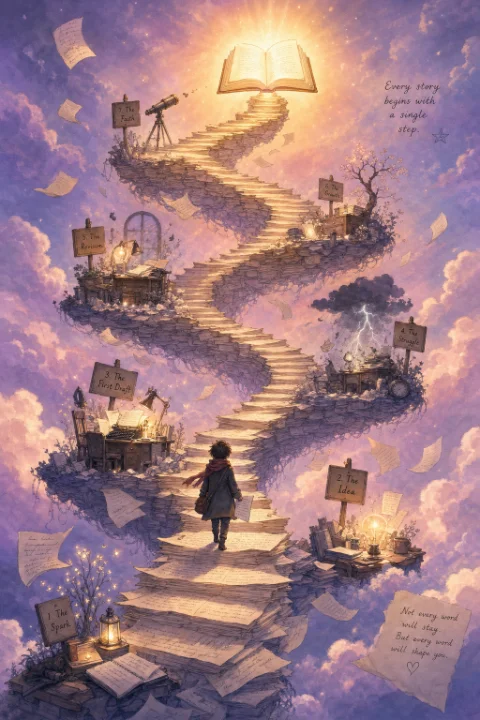
It is not impossible. It is a process, and like any large process it becomes manageable the moment you stop looking at the whole mountain and start looking at the next step. Every novelist who ever finished a book did it the same way: one stage at a time, one scene at a time, one imperfect draft followed by revision. There is no secret reserved for the talented few. There is a sequence of learnable skills, applied with enough patience to see the thing through.
This guide walks through that sequence from beginning to end. It will not pretend the work is easy, because it is not. But it will give you a clear map of the whole territory, so that wherever you are in the process, you know what you are doing now and what comes next.
Start with the idea that will not leave you alone
Every novel begins with an idea, but not every idea can sustain a novel. The ideas that carry a writer through the long months of drafting are rarely the ones that sound most impressive. They are the ones that will not let go, the premise or character or question that keeps surfacing in your mind when you are meant to be thinking about something else.
Do not worry at this stage about whether the idea is commercial or original or good enough. Worry only about whether it genuinely compels you, because genuine compulsion is the only fuel that lasts across an entire novel. Ambition alone runs dry somewhere in the middle. The story you actually need to tell is the one with the best chance of being finished.
Once you have your idea, write down in plain sentences what it is really about beneath the surface. Not the plot, but the emotional core. Who is at the centre of it, what they want, what they fear, and what they might have to lose. Three clear sentences capturing those things are enough to begin building on.
Understand what a story actually needs
Before you plan or draft anything, it helps to know what you are actually building. Underneath all the complexity of craft, a story that works needs surprisingly few things: a character the reader cares about, something that character wants badly, and something meaningful standing in the way. Everything else grows out of those foundations.
The want must be specific rather than vague, and the obstacle must carry genuine cost, because uncertainty about whether the character will get through is what keeps a reader turning pages. This underlying architecture is worth understanding deeply before you begin, and it is the subject of its own detailed discussion in Plot: A Complete Guide to Constructing Stories That Work, which is worth reading alongside this guide as you develop your idea into a full story.
There is also a persuasive dimension to structure that many beginning writers miss. A well-built story is not just a sequence of events; it is an engine designed to keep a reader committed from one page to the next. The way structure itself functions as a form of quiet persuasion is explored in Story Structure as Reader Persuasion: How to Make People Keep Turning Pages, and holding that idea in mind from the start will shape better decisions everywhere else.
Decide how much to plan before you write
One of the first real choices every novelist faces is how much to plan before drafting. Writers tend to fall somewhere on a spectrum between two poles. At one end are the planners, who outline extensively before writing a word. At the other are the discovery writers, who begin with a character or situation and find the story by writing it. Most working novelists sit somewhere in between, and the right position for you is largely a matter of temperament rather than correctness.
If you are drawn to planning, or if you have started novels before and lost them in the middle, a structured method can be transformative. Two of the most useful are worth knowing well. The Save the Cat beat sheet gives you a series of named story beats at specific points in the narrative, which is especially helpful for commercial and genre fiction where pace matters; there is a full walkthrough in Save the Cat Beat Sheet for Fiction Writers: A Practical Guide to Plotting Your Novel. The Snowflake Method takes the opposite approach, starting from a single sentence and expanding outward in stages until you have a full scene list, and it suits writers who have a strong premise but struggle to generate plot; it is laid out step by step in The Snowflake Method for Novel Planning: A Step-by-Step Guide for Fiction Writers.
Whichever way you lean, you do not need a perfect plan to begin. You will learn more about your story in the first ten pages of actual prose than in weeks of outlining, because the writing itself is a form of discovery. Plan enough to feel oriented, then start.
Build characters worth following
A plot is only as compelling as the people moving through it. Before and during drafting, spend real time getting to know your protagonist, not through questionnaires about their favourite colour but through the load-bearing contradictions that make them feel human: the two true things about them that sit in tension, the false belief they carry about themselves, the gap between who they think they are and who they actually are.
The most important thing to understand about character is that readers do not learn who a person is from description. They learn it from choices made under pressure. What a character does when the options are all bad, when no one is watching, when the right thing has just become expensive, is where their true self is revealed. Build your protagonist so that the events of the plot force exactly these revealing choices, and the character will come alive on the page rather than sitting inert while you narrate their qualities.
Open with a first chapter that earns the second
The opening of your novel does a disproportionate amount of work. It is where a reader decides, often within a page or two, whether to keep going, and where an agent or editor decides whether to read on. This does not mean starting with an explosion. It means starting with something in motion: a live question, a voice worth staying for, a sense that the story has already begun rather than that it is clearing its throat.
Getting the opening right is worth real attention, and the specific techniques for constructing a compelling entry point, where to begin, what to withhold, how to generate the pull that carries a reader into chapter two, are covered thoroughly in Writing the First Chapter Hook: How to Open a Novel Readers Cannot Put Down. It is one of the parts of the book most worth revising repeatedly, so do not expect to nail it on the first attempt.
Give yourself permission to write a bad first draft
This is the single most important thing to understand about drafting, and the one most beginning novelists find hardest to accept. A first draft is not a book. It is the raw material from which a book will eventually be made, and judging it by the standards of a finished novel is like criticising a pile of bricks for not yet being a house.
The writers who finish novels are not the ones who write perfect sentences from the start. They are the ones who decided that a rough sentence on the page is more useful than a perfect sentence still in their head, because rough sentences can be revised and blank pages cannot. Lower your standards for the first draft deliberately. Your only job at this stage is to produce the material. The craft comes later, in revision, when there is something to work with.
A daily word count target helps enormously here. Somewhere between three hundred and a thousand words a day is sustainable for most people with full lives, and consistency matters far more than intensity. Three hundred words every day produces a complete novel in a year. The writer who shows up steadily finishes. The writer who waits for inspiration usually does not.
Write scenes, because scenes are what novels are made of
A novel is not experienced as a plot or a theme. It is experienced as a sequence of scenes, one after another, and the quality of those scenes is the quality of the book. Learning to build a strong scene is therefore one of the most valuable skills you can develop, and it repays study.
Every effective scene contains a character who wants something within it, some change that leaves things different by the end, and enough forward pressure to carry the reader into the next scene. Getting this right at the scene and chapter level is what separates a manuscript that flows from one that stalls, and the full mechanics are laid out in How to Write Strong Scenes and Chapters. Reading that alongside your drafting will make the daily work of writing considerably more purposeful.
Bring the world to life through the senses
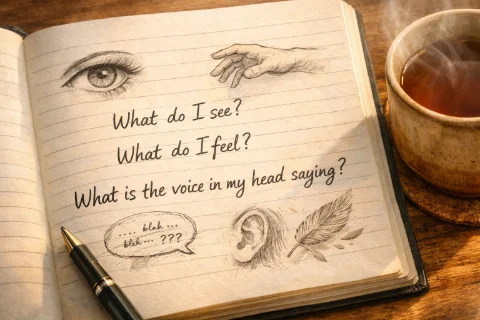
Prose becomes real when the reader can feel it, and feeling comes through the senses. A scene set in a kitchen that has no temperature, no smell, no particular quality of light is a scene happening in a void, however good the dialogue. A small number of precise sensory details, chosen well, anchor the reader inside the story world and make everything that happens there matter more.
The skill of using sensory detail well is subtler than simply adding description; it is about selecting the few details that carry the most weight and using them to ground emotion and meaning rather than merely decorate. This is developed in depth in Using Sensory Details to Bring Fiction to Life, which pairs naturally with the broader principle of showing rather than telling.
That principle deserves its own mention, because it underlies so much of what makes prose vivid. Rather than naming an emotion or stating a fact about a character, the stronger move is almost always to dramatise it so the reader arrives at the conclusion themselves. The full technique, including when telling is actually the better choice, is covered in Show Don't Tell: The Technique That Transforms Prose.
Choose the right point of view
Point of view is one of the most consequential technical decisions in a novel, and it is worth making deliberately rather than by default. First person creates intimacy and a strong, distinctive voice but limits the reader to one perspective. Third person limited offers a similar closeness with more flexibility. Third person omniscient can range across the whole story world but at some cost to intimacy. Each choice shapes what the reader can know, how close they feel to the characters, and what kind of story you are able to tell.
Getting this decision right early saves enormous pain later, because changing point of view in revision means rewriting almost everything. The trade-offs of each option, and how to choose the one that serves your particular story, are set out in Point of View in Fiction Writing: A Complete Guide. Settle this before you get deep into the draft.
Finish the draft before you fix it
There is a strong temptation, especially for first-time novelists, to keep circling back to revise the early chapters instead of pushing forward into the unwritten ones. Resist it. A first draft that is endlessly polished at the front and never finished at the back is the most common way novels die.
The goal of the first draft is completion, not quality. When you type the final sentence for the first time, the draft may be rough in ways that are almost comical, but it will exist, all the way from beginning to end, which is more than it was before. Everything wrong with it can now be fixed, and fixing is a different and more tractable skill than creating from nothing. Get to the end first. The end is where the real work of making it good actually becomes possible.
Revise in passes, not all at once
Revision is where a rough draft becomes a real book, and it is best approached in layers rather than attempting to fix everything simultaneously. The first pass is structural: does the story work, are the stakes clear, does the middle sag, does the ending land, are there scenes that change nothing and should be cut. Only once the structure is sound is it worth moving to the finer layers of character consistency, scene craft, and finally the line-level polish of the prose itself.
Trying to fix a comma while you are still deciding whether a whole chapter belongs in the book is wasted effort, because that chapter may not survive. Work from the largest problems down to the smallest. A complete, practical sequence for approaching this daunting stage is provided in Editing Your First Draft: A Complete Guide for Fiction Writers, which will save you from the common trap of polishing prose that later gets deleted.
Keep going, because that is the whole secret
After all the craft and the structure and the technique, the single thing that separates the novelists who finish from the ones who do not is simply that the finishers kept writing on the days when the writing felt bad. They wrote through the hopeless middle, past the chapters that felt impossible, and discovered on the other side that finishing was always a matter of persistence more than talent.
Your first novel will not be perfect. Nobody's is. But a finished imperfect novel can be revised, submitted, published, learned from and built upon, while a perfect novel that lives only in your head can do none of those things. The book exists the moment you finish it, and finished is the only version that matters.
Wherever you are in the process right now, whether staring at a blank page or deep in a difficult draft, the next step is always the same: write the next scene. Do that enough times, with enough patience, and one day the last scene is the one you are writing. That is how every novel that has ever existed got written, and it is how yours will too.