Introduction
Finishing a first draft is one of the most significant things a fiction writer can do.
Not because the first draft is good. It almost certainly is not, at least not in the way a finished novel needs to be. But because it exists. Because the story that lived only in your head and in fragments of notes and in the anxious hope that you could actually do this has been transferred, imperfectly and incompletely but genuinely, onto the page. You have something to work with now. That is not a small thing.
The first draft is not the book. It is the raw material from which the book will be made. Understanding that distinction, truly internalising it rather than just knowing it intellectually, is the foundation of every good revision process. Writers who approach their first draft as something to be polished are doing a fundamentally different and less effective kind of work than writers who approach it as something to be understood and rebuilt.
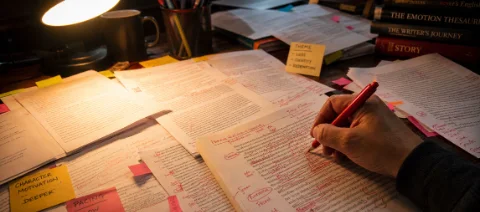
Editing a first draft is not proofreading. It is not fixing typos and smoothing sentences. It is a deep, structural, creative process that asks you to read your own work with the same clarity and honesty you would bring to reading someone else's, to identify what the story is actually doing versus what you intended it to do, and to make the sometimes difficult decisions required to close the gap between those two things.
This guide covers the complete editing process for a fiction first draft, from the initial read-through to the final polish, with specific attention to the different kinds of editing required at each stage and the order in which they should be approached.
Step Away Before You Begin
The single most important thing you can do before editing your first draft is to not edit it immediately.
The temptation to begin revising as soon as the first draft is complete is understandable and almost universal. The story is fresh in your mind. You can see the problems clearly. You want to fix them while everything is still vivid. Starting immediately feels like momentum.
It is not. It is the enemy of clear-eyed revision.
When you finish a first draft, you are too close to it to see it accurately. You read what you meant to write rather than what you wrote. You fill gaps automatically with the context in your head rather than noticing that the page does not actually contain that context. You cannot see the structural problems clearly because you are still inside the structure. You cannot hear where the voice goes wrong because you are still hearing the voice you were aiming for rather than the one you produced.
Distance is what makes genuine revision possible. The minimum useful distance is usually two weeks. Many experienced writers prefer four to six weeks, or longer. Some finish a draft and immediately begin a new project, not returning to revise until the new draft is done.
The length of time matters less than the quality of the distance. You need to reach the point where you can read your own manuscript with something approaching the perspective of a reader encountering it for the first time. That perspective is the most valuable thing you can bring to revision, and it cannot be rushed.
Use the time away productively if you wish. Read in your genre. Work on something else. Live your life. But do not read the draft, do not tinker with scenes, do not revise passages in your head. Let it rest completely. The distance you create now will pay itself back many times over when you begin the revision.
The First Read-Through
When you return to the draft, the first thing you do is read it. All of it, from beginning to end, as continuously as possible.
Do not edit during this read. Do not stop to fix things. Do not rewrite sentences that are not working or restructure scenes that feel wrong. Read with a pen or a notepad beside you and make brief notes when something strikes you, but keep reading. The goal of the first read-through is not to fix anything. It is to understand what you actually have.
Reading the entire draft in as few sittings as possible gives you the closest approximation to the experience your reader will have. Problems that are invisible when you are working scene by scene become visible when you can feel the shape of the whole. The chapter that seemed fine in isolation reveals itself as the place where the story loses momentum when you experience it in the context of everything around it. The character who seemed consistent when you were writing them reveals a significant inconsistency in their behaviour across the arc of the story.
During this read-through, pay attention to your own responses as a reader. Where do you feel pulled forward? Where does your attention drift? Where do you feel something, and where do you feel nothing where you expected to feel something? Where are you confused? Where does something feel false? These responses are data. They are pointing to the places where the work is and is not yet doing what it needs to do.
After the read-through, before you do anything else, write a brief summary of what you actually observed. Not what you intended or hoped, but what is actually on the page. What is the story about? Who is the protagonist and what do they want? What is the central conflict? Does the story deliver on the promises it makes? Where are the biggest problems?
This honest assessment of the actual draft rather than the intended draft is the foundation of everything that follows.
The Levels of Editing and Why Order Matters
Editing a first draft requires working at multiple levels, and working at those levels in the right order is one of the most important things a writer can do to make the process efficient.
The levels, from largest to smallest, are structural editing, scene-level editing, line editing, and copyediting. Each level has its own concerns and its own tools, and each must be addressed in sequence rather than simultaneously.
The reason order matters is straightforward. There is no point polishing the prose of a scene that will be cut in structural revision. There is no point refining the dialogue in a scene whose structure is wrong. There is no point fixing sentence-level problems in a passage whose scene-level function is unclear.
Working from large to small ensures that every refinement made at a smaller level is built on a foundation that has already been made sound at the larger level. Working from small to large, which is the instinct most writers have because sentence-level problems are the most immediately visible, is an inefficient use of revision time and often means redoing work that has been rendered irrelevant by larger structural changes.
Structural Editing: Getting the Foundation Right
Structural editing is the largest and most fundamental level of revision. It addresses the architecture of the story: the plot, the character arcs, the pacing, the balance of scenes, and the overall shape of the narrative from beginning to end.
The questions structural editing asks are the biggest questions a story can face. Does the plot hold together? Does each act do what it needs to do? Is the protagonist's arc complete and earned? Are the stakes clear and consistently maintained? Does the story start in the right place and end in the right place? Are there scenes or subplots that are not pulling their weight? Are there gaps in the narrative where something is missing that the story needs?
These are not small questions, and answering them honestly sometimes requires the hardest decisions in the entire editing process. Cutting a character who is not working. Restructuring the order of events. Adding a scene that was not in the first draft because the story needs something that is currently absent. Recognising that the ending does not yet deliver on the promises made at the beginning and rebuilding it from the ground up.
Structural editing requires the writer to hold the entire story in their head simultaneously and to evaluate the function of each part in relation to the whole. This is why the full read-through comes first. Without a clear picture of the whole, structural decisions cannot be made with any reliability.
Evaluating the Plot
Read through your notes from the first read-through and look at the plot as a sequence of cause and effect. Does each major event grow organically from what preceded it? Is the progression of complications genuinely escalating, or is the story cycling through difficulties at roughly the same level of intensity throughout? Does the climax feel like the inevitable convergence of everything that came before it, or does it feel like an event that happened to be placed at the end?
Map the major structural beats of your story. The inciting incident, the first plot point, the midpoint, the dark moment, the climax, the resolution. Are they present? Are they in the right proportions? Are they doing what they need to do at each stage of the story's development?
Evaluating the Character Arcs
The protagonist must change across the story. Not necessarily in the way they planned or hoped, but fundamentally. Something must be different about who they are or what they understand at the end from what it was at the beginning.
Trace the emotional and psychological arc of your protagonist from page one to the final page. Is the change visible and earned? Is it driven by the events of the story and the choices the protagonist makes, or does it feel imposed? Is the person at the end recognisably the same person as the one at the beginning, just changed by experience?
Do the same for any secondary characters who carry significant weight in the story. Not every character needs a full arc, but every significant character should be changed in some way by the events of the story.
Evaluating the Pacing
Look at the distribution of scene lengths across the manuscript. Are the longest scenes the ones that deserve the most space? Are the shortest scenes the ones that need to move quickly? Is there a cluster of long, slow scenes in the middle of Act Two that is creating a pacing problem? Is the climax given enough space to breathe, or does it rush through the moment the entire story has been building toward?
Identify the scenes that exist primarily to serve the writer's understanding of the story rather than the reader's experience of it. These are often scenes that do not move anything forward, that repeat information already established, or that develop character beats already made clear elsewhere. They were useful to write. They do not need to be read.
Making the Big Cuts
Structural editing sometimes requires cutting material that is well written. A subplot that was interesting in conception but does not add enough to the main story to justify its weight. A secondary character who dilutes the focus without contributing sufficiently to the central conflict. A sequence of scenes in Act Two that effectively pause the story rather than advancing it.
Cutting well-written material is one of the hardest things in revision and one of the most important. The quality of the material is not the relevant criterion. The criterion is whether it is earning its place in the story. Material that is beautifully written but structurally unnecessary is still structurally unnecessary.
Many writers keep a separate document for cut material. Knowing that the cut scenes are saved rather than destroyed makes the cutting easier, and occasionally cut material finds its way back in, or into a different project, at a later stage.
Scene-Level Editing: Making Every Scene Work
Once the structure of the story is sound, the focus shifts to individual scenes.
Scene-level editing asks whether each scene is doing its job effectively. Every scene in a finished novel should be doing at least one of the following: advancing the plot, developing character, building tension, or establishing something about the world that is essential for the reader to understand. Most scenes should be doing at least two of these things simultaneously.
A scene that is doing only one thing is a candidate for cutting or compression. A scene that is doing none of these things must be cut.
Scene Goals and Outcomes
Every scene should have a goal for at least one character: something they want to achieve or find out or avoid within the scene. And every scene should have an outcome that either achieves that goal, fails to achieve it, or achieves it in a way that creates new complications.
A scene without a goal is a scene that drifts. A scene without a meaningful outcome is a scene that ends without having done anything. Both produce the feeling in the reader that the story is not going anywhere, which is the most damaging pacing problem a novel can have.
Read each scene and ask: what does the point of view character want in this scene? What stands in the way? What is the outcome, and how does that outcome affect what comes next? If you cannot answer these questions clearly, the scene needs restructuring.
Scene Beginnings and Endings
Scenes begin too early and end too late far more often than the reverse. The first paragraph of most scenes can be cut without losing anything the reader needs. The final paragraph of most scenes runs past the moment that earned the scene's ending and into a denouement that belongs in the next scene.
Trim scene openings to the last possible moment before something meaningful is happening. Cut scene endings to the first moment after the scene's essential work is done. The tightening that results from this alone often transforms the pacing of a manuscript.
The Entry and Exit Points
Related to scene beginnings and endings but distinct from them: are characters entering and exiting scenes in the most economical way? Scenes that begin with characters travelling to a location, sitting down, ordering food, exchanging pleasantries, and settling in before anything significant happens are scenes that have started too early. Get to the point of the scene as quickly as possible and trust the reader to understand that the getting-there happened without being shown.
Line Editing: The Prose Itself
With the structure and the scenes working, the focus moves to the line level: the prose itself, sentence by sentence and paragraph by paragraph.
Line editing is where the writing becomes writing in the fullest sense. It is the craft of making the language do precisely what the story needs it to do, no more and no less, with the rhythm and clarity and specificity that serves the reader's experience most fully.
Clarity
The first job of every sentence is to be understood. Prose that is difficult to parse, that requires re-reading to yield its meaning, that obscures its subject and action in layers of qualification or unusual construction, is prose that is working against the reader rather than for them.
Read every sentence asking whether a reader encountering it for the first time would understand it immediately. Not every sentence needs to be simple. But every sentence needs to be clear. Complexity that creates richness is a different thing from complexity that creates confusion.
Specificity
Vague language is the most common and most correctable weakness in first draft prose. Abstract nouns, generic verbs, unspecific adjectives, descriptions that gesture toward a thing rather than rendering it precisely.
Move felt sad at something that moves the reader. Moved slowly becomes specific: shuffled, dragged, inched. Nice becomes what nice actually meant in this specific context: warm, comfortable, unremarkable. Walked into the room becomes whatever this particular person's particular way of entering this particular room actually looked like.
Specificity is the difference between prose that describes and prose that shows. It is the mechanism behind show don't tell at the sentence level. Every revision pass should be pushing the language toward greater precision, toward the exact word that captures exactly this, rather than the approximate word that captures something like this.
The Passive Voice
Passive constructions, where the subject of the sentence is acted upon rather than acting, drain energy from prose and distance the reader from the action. They are also a reliable signal of places where the writer was not fully committed to what was happening in the scene.
Active verbs with clear agents performing clear actions create the sense of events happening in real time. Passive constructions create the sense of events being reported after the fact. The first is almost always more engaging.
This does not mean passive voice is never appropriate. It has specific uses: when the agent of an action is unknown or deliberately obscured, when the emphasis of a sentence needs to fall on the object rather than the subject, when a particular rhythm requires it. But in most sentences, most of the time, active construction is stronger.
Eliminating Filler
First drafts are full of words that are not earning their place. Adverbs that duplicate information already carried by the verb. Qualifiers that hedge unnecessarily. Throat-clearing phrases that delay the sentence getting to its point. Redundant dialogue tags that state what is already clear from the dialogue itself.
Very, really, quite, just, rather, somewhat, actually, literally, basically, honestly: these words appear hundreds of times in most first drafts and contribute nothing in the vast majority of their appearances. Read for them specifically and cut them unless there is a genuine reason for each one.
Dialogue attribution is another source of filler. Said is almost always the right word, and said is almost always sufficient. Adverbs attached to said, she said quietly, he said angrily, are almost always telling rather than showing, delivering information the prose itself should already be carrying.
Sentence Rhythm
Prose has rhythm, and that rhythm shapes the reading experience in ways the reader feels without consciously registering. Sentences that all have the same length and structure create a monotonous rhythm that makes even interesting content feel flat. Prose that varies sentence length and structure deliberately creates a texture that is more pleasurable to read and that can be used to guide the reader's experience of pace and emphasis.
Read your prose aloud during line editing. The ear catches rhythmic problems that the eye misses. A sentence that trips you up when spoken is a sentence that will trip up the reader. A stretch of prose that becomes monotonous when read aloud will feel equally monotonous on the silent page.
Copyediting: The Final Pass
Copyediting is the last stage of the editing process and the most granular. It addresses grammar, punctuation, spelling, consistency, and the surface correctness of the prose.
It is also the stage most commonly confused with editing itself, particularly by writers in the early stages of developing their process. Copyediting is important, but it is the smallest and least significant of the editorial levels. A manuscript that is structurally sound, scene-level effective, and beautifully written at the line level will survive copyediting issues. A manuscript that is grammatically perfect but structurally broken cannot be saved by flawless punctuation.
Copyediting is best done when everything else is finished, because revisions made at higher levels will introduce new surface errors that need to be caught, and copyediting work done before structural revision is likely to be partially wasted.
Consistency
Consistency is the primary concern of copyediting beyond basic correctness. Character names spelled the same way throughout. Physical descriptions that do not contradict themselves between chapters. Timeline consistency across scenes that reference specific dates or intervals. Place names, invented terminology in fantasy and science fiction, and any other proper nouns or invented language maintained consistently from first appearance to last.
A continuity document, kept during writing and updated during revision, makes consistency errors much easier to catch. A simple document listing character names and physical details, place names, key dates, and any invented terminology gives you a reference against which to check the manuscript.
The Value of Fresh Eyes
No writer can fully copyedit their own work. The brain fills in what was meant rather than reading what is there, which means errors that are obvious to a reader encountering the text fresh become invisible to the writer who created it.
Reading the manuscript aloud catches many errors the silent read misses. Reading it in a different format, printed rather than on screen, or in a different font, creates just enough unfamiliarity to make errors more visible. Reading backwards, sentence by sentence, removes the context that allows the brain to auto-correct, making individual sentence errors harder to miss.
But the most effective copyediting tool is another pair of eyes. A professional copyeditor, a skilled beta reader, or a trusted colleague who is strong on language can catch what you cannot see yourself. For any manuscript being prepared for publication, whether traditional or indie, professional copyediting is an investment worth making.
Working With Beta Readers
Beta readers, readers who respond to the manuscript before publication and provide feedback on the reading experience, are one of the most valuable resources in the revision process and one of the most misunderstood.
The most useful beta reader feedback is not general impressions but specific responses to specific questions. Ask your beta readers where their attention drifted. Ask them which characters they cared about most and least, and why. Ask them whether the ending satisfied them and whether it felt earned. Ask them whether they were confused at any point and where. Ask them what they felt the story was about.
These specific questions produce feedback that is actionable. General impressions, I liked it, it was good, the middle was a bit slow, are well-intentioned but difficult to act on. Specific responses to specific questions give you the data you need to make informed revision decisions.
Choose beta readers whose reading tastes overlap with the genre and audience of your manuscript. A beta reader who does not read in your genre will apply the wrong set of expectations and produce feedback that is not calibrated to what your book is trying to do.
Take time between receiving feedback and deciding how to act on it. The immediate response to critical feedback is almost always defensive, and defensive revision decisions are usually wrong. Let the feedback settle, then read it again asking which responses point to genuine problems in the manuscript rather than simply reflecting the individual preferences of that particular reader.
When to Stop Revising
Revision has a natural endpoint that is not the same as perfection.
Perfection is not available. Every writer who has published work they subsequently read and wished they could revise further knows this. The goal of revision is not a manuscript with no remaining problems. It is a manuscript where the remaining problems are small enough that they do not prevent the book from being what it needs to be for its readers.
There are signs that revision is approaching its natural endpoint. The changes you are making are increasingly small. The problems you are finding are at the surface level rather than the structural level. Reading the manuscript produces mostly satisfaction rather than the nagging sense that something significant is still wrong. The book feels, in its essential shape and substance, like the book you set out to write.
There are also signs that revision is becoming counterproductive. You are changing things back to how they were. You are revising passages that are already working because you cannot stop touching the manuscript. You have lost the ability to tell whether changes are improvements or simply differences.
When revision becomes counterproductive, the manuscript needs to go out into the world rather than back through another pass. Not because it is perfect, but because continuing to revise is no longer making it better and the time has come to let it be what it is.
Every finished, published novel represents a writer's best effort at a particular point in time. The next book will be written by a better writer, and it will be better for that reason. But only if this book is finished and released rather than endlessly revised in the search for a perfection that writing, by its nature, never quite reaches.
Conclusion
Editing a first draft is not a lesser act of creativity than writing one. It is a different act of creativity, one that requires its own skills, its own patience, and its own kind of courage.
The courage to see clearly what is not working. The patience to address structural problems before surface ones. The discipline to cut well-written material that the story does not need. The honesty to hold your own work to the standard you would apply to any book you love as a reader.
The first draft contains the story. The edited manuscript is the story, shaped and clarified and strengthened until it is as fully itself as you can make it.
That process, unglamorous and demanding and occasionally painful as it is, is where the book is actually made.
Do the work. The story you have in you deserves the full effort of making it everything it can be.
Indie Reading Community is where independent authors and passionate readers find each other. Explore books across every genre, read author interviews, and browse craft articles built for indie writers and readers at indiereadingcommunity.com