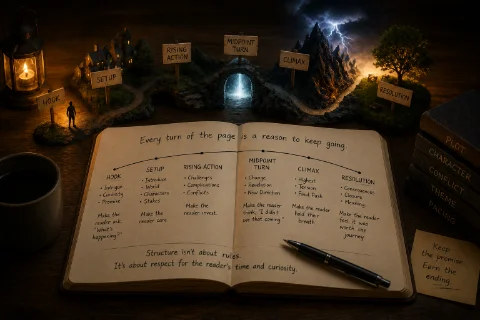
Introduction: Structure Is Not a Cage
Many writers think story structure is a set of rules.
Act One must do this.
The midpoint must do that.
The climax must arrive here.
The ending must resolve there.
This can make structure feel mechanical, as if writing a novel means filling boxes in the correct order. But story structure is not really about obeying a diagram.
It is about persuasion.
A good structure convinces the reader to begin.
Then it convinces them to continue.
Then it convinces them that the journey matters.
In that sense, story structure is less about how to write a book and more about how to make someone want to read it.
The writer’s job is not only to arrange events.
The writer’s job is to manage attention.
What Story Structure Really Does
Story structure gives readers a reason to keep moving.
It creates questions.
It delays answers.
It raises stakes.
It changes emotional pressure.
It offers rewards at the right moments.
It makes the reader feel that the next page matters.
Without structure, a story may contain beautiful sentences, interesting characters, and strong ideas, but still feel shapeless. The reader may admire the writing and still put the book down.
Structure is the invisible hand that says:
Stay.
Something is coming.
You need to know what happens next.
The Reader Is Always Asking One Question
Every reader is silently asking:
Why should I keep reading?
They may not say it directly.
They may not even think it consciously.
But the question is always there.
A good opening answers it.
A good chapter ending answers it again.
A good midpoint renews it.
A good final act proves that the answer was worth waiting for.
Story structure is the art of repeatedly answering that silent question.
Structure Begins With a Promise
Every story begins by making a promise.
The promise may be:
This mystery will reveal a truth.
This romance will test two hearts.
This fantasy will show a world worth entering.
This literary novel will uncover an emotional wound.
This thriller will tighten danger until escape seems impossible.
This family drama will expose what everyone has hidden.
Readers continue because they believe the promise will be fulfilled.
Structure is how the writer protects that promise.
Curiosity Is the First Persuasion Tool
Readers do not need everything explained immediately.
In fact, they usually should not receive everything at once.
Curiosity is one of the strongest forces in storytelling.
A question appears.
A character hides something.
A strange object is introduced.
A relationship carries tension.
A line of dialogue suggests history.
A door remains locked.
The reader wants to know more.
That desire becomes momentum.
Structure controls when questions are opened, deepened, delayed, answered, or transformed.
The Difference Between Information and Interest
Many writers give information too early.
They explain the world.
They explain the backstory.
They explain the wound.
They explain the system.
They explain the rules.
But information alone does not create interest.
Interest comes when information is connected to desire, danger, mystery, emotion, or change.
For example:
Weak version:
“The kingdom had been at war for twenty years.”
Stronger version:
“The kingdom had been at war for twenty years, and tomorrow the princess would be asked to marry the man who started it.”
The second version turns background into pressure.
That is structure at work.
Pacing Is Persuasion
Pacing is not only speed.
It is the rhythm of attention.
A fast scene can excite the reader.
A quiet scene can deepen emotion.
A delayed answer can create suspense.
A sudden reveal can create shock.
A reflective pause can make the next event matter more.
Good pacing does not mean everything happens quickly.
It means the reader always feels carried.
The story may slow down, but it should not go empty.
Even quiet scenes need a reason to exist.
Every Scene Should Create a Reason to Continue
A scene does not always need action.
It does not always need conflict.
It does not always need a twist.
But it should create movement.
Movement can be external or internal.
A decision changes.
A relationship shifts.
A question sharpens.
A secret becomes heavier.
A character sees something differently.
A danger moves closer.
A hope becomes harder to protect.
If nothing changes, the reader feels stillness.
Stillness is not always bad.
But meaningless stillness weakens persuasion.
Chapter Endings Are Invitations
A chapter ending is not simply a stopping point.
It is an invitation to continue.
Some chapter endings use direct suspense.
A knock at the door.
A missing body.
A sudden confession.
A name revealed.
Others use emotional suspense.
A character understands something but does not say it.
A relationship shifts.
A memory returns.
A choice becomes unavoidable.
The best chapter endings do not always shout.
Sometimes they whisper the perfect unanswered question.
Structure Is About Withholding Without Cheating
Writers must withhold information carefully.
Withholding creates curiosity.
But unfair withholding creates frustration.
The reader should feel that the story is guiding them, not tricking them.
Good withholding says:
You do not know yet, but you will understand why.
Bad withholding says:
The answer is being hidden only because the author needs you to stay confused.
The difference is trust.
Structure must build trust even while delaying answers.
The Middle Is Where Persuasion Is Tested
Many novels weaken in the middle.
The opening has promise.
The ending has destination.
But the middle can become a swamp.
This happens when scenes repeat the same emotional or plot condition.
The character wants the same thing in the same way.
The conflict stays at the same temperature.
The mystery does not deepen.
The relationship does not shift.
The reader begins to feel that the book is moving in circles.
A strong middle changes the terms of the story.
The question becomes harder.
The desire becomes more complicated.
The cost becomes clearer.
The reader realizes the story is larger than it first appeared.
The Midpoint as a New Persuasion
The midpoint often works because it renews the reader’s interest.
It says:
You thought this story was about one thing.
Now see what it is really about.
This does not always need to be a dramatic twist. It can be a revelation, a decision, a reversal, a discovery, or a change in emotional understanding.
The midpoint should make the reader feel that the book has opened deeper.
The same story continues, but the meaning has expanded.
Emotional Investment Is Stronger Than Plot Curiosity
Plot questions make readers turn pages.
Emotional investment makes them care.
A reader may want to know who killed the victim.
But they stay awake reading because they care what the answer will do to the detective, the widow, the child, the town, or the liar who has almost become honest.
Structure should not only organize events.
It should increase emotional attachment.
The question is not only:
What happens next?
It is also:
What will this do to the people I care about?
The Reader Needs Rewards
If a story only delays, readers grow tired.
A good structure offers rewards along the way.
Small answers.
Emotional moments.
Revealed connections.
Changes in power.
Moments of beauty.
Moments of danger.
Moments of recognition.
A reader will accept delayed satisfaction if the journey keeps providing smaller satisfactions.
Structure is the rhythm of promise and reward.
The Opening Must Earn Attention
The beginning of a story has one important task.
It must earn attention.
This does not mean the book must start with an explosion.
It means the opening must create a reason to care.
A strange situation.
A compelling voice.
An emotional wound.
A dramatic question.
A strong atmosphere.
A person in motion.
A sentence that feels alive.
The reader does not owe the writer attention.
The opening must win it.
The Ending Must Justify the Journey
If the opening makes a promise, the ending must answer it.
Not always with perfect happiness.
Not always with complete explanation.
But with emotional meaning.
The reader should feel that the journey had shape.
That the questions mattered.
That the delays had purpose.
That the scenes were building toward something.
An ending does not need to give readers everything they wanted.
But it should give them something that feels earned.
Structure as Emotional Architecture
Think of structure as architecture.
The opening is the door.
The early chapters are the hallway.
The middle rooms deepen the house.
The hidden staircase changes the reader’s understanding.
The final room reveals why the house was built this way.
Readers may not notice the architecture while reading.
They only feel whether the house invites them forward.
Good structure is often invisible.
But without it, the reader gets lost.
How to Think About Structure as Persuasion
1. Ask What the Reader Wants to Know
Every section should create or deepen curiosity.
2. Make Every Scene Change Something
A scene should alter information, emotion, power, danger, or desire.
3. Delay Answers With Purpose
Do not hide facts randomly. Delay them because their timing matters.
4. Reward the Reader Often
Offer smaller satisfactions before the final payoff.
5. Keep Emotional Stakes Alive
Readers continue when they care about consequences.
6. Let Structure Serve the Promise
Every story makes a promise. Shape the book around fulfilling it.
7. End With Meaning
A good ending proves that the reader’s attention was respected.
Example: Event List vs Persuasive Structure
Event list:
A girl moves to a new town.
She meets a neighbor.
She finds an old map.
She visits the woods.
She discovers a hidden house.
Persuasive structure:
A girl moves to a new town and notices every adult avoids mentioning the woods.
A neighbor warns her not to ask about the old map in the library.
She finds her own name written on the back of that map.
When she visits the woods, the path seems to recognize her.
The hidden house contains a room that looks exactly like her childhood bedroom.
The events may be similar.
But the second version persuades.
It creates questions, escalation, mystery, and emotional pressure.
Common Mistakes Writers Make
Treating Structure Like a Formula
A formula gives shape.
Persuasion gives life.
Explaining Too Early
Curiosity dies when everything is answered before readers care.
Confusing Movement With Momentum
Many events can happen while the story still feels static.
Forgetting Emotional Stakes
Plot without feeling becomes machinery.
Saving All Rewards for the End
Readers need meaningful moments throughout the journey.
Why This View Frees Writers
Seeing structure as persuasion can free writers from rigid formulas.
Instead of asking:
Did I place the inciting incident correctly?
Ask:
Have I given the reader a reason to continue?
Instead of asking:
Is this the right beat?
Ask:
What is the reader curious about here?
Instead of asking:
Am I following the structure?
Ask:
Is the story earning attention?
This approach makes structure practical, flexible, and human.
The Shape of Wanting to Read
Story structure is not a prison.
It is not a checklist.
It is not a machine that writes the book for you.
Story structure is the art of shaping reader desire.
It controls curiosity.
It guides emotion.
It protects promises.
It times revelations.
It builds trust.
It turns pages into invitations.
A well-structured book does not merely contain events in order.
It persuades the reader that the next page matters.
Then the next.
Then the next.
Until the reader reaches the end and realizes the structure was not a set of rules at all.
It was the quiet intelligence of the story knowing how to be read.