One of the advantages of getting older? Caring less what people think.
Last week I wrote about discovering writing in my sixties and how pleased I am to have found something that keeps me challenged, creative and, hopefully, the little grey cells working.
But there's another advantage to discovering writing later in life that I've been thinking about.
I don't particularly care what people think of me anymore.
Well, perhaps that's putting it a bit strongly. Of course, I'd prefer people to enjoy my books rather than tell me they're rubbish. But the prospect of someone disliking what I've written doesn't particularly bother me.
And I wonder whether that would have been the case if I'd started writing thirty years ago.
The freedom to just write
I suspect one of the things that stops people from writing is worrying about what others might think.
What if nobody likes it? What if somebody gives it a terrible review? What if people laugh at what I've written?
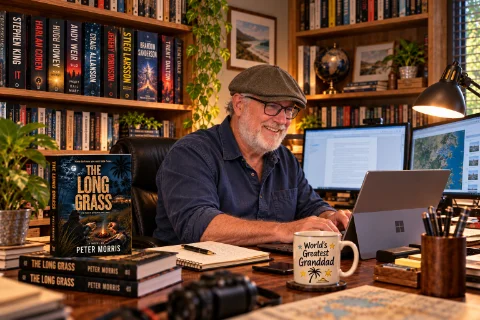
For whatever reason, those thoughts never really entered my head when I started writing The Long Grass.
Perhaps it's one of the benefits of getting older. You become a little more comfortable with who you are and a little less concerned about what everyone else thinks.
Whether that's healthy or not, I'll leave to somebody more qualified than me. But it's certainly liberating.
Borrowing from a lifetime of memories
At the moment, I'm writing a section of my second Annette Mollison novel involving two young people meeting in Townsville in the early 1970s.
I've been drawing on memories of my own childhood, particularly watching my sister navigate her teenage years and the occasional battles she had with our father.
I've also found myself remembering kids I knew growing up. Some had a wonderful ability to say exactly what was on their minds, regardless of the consequences. I always admired that, probably because I wasn't quite as good at it myself.
Now, more than fifty years later, I can take bits and pieces of those memories and turn them into fictional characters.
They're not necessarily based on any one person. They're combinations of personalities, conversations, experiences and a fair bit of imagination.
And I've discovered that creating those people and watching them interact is one of the most enjoyable parts of writing.
Getting the facts right. Mostly.
I've also been thoroughly enjoying the research for the new novel, which I'm increasingly convinced will be called Gone for Now.
The opening involves a man driving a 1977 Chrysler Valiant Drifter, so naturally I found myself researching everything I could about those cars.
I've done the same with police procedures, firearms, forensic investigations and all sorts of other things.
I like getting those details right, particularly when the story is set in a recognisable place and period.
But I've also learnt something important.
It's fiction.
If I decide a character says something, makes a particular decision or takes the story in an unexpected direction, that's entirely up to me.
I don't have to justify every conversation or every fictional event against some historical record. There are facts I want to get right, certainly. But the most important thing is still the story.
And sometimes I suspect I can spend far too long worrying about the little details when I should be getting on with telling it.
Perhaps I started at just the right time
So maybe discovering writing in my sixties wasn't such a late start after all. I've accumulated a lifetime of memories, met some extraordinary people and experienced things that I can now draw upon when creating stories.
And perhaps, just as importantly, I've reached an age where I'm comfortable enough to put those stories out into the world without worrying too much about what everybody thinks.
I'm still learning. I'm still making mistakes. And I certainly don't expect everyone to love everything I write.
But I'm having a great time doing it.
And at this stage of my life, that's a pretty good reason to keep going.