If you've ever sat down to write a novel and found yourself staring at a blank page three chapters in, wondering where your story is supposed to go, you're not alone. Plotting a novel is genuinely hard. Most writers either over-plan (and lose the joy of discovery) or under-plan (and run out of road at the worst possible moment).
The Snowflake Method sits somewhere in the middle. It gives you a structure to build from without locking you into a rigid outline before you've even met your characters properly. It's one of the most widely used novel planning techniques among indie authors, and once you understand how it works, you'll see why.
What Is the Snowflake Method?
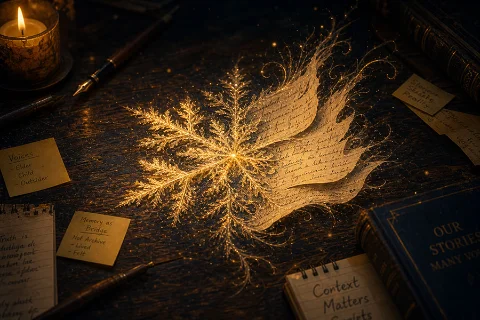
The Snowflake Method was developed by physicist-turned-novelist Randy Ingermanson. The core idea comes from a concept in mathematics: a snowflake fractal is built by starting with a simple triangle and repeatedly adding detail at smaller and smaller scales. Each pass makes it more complex, but the original shape is never abandoned.
Ingermanson applied that same logic to novel planning. You start with the simplest possible version of your story, then expand it in multiple passes until you have enough material to write a full draft.
The method has ten steps, though most writers don't use all of them in order, and some skip a few entirely. What matters is the principle: start small, expand gradually, and let each layer inform the next.
The Ten Steps of the Snowflake Method
Step 1: Write a One-Sentence Summary
Before anything else, describe your novel in a single sentence of no more than fifteen words. This is your story's foundation. Not a tagline, not a marketing blurb — just the core of what happens and why it matters.
A useful sentence usually includes who the main character is, what they want, and what's standing in the way. Think of it like a log line for a film. If you can't write one sentence that captures your story, you may not have a clear enough idea yet to start writing.
This forces you to make decisions early, which saves time later.
Step 2: Expand to a One-Paragraph Summary
Now take that sentence and expand it into a paragraph of about five sentences. The structure Ingermanson recommends is:
- One sentence for the story setup
- Three sentences for the major disasters or turning points
- One sentence for the ending
You're not writing your back cover copy here. You're mapping the bones of the plot. This paragraph becomes your reference point throughout the whole process.
Step 3: Write a Character Summary for Each Major Character
For each major character, write a one-page summary that covers:
- Their name and basic role in the story
- Their motivation (what do they want, most deeply?)
- Their goal (what specific thing are they trying to achieve?)
- Their conflict (what's stopping them?)
- Their epiphany (what do they learn or how do they change?)
- A one-paragraph summary of their arc
This is where many writers discover that their characters aren't doing enough — or that two characters want the same thing, leaving the story without real tension. Catching this early is much easier than catching it on page 200.
Step 4: Expand Your Story Summary to a Full Page
Go back to the one-paragraph summary from Step 2 and expand each sentence into its own paragraph. You should end up with roughly five paragraphs covering the beginning, the escalating conflicts, and the ending.
At this stage, you're allowed to change things. If something doesn't work when you expand it, fix it now rather than discovering the problem mid-draft. The point is to build the story in the planning phase, not fight it in the writing phase.
Step 5: Write a Full Character Synopsis for Each Major Character
This is a longer version of Step 3. For each major character, write a one-to-two page synopsis of the story from their point of view. You'll write the whole story again, but through their eyes.
This step does something that no amount of plot outlining can do: it forces you to understand why each character does what they do. Characters who feel flat in a first draft often do so because the writer only ever thought about what they do, not why they do it.
If a character's actions don't make sense from their own perspective, readers will feel it, even if they can't articulate what's wrong.
Step 6: Expand Your Story Synopsis to Four Pages
Take the one-page summary from Step 4 and expand each paragraph into a full page. You now have a four-page document that covers the entire novel in rough form. Every major scene should be implied here, even if not named explicitly.
This is your working document for the rest of the planning process. If you needed to hand your novel off to someone else and have them write it, this document would tell them enough to do so.
Step 7: Build a Character Chart
Create a detailed spreadsheet or chart for each character that goes deeper than anything you've written so far. Cover physical description, backstory, personality, relationships with other characters, how they change throughout the story, and anything else that's relevant to who they are.
This isn't busywork. Characters who feel real on the page are characters the writer knows well off the page. The details you put in this chart may never appear directly in the novel, but they'll shape every scene those characters appear in.
Step 8: Make a Scene List
Go through your four-page synopsis and turn it into a list of scenes. For each scene, note the point-of-view character, what happens, and what changes as a result.
The "what changes" part matters. A scene where nothing changes is a scene that probably doesn't need to be in the novel. Every scene should shift the story forward or deepen the reader's understanding of something important.
Your scene list might run to fifty entries or two hundred, depending on how long your novel is and how detailed you've been. This list is what you'll write from.
Step 9: Write Scene Descriptions
For each entry on your scene list, write a short prose description of what happens. Not the scene itself, just a paragraph or two explaining the situation, the conflict within the scene, and how it ends.
Some writers skip this step entirely and go straight from the scene list to the draft. Others find it essential. The more complex your novel, the more useful this step tends to be.
Step 10: Write the First Draft
You've done the planning. Now you write. The difference between starting here and starting from scratch is significant. You have a scene list to work from, characters you understand, and a story structure you've already tested at multiple levels of detail.
This doesn't mean the draft will write itself. But you're far less likely to hit a wall, write yourself into a dead end, or spend six months on a story that doesn't hold together.
Does the Snowflake Method Work for Every Writer?
No single planning method works for everyone. Some writers — often called "pantsers," as in writing by the seat of your pants — find that any planning kills their creative energy. The story only becomes clear to them in the act of writing it.
The Snowflake Method is better suited to writers who:
- Already know they need some level of structure before they can write comfortably
- Have started novels before but lost momentum before finishing
- Are writing genre fiction, where plot architecture tends to matter a lot
- Are working on a longer or more complex project than they've attempted before
If you're a pantser who's curious about planning, you don't have to do all ten steps. Even just writing the one-sentence summary and the character motivations can give you enough scaffolding to keep moving when you get stuck.
Common Mistakes Writers Make with the Snowflake Method
Treating the outline as fixed. The whole point of doing this in layers is that each layer can revise the one before it. If you discover in Step 5 that a character's arc doesn't match what you planned in Step 3, change Step 3. The outline serves the story, not the other way around.
Skipping the character steps. Steps 3 and 5 are the ones writers are most tempted to rush through. They feel less exciting than plotting. But the character work is what separates a novel with a compelling story from one with a compelling story and characters readers actually care about.
Planning indefinitely. The Snowflake Method can become a form of productive procrastination. At some point, you have to stop planning and write. The ten steps are a means to the draft, not a replacement for it.
Following the steps in rigid order. Ingermanson himself says you can adapt the process. If you get to Step 4 and realize your one-sentence summary is wrong, go back and fix it. The method is iterative, not linear.
Adapting the Snowflake Method for Indie Authors
If you're an indie author working on a publishing schedule, the Snowflake Method has some practical advantages beyond just helping you write better novels.
The one-sentence summary and the one-paragraph summary from Steps 1 and 2 become your blurb drafts. The character work from Steps 3 and 5 can feed directly into the character bios you use in series bibles or author notes. The scene list from Step 8 makes it easier to delegate developmental editing, because an editor can see the structure of the book before reading the draft.
For series writers in particular, doing the full Snowflake process for each book in advance helps you track continuity, plan long-arc character development, and avoid writing yourself into a corner that spans multiple volumes.
Getting Started Today
If you've never tried structured planning before, the lowest-risk way to experiment with the Snowflake Method is to just do Steps 1 through 3.
Write one sentence about your novel. Write five sentences. Write out what your main character wants, what's in their way, and what they learn.
That alone will tell you whether you have a story that's ready to be written. And if it's not ready yet, now is the time to find out — before you've invested months of writing time into it.
The Snowflake Method isn't magic. But for writers who need a bridge between the idea and the draft, it's one of the more practical tools available. Give it an honest try, adapt the parts that don't fit your process, and see what it does for your writing.