Introduction
Plot is the most argued-about word in fiction writing.
Ask ten writers what plot means and you will get ten different answers, some of them contradictory. Plot is what happens. Plot is why things happen. Plot is the arrangement of events. Plot is the shape of the story. Plot is the engine. Plot is the skeleton. Plot is everything or plot is secondary to character or plot is a commercial concern that serious literary fiction transcends.
The confusion is real, and it matters, because writers who are unclear about what plot actually is tend to be unclear about how to build one. They produce stories where things happen but nothing develops, where events accumulate without building toward anything, where the reader finishes with the uncomfortable sense that the story did not quite add up to what it seemed to be promising.
Understanding plot clearly, at a level deeper than event sequence or story summary, is one of the most valuable things a fiction writer can do. Not because plot is the most important element of fiction, though for many genres and readers it is close to that, but because plot is the element that holds everything else together. Character, theme, voice, world, and language all need a structure to live in. Plot is that structure.
This guide is a comprehensive examination of what plot is, how it works, what its components are, how it relates to character and theme, what the most important structural models are and when to use each, and how to diagnose and fix the most common plot problems in fiction.
What Plot Actually Is
The simplest definition of plot is the sequence of events in a story. But that definition, while not wrong, is incomplete in a way that causes problems.
A sequence of events is a chronicle. Things happen in order. First this, then that, then the other. A chronicle can be interesting if the events themselves are interesting, but it does not have the quality that distinguishes a story from a sequence of occurrences. It does not have inevitability.
The literary theorist E.M. Forster made a distinction that remains one of the most useful in discussions of plot. He distinguished between story, which he defined as a narrative of events arranged in their time sequence, and plot, which he defined as a narrative of events with the emphasis falling on causality. His example is famous: the king died and then the queen died is a story. The king died and then the queen died of grief is a plot.
The addition of of grief transforms the sequence into a plot because it introduces causality. The second event does not merely follow the first. It is caused by it. And causality is the mechanism that makes plot feel like more than a sequence of things that happened. It makes the events feel necessary, connected, and meaningful.
Plot, properly understood, is causally connected events. Each event in the plot should arise from what preceded it and lead inevitably toward what follows. The chain of cause and effect that runs through the story from the first pages to the last is what creates the sense that the story is going somewhere, building toward something, earning its ending through everything that came before.
This is why the question to ask about any event in a plot is not what happens next but why does this happen and what does it cause. The first question produces chronicle. The second produces plot.
The Relationship Between Plot and Story
The distinction between plot and story, or more precisely between the events of a narrative and the arrangement of those events, is one of the foundational concepts in narrative theory and one of the most practically useful for writers.
Story, in this technical sense, is everything that happens in the fictional world of the narrative, whether shown to the reader directly or not. The protagonist's childhood, the events that occurred before page one, the scenes that happen offstage while the narrative is elsewhere, the backstory of every character. All of this is story.
Plot is the selection and arrangement of story events that the narrative chooses to show, in the order it chooses to show them, with the emphasis it chooses to apply to each. Plot is the editorial and artistic shaping of story into the experience the reader actually has.
This distinction has enormous practical implications. A writer who understands only story is a writer who feels obligated to show the reader everything that happened, in the order it happened, from the beginning. The result is often a novel that starts too early, covers too much ground, and fails to create the sense of shape and inevitability that a well-constructed plot provides.
A writer who understands the distinction between story and plot understands that the artistic decisions about what to show, what to omit, what to summarise, what to dramatise fully, and in what order to present information to the reader are among the most important decisions in the entire writing process. The plot is not what happened. It is how the writer chose to present what happened, and that choice is a creative act of the highest order.
Many of the most sophisticated narrative techniques in fiction, including non-linear structure, multiple timelines, unreliable narration, and stories that begin in medias res, are fundamentally about the relationship between story and plot. They exploit the gap between what happened in the story and what the narrative chooses to reveal and when, using that gap to create mystery, irony, retrospective understanding, and the specific pleasures of a reader who is gradually assembling the full picture from the pieces the narrative provides.
The Components of Plot
A plot, regardless of its genre or complexity, is built from a set of fundamental components. Understanding these components individually and how they work together is the practical foundation of plot construction.
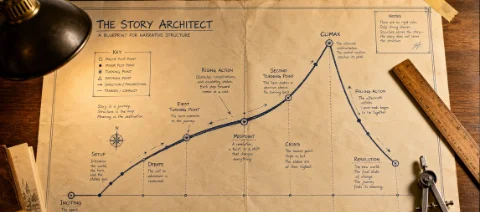
Exposition
Exposition is the information the reader needs in order to understand the story. It includes the establishment of setting, the introduction of characters, the presentation of the situation that exists before the central conflict begins, and any background information essential for comprehension of what follows.
Exposition is often thought of as the opening of the story, but it is not confined to the beginning. Exposition occurs throughout a narrative whenever new information necessary for understanding is delivered to the reader.
The craft challenge of exposition is delivering necessary information without stopping the story to do so. Exposition that arrives in large blocks, what is commonly called an info dump, interrupts narrative momentum and asks the reader to absorb context before they have sufficient investment to want it. Exposition that is woven into action and dialogue, delivered in small doses attached to moments that are themselves interesting, maintains momentum while building the reader's understanding.
The principle that governs effective exposition is need. Deliver information when the reader needs it to understand what is happening, not before. Trust the reader to tolerate a degree of initial uncertainty and to stay engaged while the necessary context is gradually built. Most readers are more comfortable with uncertainty than writers give them credit for, as long as something interesting is happening while the uncertainty exists.
Inciting Incident
The inciting incident is the event that sets the plot in motion. It is the disruption of the status quo established in the exposition, the thing that happens to or because of the protagonist that makes the rest of the story necessary.
A strong inciting incident does three things. It introduces or significantly escalates the central conflict. It raises the central dramatic question the story will spend its length answering. And it changes the protagonist's situation in a way that demands a response.
The inciting incident is not always the first thing that happens in the narrative. Some stories begin with the inciting incident immediately. Others establish the protagonist's world and situation before the disruption occurs. The right timing depends on how much context the reader needs before the disruption will register with its full force.
What the inciting incident must never be is a non-event. A disruption that does not genuinely change anything, that the protagonist can simply return to their ordinary life after experiencing, is not an inciting incident. It is an occurrence. The inciting incident must make return to the ordinary world impossible, either because the world has changed or because the protagonist has been changed by encountering it.
Rising Action
Rising action is the section of the plot between the inciting incident and the climax, during which the protagonist pursues their goal in response to the central conflict and encounters escalating obstacles in that pursuit.
The key word in that description is escalating. The obstacles the protagonist faces during the rising action should increase in difficulty and personal cost as the story progresses. Early obstacles test the protagonist's practical capabilities. Later obstacles test their values, their relationships, and their fundamental beliefs about who they are and what they are willing to do.
Rising action is not simply a sequence of increasingly difficult problems. It is the space in which character is revealed and developed, relationships are built and strained, stakes are established and raised, and the reader's understanding of and investment in the story deepens to the point where the climax will land with its full weight.
The rising action is the longest component of most plots and the hardest to sustain because it lacks the natural momentum of the inciting incident and the natural endpoint of the climax. It must create its own momentum through the consistent escalation of stakes, the deepening of character, and the management of the reader's curiosity about how the central conflict will resolve.
Complications and Reversals
Within the rising action, specific moments of complication and reversal serve to prevent the plot from becoming a simple linear escalation toward the climax.
A complication is an event that makes the protagonist's pursuit of their goal more difficult, either by introducing a new obstacle or by changing the nature of an existing one. Complications should arise from the events that preceded them, not from external accident or authorial convenience. A complication that grows organically from the characters' choices and the established logic of the world feels inevitable. A complication that arrives because the plot needed something to happen feels manufactured.
A reversal is a more dramatic turn: a moment when the direction or the nature of the conflict changes significantly. Not simply harder, but different in kind. A reversal might be a revelation that reframes everything the protagonist thought they understood. It might be the unexpected loss of something the protagonist had been relying on. It might be a betrayal that changes the nature of the protagonist's relationship to the conflict.
Reversals are the structural hinges of the plot. They prevent the story from feeling like a single long escalation and create the internal variation that keeps the reader from being able to predict too precisely what is coming next.
The Midpoint
The midpoint is a structural beat that falls roughly at the centre of the story and represents a significant shift in the plot. It is a more substantial reversal than the complications that precede and follow it, one that fundamentally changes the nature of the protagonist's pursuit or the stakes of the conflict.
Midpoints often take one of two forms. The false victory is a midpoint where things appear to be going well for the protagonist before the situation worsens dramatically, revealing that the apparent victory was built on incomplete understanding. The false defeat is a midpoint where the protagonist experiences a significant loss that forces a reassessment of everything they have been doing and a new strategy for moving forward.
The midpoint matters structurally because without it, the middle of the story risks feeling like a single undifferentiated section of rising difficulty. The midpoint creates a pivot, a point where the story visibly shifts gear and the second half of the middle feels different in nature from the first. It breaks the longest section of the plot into two distinct movements and prevents the reader from experiencing the middle as a single protracted stretch of escalation.
The Crisis or Dark Night of the Soul
Near the end of the rising action, the protagonist reaches their lowest point. The goal appears unachievable. Their resources, whether physical, emotional, relational, or psychological, are at their most depleted. The possibility of failure feels most real. This moment is sometimes called the crisis, the dark night of the soul, or the all-is-lost moment.
The crisis is not simply a difficult scene. It is the emotional core of the story. The depth of the protagonist's despair at this moment is what gives the climax its weight, because without genuine despair, triumph carries no emotional charge. Without the real possibility of failure, success means nothing.
The crisis also serves a character function. It is the moment that most clearly reveals who the protagonist is, because it is the moment when their ordinary resources have failed and they must find something deeper or accept defeat. What the protagonist does at their lowest point, whether they find something within themselves they did not know was there, whether they accept help they had previously refused, whether they make a choice that costs them something real, is the most definitive statement the story makes about their character.
The resolution of the crisis, the moment when the protagonist finds the will or the understanding or the resource that allows them to move toward the climax, must be earned. It must grow from who the protagonist is and what they have learned through the story rather than arriving from outside as authorial rescue.
The Climax
The climax is the moment of highest tension in the story, the scene or sequence where the central conflict is decided. Everything the plot has been building toward converges here, and the outcome of the central dramatic question is determined.
A strong climax has several essential qualities.
It is the most intense moment in the story. Not necessarily the most action-packed, but the moment where what is at stake feels most real and most immediate. The intensity of a climax comes from the reader's investment in the outcome, which is built by everything that came before it.
It requires the protagonist to be active. The protagonist must do something that determines the outcome. A climax in which the conflict resolves around the protagonist rather than through their agency is a climax that undermines everything the story invested in the protagonist. Readers follow protagonists because they want to see how this specific person will meet this specific challenge. A passive climax denies them that.
It requires the protagonist to use what they have become. The person who resolves the climax should be the person the story made them into, not the person they were at the beginning. The whole point of the journey is that the protagonist has changed, and the climax is the test that proves the change is real and sufficient. If the protagonist at the beginning could have resolved the conflict in the same way, the journey was unnecessary.
It answers the central dramatic question raised by the inciting incident. Whatever question the story posed at its beginning must be answered, definitively, at the climax. Not necessarily in the way the protagonist hoped or the reader expected, but answered. A climax that leaves the central question unresolved is not an open ending. It is an unfinished plot.
Falling Action
After the climax, the story needs space to breathe before it ends. The falling action is the brief section where the immediate consequences of the climax play out, where the dust settles and the new reality established by the climax begins to take shape.
The falling action is often shorter than writers expect it needs to be. Readers who have been carried through a satisfying climax do not need extensive explanation of its implications. They need enough to feel that the story has genuinely concluded, that the world of the novel has found its new equilibrium, and that the important questions have been addressed.
The most common falling action error is extending it too long, turning the period after the climax into a second story that dissipates the energy the climax created. The other common error is cutting it too short, ending immediately after the climax in a way that feels abrupt and denies the reader the emotional processing time the story has earned.
Resolution
The resolution is the final state of the story world and the final state of the protagonist. It is the answer to the question of where everything lands after the events of the plot have played out.
A strong resolution satisfies the reader on two levels simultaneously. It resolves the external plot, the concrete situation that the story was built around. And it resolves the internal arc, the emotional and psychological journey the protagonist has been on. The best resolutions tie these two together so that the external resolution is a direct expression of the internal resolution.
The resolution does not have to be happy. It does not have to give the protagonist what they wanted at the beginning of the story. It does not have to resolve every question the story raised. What it has to do is feel true. It has to feel like the inevitable consequence of everything that came before it, the place this story could not have ended anywhere but.
Plot and Character: The Essential Relationship
The debate about whether plot or character is more important in fiction is one of the oldest and least productive arguments in literary criticism. It is unproductive because the premise of the debate is wrong.
Plot and character are not competing elements. They are the same element viewed from two different angles.
Character determines plot because who a character is determines the choices they make, and choices are the mechanism through which plot develops. A different character in the same situation would make different choices and produce a different plot. The plot is not a track the character runs along. It is the shape that the character's choices carve through the story's possibilities.
Plot reveals character because it is through the choices made under pressure, especially escalating pressure, that character becomes visible. A character can be described as brave or loyal or dishonest, but those descriptions are labels. The plot is where the truth behind the labels is demonstrated, where the character must actually choose to be brave or fail to be, must actually demonstrate loyalty or betray it, must actually be honest or lie at a moment when the cost of honesty is real.
The plots that feel most inevitable, the ones that produce the sense that this story could not have ended any other way, are the ones where character and plot are most fully integrated. The events that occur are the direct consequence of who these specific people are. The character's choices drive the plot, and the plot's pressures reveal the character. Neither element is prior. Neither is more important. They are the same creative process operating simultaneously.
This integration is why the advice to start with character rather than with plot, common in craft discussions, has genuine value. A plot constructed in the abstract and then populated with characters is almost always less convincing than a plot that emerges from the specific logic of specific characters making specific choices. Starting with character and asking what this person would do in this situation produces plot that feels grown rather than constructed.
Plot and Theme
Theme is what the story is about beneath its surface. The subject is what happens. The theme is what the story is saying about the human condition through what happens.
Plot and theme should not be thought of as separate concerns, one belonging to the story's surface and the other to its depths. The best plots are the ones where the external events are a concrete embodiment of the thematic concerns. Where the protagonist's external struggle is also an expression of the internal or thematic struggle. Where the climax resolves the plot question and the thematic question simultaneously.
A plot about a character trying to escape a controlling relationship is also potentially a plot about the nature of freedom and what people are willing to sacrifice for it. A plot about a detective solving a murder is also potentially a plot about the limits of human understanding and whether justice is possible in an unjust world. A plot about a person trying to save their community from environmental destruction is also potentially a plot about the relationship between individual action and systemic problems.
The surface plot and the thematic depth do not have to be explicitly connected for the reader. In fact, the most powerful thematic expression in fiction is almost always implicit rather than stated. The reader experiences the theme through the plot rather than being told about it. The events of the story carry the thematic weight without the narrative needing to stop and identify it.
Writers who think about theme from the earliest stages of plot development tend to produce more coherent and resonant plots than writers who think about theme only after the plot is constructed and attempt to layer it in during revision. Not because the theme needs to be imposed on the plot but because a writer who is clear about what they are trying to say is better positioned to construct a plot whose events embody that saying naturally.
Structural Models for Plot
Over centuries of storytelling, certain structural models for plot have been identified and formalised. These models are not prescriptive formulas that all fiction must follow. They are descriptive frameworks that identify patterns common to stories that work, patterns that reflect something true about how human beings respond to narrative.
The Three-Act Structure
The three-act structure is the most widely used framework in discussions of plot and the most broadly applicable across genres and forms.
Act One establishes the protagonist's world, introduces the central conflict through the inciting incident, and ends when the protagonist commits to engaging with that conflict in a way that makes return to the ordinary world impossible.
Act Two follows the protagonist through escalating complications, a significant midpoint shift, and deepening consequences until the protagonist reaches their lowest point and must find a way to move toward resolution.
Act Three begins with the protagonist's renewed commitment or new understanding, builds through the climax where the central conflict is resolved, and concludes with the falling action and resolution.
The three-act structure works because it reflects the natural arc of meaningful human experience: a world is disrupted, a struggle to respond follows, and the struggle either transforms the world or transforms the person who went through it.
The Hero's Journey
The hero's journey, identified and described by Joseph Campbell in his study of mythology, is a pattern that appears across cultures, periods, and forms with remarkable consistency. It describes a protagonist who is called away from their ordinary world, crosses a threshold into a world of adventure and challenge, faces a series of tests that change them, reaches a central ordeal, achieves what they sought, and returns to the ordinary world transformed.
The hero's journey is not a plot formula so much as an archetypal pattern that resonates because it reflects something true about the experience of significant change and growth. Its elements appear in stories from ancient myth to contemporary commercial fiction, not because writers are following a template but because the underlying pattern describes something universally recognisable about the experience of transformation.
The Story Circle
Dan Harmon's story circle, a simplified version of Campbell's hero's journey adapted for contemporary narrative, describes an eight-stage cycle: a character is in a zone of comfort, they want something, they enter an unfamiliar situation, they adapt to it, they get what they wanted, they pay a heavy price for it, they return to their familiar situation, and they have changed.
The story circle is useful precisely because of its simplicity. It reduces the essential arc of a plot to its most fundamental components and makes the relationship between want, action, consequence, and transformation immediately visible.
Freytag's Pyramid
Gustav Freytag's nineteenth-century analysis of dramatic structure identified five stages: exposition, rising action, climax, falling action, and resolution. This model, known as Freytag's pyramid from the shape its visual representation creates, remains useful for understanding the basic shape of a plot even when more sophisticated models are being employed.
Save the Cat
Blake Snyder's Save the Cat structure, developed for screenwriting but widely applied to fiction, identifies fifteen specific structural beats and their placement in a story. It is the most specific and prescriptive of the major structural models, and it works best as a diagnostic tool for identifying where a plot is missing important structural moments rather than as a template to be followed rigidly from the beginning.
Subplot and Secondary Plot Lines
Most novels contain more than one plot line. The protagonist's main plot, the story's central conflict and its resolution, is almost always accompanied by one or more subplots that enrich the main story, develop secondary characters, explore thematic concerns, and create the sense that the world of the novel is wider than any single storyline.
A subplot is a secondary story that runs alongside the main plot, usually involving secondary characters or a secondary dimension of the protagonist's life. A romance subplot in a thriller. A family conflict subplot in a fantasy quest. A professional crisis subplot in a literary novel focused primarily on a personal relationship.
The essential requirement for a subplot is that it should connect meaningfully to the main plot, either by influencing its events, developing the protagonist in ways that affect their main plot choices, or exploring the same thematic territory from a different angle.
A subplot that is entirely disconnected from the main plot is not a subplot. It is a parallel story that happens to appear in the same book. Disconnected parallel stories dilute focus and energy without adding the richness that genuine subplots provide.
The best subplots illuminate the main plot by contrast or parallel. A romantic subplot in which a secondary character successfully achieves the intimacy the protagonist is failing to achieve creates a thematic resonance that enriches both stories. A subplot in which a secondary character faces the same fundamental choice as the protagonist and makes a different decision creates dramatic irony and expands the thematic exploration of that choice.
Subplots should also be resolved. Not necessarily as fully or as explicitly as the main plot, but in a way that acknowledges their completion and the role they played in the overall story. An unresolved subplot is an unfulfilled promise to the reader.
Common Plot Problems and How to Fix Them
Understanding plot at a theoretical level is necessary but not sufficient. Writers also need to be able to diagnose and fix specific plot problems in their own work.
The Sagging Middle
The most common plot problem in novels is the sagging middle: the section of Act Two where the story loses momentum and the reader's engagement begins to drift.
The sagging middle almost always has one of two causes, or both simultaneously. The first is that the stakes have stopped escalating. The protagonist is encountering obstacles of roughly equal difficulty throughout the middle section, which creates the impression of a story running in place rather than building toward something. The second is that the midpoint is not working as a genuine pivot, leaving the second half of the middle feeling like a repetition of the first rather than a genuinely different movement.
The fix for a sagging middle begins with identifying where the escalation broke down. Find the last moment of genuine escalation, the last point where the stakes genuinely rose rather than simply continued, and look at what happened after it. The material between that point and the next genuine escalation is the material that needs to be strengthened, restructured, or cut.
Reconsidering the midpoint is often part of the fix. The midpoint needs to be a genuine reversal, something that genuinely changes the nature of the conflict rather than simply making it harder. A more significant midpoint event, one that reframes the protagonist's understanding or forecloses an option they were relying on, often resolves a sagging middle by giving the second half of Act Two a new direction and increased urgency.
Coincidence and Deus Ex Machina
A plot that relies on coincidence to resolve problems, or on external rescue when the protagonist cannot solve their own difficulties, has broken the fundamental contract of plot causality.
Coincidences that create problems for the protagonist are generally acceptable, because bad luck is a feature of real life and readers accept it as such. Coincidences that solve problems for the protagonist are not, because they remove the protagonist's agency and deny the reader the satisfaction of watching the protagonist earn their resolution.
The fix is almost always to look for the solution that was already present in the story and was not being used. A character or resource established earlier that can now play a role in resolution. A quality of the protagonist that was developed across the story and can now be deployed at the moment of greatest need. A piece of information that was introduced earlier whose significance was not yet clear.
Foreshadowing, the technique of establishing elements early that will become significant later, is the primary tool for avoiding coincidence and deus ex machina. When the solution to the climax was present in the story from early on, its deployment at the critical moment feels inevitable rather than convenient, because the reader has the satisfying retrospective experience of recognising something they did not know they needed to notice.
Plot Holes
A plot hole is a logical inconsistency in the causal chain of the plot: an event that cannot be explained by the established rules and logic of the story, a character action that contradicts what the character has been established to be, or a consequence that does not follow from its supposed cause.
Plot holes are damaging not only because they are logically incorrect but because they break the reader's immersion. Every time a reader notices something that does not make sense, they are reminded that they are reading a constructed fiction rather than experiencing a real narrative. That reminder is exactly what all narrative craft is trying to prevent.
Fixing plot holes requires first finding them, which is harder than it sounds because the writer who created the plot often cannot see its holes. Reading the manuscript with specific attention to causality, asking at each event how this follows from what came before, is the most systematic approach. Beta readers who are willing to raise logical questions are invaluable here, because they encounter the logic of the story without the writer's compensating knowledge of what was intended.
Once a hole is found, the fix is either to adjust the events so the hole closes, to add material that provides the missing causal link, or to establish earlier that the rules of the story world permit what seems like an inconsistency.
The Unearned Ending
An ending that arrives before the story has done the work to justify it is perhaps the most damaging plot failure, because it is the last experience the reader has of the book and the one they will carry away with them.
Unearned endings usually result from one of three problems. The climax relies on an ability or resource the protagonist did not possess or demonstrate earlier. The protagonist's internal change happens too suddenly or without sufficient cause in the events of the story. The conflict is resolved by external forces rather than the protagonist's own agency.
The fix for an unearned ending almost always requires revision of what came before it rather than revision of the ending itself. The ending can only be as strong as the preparation for it. If the protagonist's moment of triumph relies on a quality of character, the seeds of that quality need to have been planted and developed across the full length of the story. If the ending requires the protagonist to understand something they did not understand before, the journey toward that understanding needs to have been genuinely made.
Work backwards from the ending and ask: what does this ending require the protagonist to be, do, or understand? Then trace the presence and development of those requirements back through the story. Every place they are absent or insufficient is a place that needs revision.
Plotting Methods: Discovery Writing Versus Outlining
Writers approach the construction of plot in fundamentally different ways, and understanding the range of approaches is useful for developing a process that works for each individual.
At one end of the spectrum is the outliner, the writer who constructs a detailed plot structure before writing a word of the actual draft. They know the inciting incident, the major complications, the midpoint, the dark moment, the climax, and the resolution before the first scene is written. They write toward a known destination.
The advantages of outlining are clear: structural problems are identified and solved before the draft is written, reducing the revision required to fix major plot issues. The writer always knows what comes next, reducing the likelihood of getting stuck. The plot is coherent from the beginning.
At the other end is the discovery writer, sometimes called a pantser, who begins writing without a predetermined plot and discovers the story in the process of writing it. The characters are given a situation and allowed to respond, and the writer follows where their responses lead.
The advantages of discovery writing are also real: the story can develop in unexpected directions that a predetermined outline would have foreclosed. Characters can surprise the writer in ways that produce better material than planning would have generated. The discovery process can produce a freshness and organic quality that planned plots sometimes lack.
Most writers work somewhere between these extremes, with varying degrees of pre-planning depending on the project, the genre, and the individual's process. Many writers who describe themselves as discovery writers do enough pre-planning to know their major structural beats even when the material between those beats is discovered in the writing. Many writers who describe themselves as outliners find that the outline changes significantly once the characters take on life in the actual draft.
The right approach is the one that produces the best work for each individual writer, and finding it is a matter of experiment and honest assessment rather than adherence to any doctrine about how fiction should be written.
Plot in Different Genres
Plot functions differently in different genres, and understanding those differences is essential for writers working within specific genre traditions.
In literary fiction, plot is often subordinated to character and thematic exploration. Events may be relatively small in scale but carry significant psychological and emotional weight. The plot is the occasion for interior experience rather than the primary driver of reader engagement. Readers of literary fiction are often more interested in the quality of the consciousness experiencing the events than in the events themselves.
In commercial genre fiction, plot tends to be more prominent and more tightly constructed. Readers of thrillers, mysteries, and action-adventure fiction are reading primarily for the experience of plot, for the tension of not knowing what will happen and the satisfaction of finding out. Plot in these genres must be air-tight in its logic, consistent in its escalation, and satisfying in its resolution.
Mystery and crime fiction have their own specific plot requirements that distinguish them from other genres. The mystery plot is constructed in reverse: the writer knows the solution and builds backward from it, creating the evidence trail and the pattern of revelation that leads the reader toward the answer without arriving there too early. The fair play convention requires that all the information necessary to solve the mystery is available to the reader before the solution is revealed.
Romance fiction has a plot structure governed by the arc of the central relationship. The meet, the developing connection, the conflict that threatens the relationship, and the resolution of that conflict in a committed partnership or at least a satisfying emotional conclusion are the structural requirements of the genre. The external plot events are primarily vehicles for developing the relationship arc.
Fantasy and science fiction add world-building as a plot consideration that does not exist in contemporary realistic fiction. The plot must establish and maintain the internal logic of the imagined world, and events must be consistent with the established rules of that world. The world-building itself often becomes a source of plot complication and resolution in ways that are specific to these genres.
Revision and Plot
The relationship between plot construction and revision is more complex than it might initially appear.
Writers who outline extensively before drafting tend to do less structural revision because major plot problems were solved before the draft was written. Writers who discover their plots in the drafting process tend to need more structural revision because the first draft is partly the process of figuring out what the plot is.
Neither approach is superior in its outcomes, only in its process. The outliner produces a more structurally coherent first draft but may sacrifice the spontaneity and surprise that discovery writing can produce. The discovery writer produces a first draft with more organic energy but more structural problems requiring attention.
What both approaches share is the necessity of reading the completed first draft as a whole and evaluating the plot honestly from that perspective. The outliner may find that the plot that worked perfectly on paper does not fully work in execution, because characters developed in the writing in ways that the outline did not anticipate. The discovery writer will almost certainly find structural problems that the process of discovery left behind.
In either case, the revision of plot at the structural level must come before revision at any other level, because everything else in the manuscript is built on the plot's foundation. Prose cannot be finalised until the scenes containing it are confirmed to be in their final form. Scenes cannot be finalised until the structure containing them has been confirmed to be sound.
Approach plot revision systematically. Map what you actually have before deciding what it should be. Trace the causal chain. Identify where it breaks down. Locate the missing beats, the over-extended sections, the climax that does not yet earn its weight. Then rebuild from the largest problems downward, solving structure before scene before sentence.
Conclusion
Plot is not the enemy of character or the concern of commercial fiction alone. It is the structure that gives everything else in a story a place to live and a reason to matter.
A story without plot is not a more literary or more honest or more artistically pure story. It is a story without the architecture that allows the reader to experience it as a meaningful whole. Even the most character-driven, interior, thematically ambitious fiction has a plot, even if that plot is quiet and its events are small. The question is never whether a story has plot. It is whether the plot is working.
Understanding plot at the level of its fundamental components, its structural models, its relationship to character and theme, its genre variations, and its most common failure modes gives writers the tools to build stories that work. Not just stories where things happen, but stories where things happen for reasons, where those reasons lead inevitably to consequences, where the consequences build toward a climax that could not have been otherwise, and where the ending leaves the reader with the satisfying sense of having been somewhere real and returned changed by the experience.
That is what plot, done well, achieves. Not a formula applied to a story. The architecture that makes a story possible.
Indie Reading Community is where independent authors and the readers who love discovering them come together. Explore books across every genre, read author interviews, and browse craft articles built for writers and readers at indiereadingcommunity.com