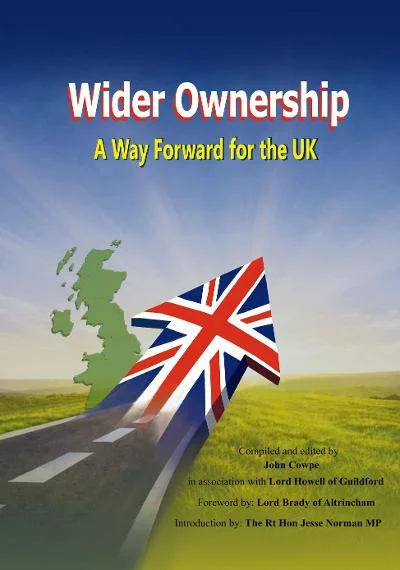
A new book makes the case for wider ownership, whether that be of homes, shares or community assets.
“Wider Ownership: A Way Forward for the UK” has been compiled and edited by former newspaper editor and author John Cowpe, in collaboration with Lord Howell, of Guildford, who as David Howell MP was an early proponent of popular democracy as a Minister in Margaret Thatcher’s Government.
The book makes the case that a fundamental shift towards a truly popular capitalism can help overcome the alienation which many people, especially the young, feel towards our economic system and democracy.
Its ambition is towards a country where many more people can enjoy a stable family life and good sustainable income, together with a feeling that they have a tangible stake in the country. It hopes to help change the often-held view that capitalism inevitably produces an “us and them” society.
In 1920 a Scottish Unionist MP Noel Skelton coined the term “property-owning democracy”, arguing that widening the base of property ownership among the working class would stabilise democracy and counter socialism. The term came to the forefront of political discourse when Prime Minister Anthony Eden used it at the Conservative Party conference in 1946.
However, it was during Margaret Thatcher’s premiership that the concept of extended ownership of both homes and shares became a reality for millions of people. Many council tenants benefited from from the opportunity to buy their own homes and privatisation of State-owned businesses led to a rapid rise in the number of people owning shares.
Sadly, since the 1980s share ownership has declined. People who had acquired shares in privatised industries, especially the utilities, saw the attraction of selling them for a quick profit. Most of these shares were lapped up by financial institutions, such as unit trusts and pension schemes.
Home ownership is in decline too. By 2024 the average age at which people bought their first home rose to 33, two years older than was the case 10 years previously. House prices at the beginning of 2025 were 8.8 times average annual earnings, more than double the rate in the 1970s.
The disillusionment felt by many young people in our society poses a threat not just to the capitalist system but also to our democracy itself. A survey conducted by academics from Royal Holloway, University of London, in the run-up to the 2024 General Election, indicated that only 29 per cent of young people surveyed were satisfied with how democracy works in the UK.
“Wider Ownership: A Way Forward for the UK” argues that the time is ripe to dust down a vision that has been on the back burner for too many years and reintroduce wider ownership to the public as the The Next Big Idea.
It is agreed across the political spectrum that the UK needs to build many more homes. Among the more controversial proposals put forward in the book are the axing of Green Belts and taking away powers of blocking developments from NIMBYs. Other ideas include the abolition of stamp duty, the recruitment of more planning officers to help speed up development and the building of much more social housing. It is also argued there needs to be more recognition by lenders that if a tenant has kept up rent payments over a reasonable period that they can afford to have a mortgage with a similar level of repayments.
With regards to share ownership, more publicity needs to be given to its benefits. In 1986 the “Tell Sid” advertising campaign was highly effective in telling people about the advantages of buying shares in the newly privatised British Gas. Something similar promoted through social media and other digital platforms might work today.
Improved Government tax incentives for businesses to introduce or extend employee share schemes would help to give employees an increased sense of personal responsibility, enabling them to see a direct link between the effort they put into their work and the rewards they receive.
The introduction of compulsory financial management studies in schools would help to reduce the fears that people have about “dipping their toes” into the stock market.
Wider Ownership: A Way Forward for the UK has a Foreword by Lord Brady, of Altrincham (formerly Conservative MP and 1922 Committee Chairman Sir Graham Brady) and an Introduction by the Rt Hon Jesse Norman MP, Shadow Leader of the House of Commons. It contains essays from Lord Howell of Guildford; Dr Kristian Niemietz, Editorial Director and Head of Political Economy of the Institute of Economic Affairs; Josh Smith, Director of Policy at NextGenTories; Andrew Dubock, Communications Manager of community ownership charity Plunkett UK; and John Cowpe.