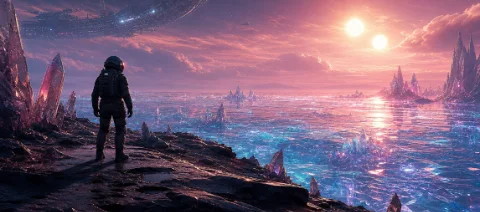
Science fiction begins with a question.
Not always a scientific question, though it often is. Sometimes a social question. Sometimes a philosophical one. Sometimes a question so simple it sounds almost naive until you follow it far enough: what if we could live forever? What if machines became conscious? What if we were not alone? What if we could go back?
The question is the seed. Everything else, the world, the characters, the conflict, the prose, grows from it. And the quality of that everything else is largely determined by how seriously the writer takes the question. How far they are willing to follow it. How honestly they are willing to face what it implies.
Science fiction is the literature of implication. Its central creative act is not inventing a cool technology or an alien civilization, though both of those can be part of it. Its central creative act is asking what follows. If this were true, what would change? What would remain the same? Who would benefit and who would suffer? What would it mean for the ordinary texture of human life, for the relationships between people, for the stories people tell themselves about who they are and what they deserve?
The science fiction that endures is almost always the science fiction that takes its central question seriously enough to follow it into uncomfortable places. The science fiction that does not endure is almost always the science fiction that treats its central concept as decoration, as a backdrop for adventure stories that could have been set anywhere, as a source of spectacle rather than a source of genuine inquiry.
This guide is about taking the question seriously. About developing science fiction concepts with the rigour, the imagination, and the human honesty that the genre at its best demands.
What Makes a Science Fiction Concept Work
Not every science fictional idea is a concept in the sense that matters for fiction.
An idea is a starting point. A concept is a developed premise with genuine story potential. The difference between them is the difference between what if there were faster-than-light travel and a fully developed understanding of what faster-than-light travel would mean for the specific world of a specific story, who controls it, who is excluded from it, what it has done to human relationships across the vast distances it makes navigable, and what the story-level conflict it generates will look like.
Moving from idea to concept requires asking the implications question repeatedly and following each answer to its own implications. What if there were faster-than-light travel? Then interstellar colonisation becomes possible. What follows from that? Power structures extend across star systems. What follows from that? The colonies eventually develop their own interests that conflict with the originating world. What follows from that? The politics of empire and independence play out across a scale of distance and time that makes them stranger and harder than their earthly analogues.
Each step of this implication chain develops the idea into something richer and more specific, something that has genuine story potential because it has genuine conflict built into it. The concept is not the idea. It is the idea fully developed to the point where it generates its own internal logic, its own contradictions, and its own questions that only narrative can answer.
A science fiction concept that works has three qualities. It is specific enough to generate a distinct world. It has internal logic consistent enough to feel real. And it carries human stakes significant enough to matter to a reader who is not inherently interested in the science itself.
That last quality is the one most often underestimated by writers new to the genre. Science fiction concepts are not interesting to readers because they are scientifically ingenious. They are interesting because of what they reveal, explore, or challenge about human experience. The science is the vehicle. The humanity is the destination.
The Relationship Between Concept and Science
Science fiction has a complicated and often misunderstood relationship with actual science.
Hard science fiction, a subgenre that takes scientific accuracy seriously and builds its concepts from extrapolations of real physics, biology, chemistry, and engineering, operates under a genuine obligation to get the science right. In hard science fiction, scientific plausibility is part of the contract with the reader. Violations of that contract are not creative choices. They are failures.
But most science fiction is not hard science fiction, and even hard science fiction requires decisions about which scientific constraints to honour and which to set aside in the interest of story. Faster-than-light travel, as currently understood, violates the laws of physics as they are known. So does much of what makes science fiction science fiction rather than contemporary realistic fiction.
The relevant question for most science fiction writers is not whether the science is accurate but whether the concept is internally consistent. Does the imagined science follow its own rules consistently? Does it have limits that feel logical given the premises the story establishes? Does it interact with the rest of the story world in ways that make sense given how it works?
A science fiction concept that is internally inconsistent breaks the reader's immersion in the same way a fantasy magic system that changes its rules for convenience does. The reader does not need the science to be real. They need it to feel real, which requires consistency, specificity, and a genuine engagement with the implications of the concept rather than a willingness to bend those implications whenever the plot requires it.
The writer does not need to be a scientist to write good science fiction, but they do need to think like one in a specific limited sense. They need to be rigorous about the rules of their invented science, honest about its implications, and willing to follow those implications even when they lead somewhere inconvenient for the story they originally planned to tell.
Extrapolation: The Core Skill of Science Fiction Writing
Extrapolation is the practice of taking a real or imagined development and following its implications forward in time, outward into society, and inward into individual human experience.
It is the core skill of science fiction writing because it is the mechanism that transforms an idea into a world. The writer who can extrapolate rigorously and imaginatively can build a science fiction world that feels genuinely lived-in, one where the central concept has touched everything, where the society, the economy, the politics, the relationships, the language, the art, and the daily routines of ordinary people all bear the marks of living with this technology or in this situation.
The failure mode of weak extrapolation is the science fiction world where only the central concept is different from the present and everything else remains exactly as it is today. This failure is so common it has a name among science fiction readers and critics: the underdeveloped future. A world where people have faster-than-light spaceships but still use cash, still have the same political systems as the early twenty-first century, still think about gender and race and class in the same ways. The central concept has not touched the world around it, which means the world does not feel real.
Rigorous extrapolation asks: if this technology or this change existed, what else would be different? What industries would arise around it? What industries would be destroyed? Who would hold power in a world shaped by it? What would ordinary people worry about? What would they celebrate? What stories would they tell each other? What would children learn in school? What would old people remember from before?
These questions do not all need to be answered on the page. Most of the answers should remain beneath the surface of the narrative, informing it without being stated. But the writer who has asked them produces a world that feels genuinely inhabited. The writer who has not produces a backdrop.
Grounding Concepts in Human Experience
The most technically sophisticated science fiction concept in the world will not produce a story that readers care about unless it is grounded in recognisably human experience.
Human experience, in this context, does not mean human beings specifically. It means the kinds of concerns, desires, fears, and relationships that readers can recognise as analogous to their own. A non-human character who wants to belong, who is afraid of dying, who loves someone and cannot tell them, who is trying to do the right thing in a situation where there is no clearly right option, is a character a human reader can inhabit emotionally even if that character has no biology in common with any creature on Earth.
The grounding of science fiction concepts in human experience is what makes the genre more than thought experiment. The thought experiment asks: what if this were true? The fiction asks: what would it feel like to live in a world where this were true? What would it cost? What would it be like to be the specific person this story is about, in this world, at this moment?
Every science fiction concept, no matter how large or abstract, should eventually resolve into a story about a specific person facing a specific problem in a world shaped by the concept. The concept creates the world. The world creates the conditions. The conditions create the specific pressures on the specific person. And the specific person's response to those pressures is the story.
A story about a world where memory can be erased and rewritten is not really a story about the technology. It is a story about identity, about what we are if not the sum of what we remember, about who has the right to define another person's past, about what it would mean to love someone whose memories of you are not their own. The technology is the premise. The questions about identity and love and power are the story.
This is the movement that distinguishes science fiction as literature from science fiction as entertainment. Both are legitimate. But the movement from concept to human experience is what produces work that endures.
Building the Science Fiction World Around the Concept
The concept is the seed of the world, but the world must grow beyond the concept to feel real.
A science fiction world is not just a setting with one thing changed. It is a fully realised social, political, economic, and cultural reality shaped by the central concept and by the history that preceded it. Building that world requires thinking about the concept's implications across multiple dimensions simultaneously.
The Technological Dimension
How does the central technology work, in broad terms? What are its capabilities and its limits? Who built it and who controls it? What did it replace, and what was lost when those things were replaced? What problems did it solve and what new problems did it create?
Technology in science fiction is rarely neutral. Every technology has winners and losers, beneficiaries and victims, those who are enhanced by it and those who are made obsolete by it. The political and economic implications of technology are as important as the technical ones for creating a believable science fiction world.
The Social Dimension
How has the central concept changed the way people relate to each other? What social structures has it created or destroyed? What new forms of inequality or solidarity has it produced? How has it changed the meaning of family, community, nation, or species?
Social change in response to technological change is one of the most fascinating and least explored areas of science fiction. The stories that engage seriously with how technology reshapes human relationships, rather than treating social structures as a fixed backdrop against which technological adventure plays out, tend to be the most genuinely speculative and the most lasting.
The Economic Dimension
Who benefits economically from the central concept, and who does not? What industries and livelihoods does it create? What does it destroy? What new forms of scarcity or abundance does it introduce, and how do those reshape the distribution of power and resources?
Economics is the dimension most often neglected in science fiction world-building, which is surprising given how thoroughly economic forces shape the real world. A science fiction world with a worked-out economic logic feels significantly more real than one where economic questions are ignored or hand-waved.
The Political Dimension
What political structures has the central concept made possible or necessary? Who holds power in this world and why? What are the central political conflicts, and how do they connect to the concept? What does governance look like in a world shaped by this technology or this change?
The Cultural Dimension
What art do people make in this world? What stories do they tell? What do they celebrate and what do they mourn? How has the central concept shaped language, religion, philosophy, and the stories people tell themselves about who they are?
Culture is often the last dimension writers think about when building a science fiction world, but it is one of the most important for creating the sense of a fully realised civilisation rather than just a political and economic system. The culture of a world is the expression of what its people value, fear, and hope for, and those values, fears, and hopes are always shaped by the material conditions the central concept has created.
The Novum and Cognitive Estrangement
Science fiction scholars, particularly Darko Suvin, have identified two concepts that are useful for understanding what science fiction does and how it works.
The novum, from the Latin for new thing, is the central speculative element of a science fiction work. The technology, the change, the departure from the reader's known reality that defines the science fictional world. Every science fiction story has at least one novum, and the novum is the conceptual engine that drives everything else.
Cognitive estrangement is the experience produced by encountering the novum. The reader's familiar reality is defamiliarised: presented in a form that makes it strange, that makes the reader see it differently, that makes visible things that were previously invisible because they were too familiar to notice.
This is one of the deepest functions of science fiction as a literary form. By creating a world that is different from our own in specific, logically developed ways, it allows readers to see our own world from the outside, to notice its structures and assumptions and contingencies in a way that direct examination often cannot achieve. A story about a world where memory is a commodity forces readers to think about what memory means in their own world, about who controls the narratives of the past and how that control is exercised, in a way that a story set in the present cannot.
The best science fiction uses its concepts not just to create an interesting imaginary world but to cast new light on the real one. This is what science fiction critics mean when they say the genre is fundamentally about the present even when it appears to be about the future. The future, or the alternate reality, or the distant alien world, is a lens for examining the actual human situation with clarity that proximity to it normally prevents.
Avoiding the Most Common Concept Failures
Science fiction concepts fail in predictable ways, and understanding those failure modes helps writers avoid them.
The Single-Change World
The single-change world is the science fiction world where only the central concept is different and everything else remains exactly as it is in the writer's present. People in this world think about their situation exactly as contemporary people would. Social structures are unchanged. Political systems are unchanged. Cultural values are unchanged.
This failure undermines the concept because it prevents the implications from developing. A world where one thing is different but everything else is the same is not a convincing world. It is a thought experiment that has not yet been turned into a story.
The fix is extrapolation. Follow the implications of the central concept through every dimension of the world and let those implications change things.
The Concept Without Stakes
A concept without human stakes is a concept without story potential. No matter how scientifically interesting or technically ingenious the central idea, if it does not create genuine conflict with genuine consequences for characters the reader cares about, it cannot sustain a narrative.
Every concept needs to be translated into the question: what does this mean for a specific person? Not for humanity in the abstract, but for a specific individual whose life is shaped by this reality in a way that creates genuine pressure and genuine possibility.
The Unexplored Implication
Many science fiction stories introduce a concept with genuinely interesting implications and then fail to follow those implications seriously. The concept is present but it has not been thought through. Its effects on the world are selective and convenient rather than consistent and thorough.
This failure tends to produce stories where the concept feels like decoration rather than foundation. The writer introduced the idea because it seemed interesting but did not ask what it would actually mean, so it sits on the surface of the story without transforming the world beneath.
The Concept as Metaphor Only
Using a science fiction concept purely as metaphor, without taking it seriously as a literal reality in the world of the story, produces a particular kind of thinness. The concept is clearly standing in for something else, and everything in the story points to the metaphorical meaning while the literal concept remains underdeveloped.
Metaphor is a legitimate and valuable function of science fiction concepts. But the best science fiction metaphors work because the literal concept is taken seriously on its own terms first. When the literal is real and specific and thoroughly developed, the metaphorical resonance becomes richer because it is grounded in something genuinely imagined rather than just symbolically deployed.
The Concept Across Different Science Fiction Subgenres
Science fiction is not a single genre but a family of related genres, each with its own relationship to the central concept and its own conventions for how concepts are developed and deployed.
Hard Science Fiction
Hard science fiction takes scientific accuracy and plausibility as primary values. Concepts in hard science fiction are typically extrapolations of real or near-real science, developed with genuine technical rigour. The reader's trust in the concept is built partly through demonstrated scientific understanding.
Hard science fiction demands more from the writer in terms of scientific knowledge and more from the reader in terms of willingness to engage with technical detail. When it works, it produces a particular kind of awe: the sense that this imagined future is genuinely possible, that the gap between our world and this one is smaller than comfortable.
Space Opera
Space opera trades scientific rigour for scale and adventure. Concepts in space opera serve primarily as the conditions for conflict and exploration rather than as subjects for rigorous extrapolation. Faster-than-light travel exists because interstellar adventure requires it, not because the physics has been worked out.
This does not mean concepts in space opera are unimportant. But their function is different: they create the stage rather than generating the drama through their implications.
Cyberpunk
Cyberpunk extrapolates the implications of networked information technology, artificial intelligence, and biotechnology into worlds defined by the collision between high technology and social decay. Concepts in cyberpunk tend to focus on the relationship between technology and power, particularly the ways in which technology concentrates power in the hands of corporations and the wealthy while transforming but not liberating everyone else.
The cyberpunk concept is almost always simultaneously a social critique. The technology is not neutral. It is an instrument of existing power structures, and the story is about what happens to people caught in the gap between the technological sublime and the social reality.
Dystopian Fiction
Dystopian science fiction extrapolates present social, political, or technological trends to their logical but horrifying conclusion. The concept in dystopian fiction is typically a social or political system rather than a technology, though technology often enables or enforces the dystopian system.
Dystopian concepts work best when they are genuinely extrapolated from real tendencies rather than invented from whole cloth. The most disturbing dystopias are the ones where the reader can trace the line from the present to the imagined future and see how one could become the other through a series of individually comprehensible steps.
Cli-Fi
Climate fiction, or cli-fi, has emerged as a significant science fiction subgenre in response to the reality of climate change. Its concepts are drawn directly from climate science and its extrapolations are grounded in scientific projections rather than speculative imagination.
The particular challenge of cli-fi is that its central concept is real, not imagined, which changes the relationship between concept and world-building. The writer is not imagining a world shaped by a speculative change. They are imagining a world shaped by a change that is already in progress.
Concept and Character: Making the Abstract Personal
The most important craft challenge in science fiction is making the abstract personal.
A concept, no matter how brilliantly developed, is an abstraction until it is experienced by a specific person in a specific situation with specific stakes. The movement from concept to story is the movement from abstraction to personal experience, and that movement requires a character whose life is genuinely shaped by the concept in ways that create both external conflict and internal pressure.
The character should not exist to illustrate the concept. They should exist as a fully realised person who happens to live in a world shaped by the concept. The concept creates the conditions of their life. Their response to those conditions is what creates the story.
This distinction matters because it determines the nature of the reader's engagement. A character who exists to illustrate a concept is a vehicle for ideas. A character who lives in a world shaped by a concept is a person the reader can inhabit, whose choices feel genuine, whose struggles feel real, whose story matters on its own terms rather than only as a vehicle for the concept's exploration.
The best science fiction characters are people first and science fictional constructs second. Their science fictional situation is the specific form their human situation takes, not a replacement for it.
Research and Science Fiction
Even science fiction that does not aspire to scientific accuracy benefits from research, because research is what allows writers to extrapolate with genuine specificity rather than vague gestures.
Research for science fiction is not primarily about getting the science right, though that is part of it for some subgenres. It is about understanding the actual implications of the concepts you are working with deeply enough to develop them beyond the obvious.
Every science fictional concept has a history of how it has been treated in the genre before. Reading that history is valuable not to avoid repetition, though avoiding unconscious repetition is part of it, but to understand what has already been explored and where genuine new territory might exist. The writer who knows how artificial intelligence has been imagined in science fiction from the mid-twentieth century to the present is better positioned to find an angle on the concept that has not been exhausted than the writer who arrives at the concept fresh and reinvents the wheel.
Research into actual science provides the raw material for extrapolation. The writer does not need a physics degree to write science fiction about the implications of quantum mechanics, but reading enough about quantum mechanics to understand what the genuinely strange implications are, rather than the pop-science versions, gives the extrapolation a specificity and strangeness that more superficial engagement cannot produce.
Research into history, sociology, economics, and political science provides the tools for extrapolating the social and political implications of concepts. How have previous disruptive technologies reshaped societies? What do we know about how power responds to technological change? What historical examples of radical social transformation can inform the imagining of future ones? These are the questions that turn a technically developed concept into a fully realised world.
The Ethical Dimension of Science Fiction Concepts
Science fiction at its most serious is an ethical literature. Its concepts are not just thought experiments about what might be possible. They are explorations of what would be good, what would be dangerous, what choices would face people in worlds shaped by these possibilities, and what those choices would reveal about human nature and human values.
The ethical dimension of a concept is not a lecture appended to the story. It is built into the structure of the world and the choices the characters must make. A story about a world where longevity treatments exist but are expensive does not need to state that this is unjust. It needs to show what life in such a world looks like, who lives it on which terms, what choices it forces, and what it reveals about the values of the society that allows it.
The ethical questions built into science fiction concepts are often the most generative source of conflict and character in the genre. Not because science fiction should be didactic, but because concepts that have genuine ethical implications create genuine dilemmas for characters, and genuine dilemmas are the engine of the most compelling fiction.
A writer who identifies the ethical implications of their central concept before writing has access to the story's deepest source of conflict and meaning. They know what is really at stake, beneath the surface level of the plot, and that knowledge shapes every scene, every character decision, and every structural choice in the work.
Conclusion
Science fiction begins with a question and earns its keep by following that question further than comfort allows.
The concepts that power the best science fiction are not just imaginative. They are rigorous. They are followed to their implications with honesty and consistency. They are grounded in enough real understanding, whether scientific, sociological, historical, or philosophical, to feel genuinely possible rather than merely imaginative. And they are translated, always, into the specific experiences of specific people whose lives they shape and whose choices they make both difficult and meaningful.
Writing science fiction concepts well is a demanding practice. It requires imagination disciplined by rigour. It requires technical engagement in service of human truth. It requires the willingness to ask uncomfortable questions and the craft to make those questions live in the experiences of characters rather than in the abstractions of ideas.
The reward is the particular power that science fiction, at its best, has always had. The power to make the reader see their own world differently. To take the familiar and make it strange. To take the strange and make it familiar. To ask what follows from where we are and to answer that question with enough honesty and enough imagination that the reader cannot quite look at their own present in the same way again.
That is what a science fiction concept, fully realised, can do.
It can change how a reader sees the world they actually live in.
That is not a small thing. It may be the most important thing fiction can do.
Indie Reading Community is where independent authors and the readers who love discovering them come together. Explore books across every genre, read author interviews, and browse craft articles built for writers and readers at indiereadingcommunity.com