I used to think copyright was for lawyers and legacy authors with backlists and movie deals. I was just a writer with a laptop and a half-finished fantasy novel, posting snippets online and dreaming of one day holding a paperback. Legal stuff felt distant and dull. Then a passing comment from a stranger made me realize how exposed I was, how exposed every writer is when they don’t understand the invisible framework that protects their words.
That framework is copyrighted, and it’s not boring. It’s the quiet guardian of your creative life. Whether you’re querying agents, self-publishing, or still drafting at 2 a.m., knowing the copyright basics for fiction authors will save you from heartbreak. It’ll help you make informed choices about sharing your work, using others’ material, and signing contracts. And it’s far simpler than you think.
This guide isn’t legal advice. I’m a writer, not a solicitor, but it’s the collected wisdom I’ve gathered from authors who learned these lessons the hard way, so you don’t have to.
What Copyright Actually Is (And When It Kicks In)
Copyright is the legal right that protects original creative works, including your novel, short story, poem, or even that sprawling fanfiction-adjacent universe you’ve built. In most countries, including the UK, US, and across the EU, copyright exists automatically the moment you fix your work in a tangible form. That means the second you type a sentence into a document, it’s protected.
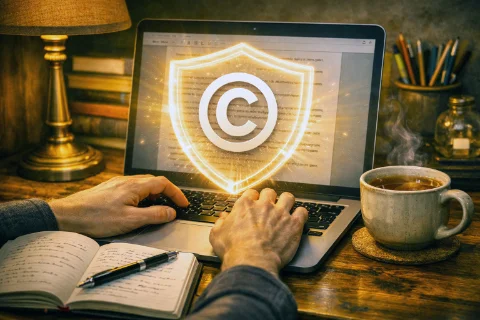
You don’t need to register it (though in some countries, registration offers extra legal benefits, more on that later). You don’t need a © symbol, though adding one is a good visual reminder. You own the copyright simply because you wrote it.
This automatic protection gives you exclusive rights to reproduce the work, distribute it, create adaptations or sequels, and publicly perform or display it. Anyone who wants to use your work in those ways needs your permission. That’s the foundation of every publishing contract, every translation deal, every audiobook narration.
Understanding this is the first step in protecting your work as a writer. You already own something valuable. The rest is about knowing how to manage that ownership.
The “Poor Man’s Copyright” Myth (And Why It’s Useless)
I once heard a writer advise another to mail themselves a copy of their manuscript and never open the envelope, something about the postmark proving the date of creation. This is the “poor man’s copyright,” and it’s a myth. It has no legal standing in most jurisdictions, and no court treats a sealed envelope as ironclad proof of anything. Please don’t waste your postage.
Instead, the best proof of creation is the digital trail you already leave: dated files, emails to beta readers, cloud backups with timestamps. Your computer records when a document was first created and last modified. That metadata is far more credible than a dusty envelope.
If you’re particularly anxious, you can register your work with an official copyright office. In the US, the Copyright Office offers registration for a small fee, and it’s a prerequisite if you ever need to sue for infringement. In the UK, there’s no formal registration system, but organizations like the Intellectual Property Office provide guidance, and you can lodge copies with services like the UK Copyright Service for evidence. These are the copyright basics for writers that actually matter.
The Danger of “Just Sharing” Your Work Online
Remember the near-miss I mentioned at the start? Here’s what happened. I’d posted three chapters of my novel on a public writing forum for feedback. The writing community was warm and helpful, and I got great notes. But I didn’t realize that some publishers and agents consider work published online, even on a password-protected forum, as having used up your “first publication rights.” Those rights are the ones publishers usually want exclusively. If your story is already out there, they may pass.
The line is blurry. A small, private critique group is generally fine. Posting a full manuscript on a public Wattpad-style platform is more likely to raise flags. The principle is this: think before you share broadly. If you might pursue traditional publication, keep your manuscript’s first public appearance under your control.
For indie authors, publishing your own work is the goal, so this is less about losing rights and more about intentionality. Put your work into the world on your terms, with your copyright protected and your distribution choices clear.
Can You Use Song Lyrics, Quotes, or Real Brands in Your Fiction?
This is the question I get asked most often, and the answer is almost always: tread very carefully.
Song lyrics are a minefield. Music rights are aggressively enforced, and even a single line can require permission (and often payment) from the rights holder. That’s why so many traditionally published novels include a line of asterisks and a note like “sung to the tune of…” instead of the actual lyrics. It’s safer to invent a fictional song or allude to the rhythm than to quote directly.
Short quotes from literary works may fall under “fair use” or “fair dealing” (depending on your country), but these doctrines are defenses, not rights. They’re argued in court, not before. The safest approach for fiction authors is to avoid reproducing substantial passages from copyrighted works. If you must reference something, paraphrase or be brief.
Brand names are trickier still. Mentioning a character drinking a Coke is generally fine, but if you depict that brand as poisoning people, you could face defamation or trademark issues. A trademark is separate from copyright and protects brand identities. For fiction, a light touch and a general rule of not making real brands central to your plot will save you headaches.
These are important copyright basics for fiction authors because a single misstep can lead to a takedown notice, a demand letter, or an expensive edit after publication.
Understanding Fair Use and Fair Dealing
Fair use (US) and fair dealing (UK and Commonwealth) are exceptions to copyright that allow limited use of protected material without permission for purposes like criticism, commentary, education, and parody. In fiction, these exceptions are narrow and unpredictable.
If you’re quoting a few lines of a famous poem as an epigraph, you might argue fair dealing, but epigraph permissions are routinely sought by traditional publishers precisely because the legal ground is shaky. If you’re writing a satirical novel that riffs on a well-known work, that’s more likely protected but still not guaranteed.
My advice, echoed by every literary lawyer I’ve spoken to, is simple: when in doubt, don’t use it without permission. Write something original that serves the same purpose. Your imagination is a safer resource than someone else’s intellectual property.
Copyright Registration and Why It Might Matter
If you’re self-publishing in the US, registering your copyright is a small step with big benefits. Registration is required before you can file an infringement lawsuit, and if you register within three months of publication (or before an infringement occurs), you become eligible for statutory damages and attorney’s fees remedies that can make enforcement practical.
In the UK and many other countries, registration isn’t necessary, but keeping clear records is wise. Date your drafts. Keep emails with beta readers. Use a copyright notice on your published book. That notice is the small © symbol, the year of first publication, and your name. It doesn’t create the right, but it reminds the world that the right exists.
For indie authors navigating copyright basics for fiction authors, this small step signals professionalism and protects your long-term interests.
Contracts, Rights Grabs, and What to Watch For
One day, someone might offer you a contract with a publisher, a platform, or an anthology editor. When that day comes, remember this: you own your copyright until you sign it away. Read every clause. Understand what rights you’re granting and for how long.
Some contracts ask for “all rights in perpetuity throughout the universe.” That means forever, everywhere, in any format that exists or might be invented. That’s a massive surrender, and unless the compensation matches, it’s rarely in your favour. Look for limited grants: print rights, ebook rights, a specific territory, a defined term. The rights you keep are often the ones that generate future income.
If a contract confuses you, get help. The Society of Authors, the Alliance of Independent Authors, and similar organisations offer contract review services. Spending a little money upfront on a consultation can save you from losing rights you’ll later wish you’d kept.
The Indie Reading Community: Where Legal Literacy Is Just Another Form of Craft
Here in the Indie Reading Community, we talk about plots and characters, but we also talk about the practical stuff that keeps authors safe. Members share experiences with publishing platforms, flag contract red flags, and remind each other that protecting your work isn’t paranoid, it’s professional.
I’ve learned more about copyright from fellow community members than from any dry textbook. A published author once walked me through her registration process over a video call. Another shared a template for a rights-reversion letter. That kind of generous, practical support is woven into our community’s fabric, and it’s one of the reasons I keep showing up.
If you’ve ever felt like the legal side of writing is a locked room, know that there are people who will help you turn the key. You’re not alone in this.
Your Stories Deserve to Be Protected
You didn’t pour years of your life into a novel just to lose it to a misunderstanding. Copyright basics for fiction authors aren’t about building walls; they’re about building a safe container for your art. They let you share boldly, publish confidently, and sleep soundly knowing your words are legally yours.
So take a moment today. Put a copyright notice on your manuscript. Check what you’ve posted publicly. Start a folder with your draft dates and beta reader correspondence. Consider registration if it applies to your situation. These small actions add up to a powerful shield.
Now I’d love to hear from you: What’s the most surprising thing you’ve learned about copyright since you started writing? Have you ever had a close call, or do you have a question that’s been nagging at you? Drop it in the comments. Let’s demystify this together, one worried writer at a time.