One of the first, most critical decisions an author must face is how to bring their work to the world. Do you pursue a traditional publishing contract, chasing prestige and a distribution network, or do you take the reins as an independent publisher, seizing control over your creative work and its financial potential?
For generations, "being published" meant one thing: a deal with a traditional house. Today, the landscape is radically different. Both paths offer vastly different financial models, which fundamentally boils down to a comparison of author royalties and profit shares. If you’ve ever wondered how much an author earns from Amazon KDP, Apple Books, Kindle Unlimited (KU), or even a potential movie deal, this guide provides a comprehensive, platform-by-platform analysis.
Decoding the Models: Two Paths to Getting Paid
Before diving into the platform data, we must understand the core philosophies of the two primary author income models.
1. Traditional Publishing: The Advance-and-Wait Model
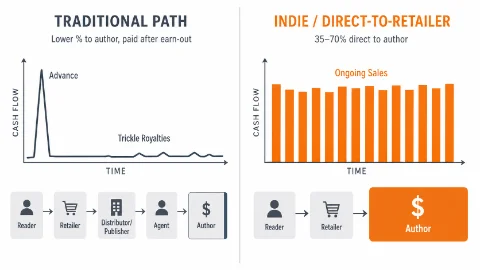
In traditional publishing, a publishing house purchases the right to license your intellectual property for specific territories and formats (e.g., North American hardback, Spanish audio). The primary allure is the upfront advance. This is a sum paid before the book is published, based on the publisher’s forecast of sales. It is, essentially, a non-refundable loan against your future earnings.
You do not "earn" traditional author royalties until your total sales "earn out" the entire advance amount. This means if you received a $10,000 advance and your royalty per copy is $1, you need to sell 10,000 copies before seeing your next dime.
Once you have earned out, the publishing house manages all production, editing, cover art, and physical distribution. In exchange for this, they keep the majority of the profit. Your ongoing income is a smaller, tiered percentage of the book’s sale price, paid periodically (e.g., biannually).
2. Independent Publishing: The High-Margin, High-Control Model
Indie publishing, often enabled by powerful online publishing tools and direct-to-retailer platforms, is a "retailer-direct" model. As the "indie publisher" yourself, you own and manage all rights and responsibilities. You cover the upfront costs for editing and cover design.
The benefit is a significantly higher indie profit share. For every sale, you pay a distribution fee (usually 30%) to the retailer, and the remaining 70% is yours. Payouts are predictable and fast, often occurring 60 days after the end of the month in which the sale was made.
Author Royalties Breakdown: Traditional vs. Indie
Let's break down the typical royalty structures by format and platform.
| Format / Platform | Traditional Publishing Royalty (Typical) | Indie Publishing Profit Share (Typical) | Key Factors affecting your earnings |
|---|---|---|---|
| Hardcover Print | 10–15% (of Retail Price) | 55–60% (of List Price minus Print Cost) | Traditional rates are tiered: 10% on first 5,000, 12.5% on next, 15% thereafter. Indies use Print on Demand (POD), which can mean lower total dollars, but higher percentages. |
| Paperback Print | 5–8% (of Retail Price) | 60% (of List Price minus Print Cost) | Print cost varies by page count, color, and size. Traditional publishers handle large runs, indies handle POD. |
| Audiobook | 10–25% (of Net Receipts) | 40% (Exclusive to Audible), ~25% (Non-Exclusive) | Distribution platforms (ACX, Findaway Voices) significantly influence audio payouts. Often involves revenue sharing. |
| Ebook | 25% (of Net Publisher Receipts, roughly 17.5% of retail) | 35% or 70% (of Retail Price) | Traditional rates are surprisingly low, given the negligible production cost. Indie rates are highly competitive. |
Platform-Specific Payouts: How Indies Earn Across the Web
The core of an indie author's business plan involves navigating the financial systems of the major online retailers. Here is a detailed look at how much you can expect to earn on each platform.
Amazon KDP (Kindle Direct Publishing)
Amazon is the undeniable giant of the book world, commanding over 80% of the US and UK ebook market. For many indie authors, KDP earnings are the main source of income.
- Ebook: KDP offers two royalty options.
- 70% Royalty: For books priced between $2.99 and $9.99. This rate is slightly reduced by small delivery fees (e.g., $0.15/MB) for large files.
- 35% Royalty: For books priced under $2.99 or over $9.99, and in certain regions.
- Paperback: Authors earn 60% of the list price, minus the variable print cost.
- Expanded Distribution: This allows B&N, libraries, and bookstores to find your book. You earn a 40% royalty, minus printing costs.
Apple Books
Apple Books is a powerful "wide" (non-Amazon) retailer with a premium reader base.
- Royalties: Apple pays a flat 70% royalty on all ebooks, regardless of price. There are no delivery fees or minimal prices. This simplicity and consistency is highly valued by wide-distribution authors.
Barnes & Noble Press
B&N offers direct access to Nook users and potentially physical shelves.
- Ebook: Authors receive a 70% royalty for all ebooks priced at $0.99 and higher.
- Print: Authors earn a royalty of 55% of the list price, minus the print cost.
Google Play Books
Google Play is unique as it places your book directly in the massive Google search ecosystem.
- Royalties: Google Play pays a robust 70% royalty at any price point, with no exclusivity requirement. They often allow authors to control their pricing more flexibly than Amazon.
Kobo Writing Life
Kobo is particularly strong in international markets like Canada, Australia, and parts of Europe and Asia.
- Royalties: Kobo pays a standard royalty based on an Independent Publisher Program contract, typically around 70% for priced ebooks above $1.99. Payment thresholds apply.
Other Essential Income Streams
Author income is rarely restricted to just book sales. Successful authors build diverse portfolios.
Kindle Unlimited (KU) / KDP Select Payout
KU is Amazon's subscription "all you can read" program. If you enroll your book in KDP Select (which requires 90-day exclusivity for the ebook format), it becomes available in KU.
- Payout: Authors are not paid per sale in KU. Instead, they are paid based on pages read. You receive a share of a KDP Select Global Fund—which can be $50M+ monthly—for every page read by a customer for the first time. The payout rate fluctuated, typically hovering around $0.004 to $0.005 per page read.
- The Decision: KDP Select is powerful for debut authors who can "unlock" bonuses, but it locks you into one ecosystem. Wide authors prefer the stability of constant sales across all platforms.
Book Movie and TV Rights
The potential for a book to be adapted for film or television is a dream for many.
- Payout: The income from a movie rights deal is highly variable and usually multi-phased.
- Option Fee: A producer pays a smaller sum (e.g., a few thousand dollars) for the exclusive option to make a film within a set period. If they don't produce, the rights revert to you, and you keep the fee.
- Purchase Price: If the project is greenlit, the purchase price can be substantial, often expressed as a percentage of the production budget (typically 2-3% of the budget), with caps and tiers. For a $50M film, this could be $1M. Authors also negotiate backend "points" or profits once the film breaks even.
Which Path Leads to Profit? A Final Verdict
The ideal publishing model is not universal; it depends on your goals, your genre, and your ability to treat your writing as a business.
The Case for Traditional Publishing:
- You need an advance to live.
- You want institutional validation.
- Your genre (e.g., some non-fiction, literary fiction) relies heavily on physical store placement.
- You cannot or do not want to manage editing, cover art, and marketing.
The Case for Independent Publishing:
- You want complete creative control.
- You write commercial, fast-paced genres (e.g., Romance, Thriller, Fantasy, Sci-Fi) that can leverage backlist momentum.
- You are prepared to reinvest in your business (for professional tools, cover art, ads).
- You prioritize immediate income and higher long-term profit margins over an upfront, repayable sum.
Whichever path you choose, understanding the financial landscape is your most powerful tool. Author earnings are no longer an industry secret; they are a strategic calculation.