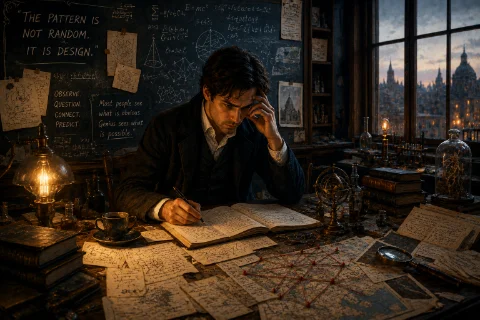
Introduction: The Myth That Stops Writers
One piece of writing advice has frightened authors for decades.
"Write what you know."
Then an uncomfortable question appears.
What if your story needs a brilliant scientist?
A master detective?
A legendary strategist?
A mathematical prodigy?
An inventor centuries ahead of everyone else?
A philosopher whose ideas reshape a civilization?
Many writers freeze.
"I am not smart enough to write someone smarter than me."
Fortunately, fiction does not require the writer to become the character.
A mystery writer does not need to become a murderer.
A fantasy author does not need to become a dragon.
Likewise, a writer does not need to become a genius.
They need to understand how genius appears from the outside and how it feels from the inside.
The goal is not to know everything.
The goal is to create the illusion of extraordinary thinking.
Intelligence Is Not the Same as Knowledge
One of the biggest mistakes writers make is confusing intelligence with information.
A character who memorizes thousands of facts may seem educated.
They do not automatically seem brilliant.
Readers recognize genius through thinking.
Not through trivia.
A genius notices unusual patterns.
Makes unexpected connections.
Asks surprising questions.
Sees possibilities others ignore.
Knowledge fills a library.
Intelligence rearranges it.
Let the Reader Arrive After the Character
One of the simplest tricks is timing.
Allow the genius character to understand something before everyone else.
The reader may not understand immediately.
Later, when events unfold, readers realize the character already saw the answer.
For example:
Everyone debates why the bridge collapsed.
One character quietly asks,
"Who approved the repairs?"
At first the question seems unrelated.
Three chapters later, readers discover the repairs were intentionally sabotaged.
The genius did not magically know the answer.
They asked the right question first.
That feels intelligent.
Intelligence Is Pattern Recognition
Real genius often looks less like lightning and more like noticing.
A detective notices that every witness avoids mentioning the same detail.
A physicist recognizes the same mathematical structure appearing in two unrelated problems.
A musician hears a missing note.
An engineer notices that every machine fails in exactly the same way.
A psychologist recognizes repeated emotional behaviors.
Extraordinary intelligence often begins with extraordinary observation.
Teach your character to notice.
The conclusions become believable.
Give Them Better Questions
Average characters often search for answers.
Brilliant characters search for better questions.
Instead of asking:
"Who stole the painting?"
They ask:
"Who benefits if everyone believes the painting was stolen?"
The second question changes the investigation.
Genius often comes from changing the frame rather than solving the existing puzzle.
Readers admire characters who redefine problems.
Hide the Thinking Until Later
Many writers explain every step of a genius character's reasoning.
Ironically, this often makes them seem less intelligent.
Real brilliance sometimes feels mysterious because we only understand it after the result appears.
Show the observation.
Hide the connection.
Reveal the reasoning later.
This creates admiration rather than confusion.
The reader experiences discovery alongside the other characters.
Intelligence Creates Simplicity
Many beginning writers assume genius sounds complicated.
In reality, truly intelligent people often simplify difficult ideas.
A genius character does not necessarily use longer words.
They use clearer ones.
Instead of overwhelming everyone with technical language, they find elegant explanations.
Readers associate clarity with mastery.
Confusion rarely feels intelligent.
The Illusion of Preparation
One powerful technique is allowing the genius character to solve problems quickly because they prepared long before the problem appeared.
Readers only see the final move.
Not the years of observation behind it.
An architect instantly identifies a structural weakness.
Not because of magic.
Because they have studied buildings for decades.
The speed impresses readers.
The explanation makes it believable.
Intelligence Is Prediction
Smart characters often anticipate rather than react.
They notice where events are heading.
Not perfectly.
Not supernaturally.
Just earlier.
A military strategist notices supply shortages before the battle.
A lawyer predicts the next legal argument.
A doctor recognizes symptoms before the disease becomes obvious.
Prediction creates the appearance of intelligence because readers experience the future arriving exactly as the character expected.
Genius Makes Mistakes Too
One mistake writers make is creating infallible geniuses.
Real intelligence does not eliminate failure.
It changes the type of failure.
A genius may underestimate emotion.
Ignore relationships.
Miss simple practical details.
Become overconfident.
Trust logic where empathy is required.
Forget ordinary needs.
Weakness creates credibility.
Perfect characters rarely feel brilliant.
They feel artificial.
Intelligence Has Blind Spots
Every expertise creates blindness.
A mathematician may struggle with people.
A diplomat may misunderstand engineering.
A detective may fail as a parent.
An inventor may overlook emotional consequences.
The more specialized the intelligence, the more believable the limitations become.
Readers trust characters who have strengths and boundaries.
Let Other Characters Notice
Sometimes the easiest way to demonstrate intelligence is through other people.
A room becomes quiet when one character speaks.
Experts pause to consider an observation.
Competitors become nervous.
Teachers stop correcting them.
Colleagues change their plans after hearing one sentence.
The reactions create credibility.
Readers think,
"If everyone respects this person's thinking, perhaps I should too."
Use Compression
Highly intelligent people often compress complicated ideas into small observations.
Imagine a political strategist saying:
"The election isn't about taxes."
Everyone argues.
Later the strategist adds:
"It's about fear."
Three words reorganize the entire discussion.
The genius does not speak more.
They say less with greater precision.
Give Them an Unusual Perspective
Many fictional geniuses are memorable because they approach ordinary situations differently.
Everyone sees a crowded train.
The architect sees load distribution.
The biologist sees patterns of movement.
The historian sees echoes of past migrations.
The economist sees resource flow.
The artist sees color relationships.
The psychologist sees invisible anxieties.
Perspective creates originality.
Readers associate originality with intelligence.
The Cost of Seeing Too Much
High intelligence often carries emotional consequences.
Seeing connections others miss can become exhausting.
A genius may struggle with boredom.
Loneliness.
Impatience.
Isolation.
Overthinking.
Sleeplessness.
Decision fatigue.
The burden makes the brilliance feel human.
Readers remember vulnerability more than perfection.
Research Deeply, Explain Simply
If your genius belongs to a specialized field, research until you understand the foundations.
You do not need to become an expert.
You need enough understanding to write with confidence.
Then simplify.
Readers enjoy feeling intelligent.
They rarely enjoy feeling excluded.
The best genius characters invite readers into discovery rather than overwhelming them with technical language.
How to Write Believable Genius Characters
1. Focus on Thinking, Not Facts
Show reasoning rather than encyclopedic knowledge.
2. Let Them Notice Small Details
Observation often appears more intelligent than explanation.
3. Give Them Better Questions
A great question can feel smarter than a clever answer.
4. Reveal Their Logic Gradually
Allow readers to catch up.
5. Create Human Weaknesses
Brilliance without flaws rarely feels believable.
6. Show Preparation
Fast solutions usually come from slow learning.
7. Respect the Reader
The reader should admire the character, not feel lectured by them.
Example: Smart vs Genius
Smart version:
"Emma solved the puzzle quickly."
Genius version:
"Emma ignored the puzzle entirely. She spent five minutes studying the person who had built it."
The second version feels different.
She questions assumptions.
She changes the problem.
Readers sense an unusual mind at work.
Common Mistakes
Confusing Genius With Constant Correctness
Intelligent people still make mistakes.
Using Endless Technical Jargon
Complex vocabulary rarely creates believable intelligence.
Explaining Every Thought
Mystery strengthens admiration.
Making Everyone Else Foolish
A genius shines brighter when surrounded by capable people.
Creating Superhuman Knowledge
Extraordinary intelligence should still respect human limits.
Why Readers Love Brilliant Characters
Readers enjoy genius characters because they expand possibility.
They show what human thinking can become.
Not through magic.
Not through impossible perfection.
But through curiosity.
Observation.
Preparation.
Creativity.
Discipline.
The best genius characters inspire readers to think differently.
Not merely admire intelligence.
But practice it.
Genius Is a Way of Seeing
Writing a brilliant character does not require becoming the smartest person in the room.
It requires understanding what intelligence looks like in motion.
It notices before others notice.
It asks before others question.
It connects before others compare.
It predicts before others react.
Above all, genius is not measured by how many answers a character has.
It is measured by how differently they see the world.
Because readers rarely remember the character who knew the most facts.
They remember the one who looked at an ordinary problem and saw a solution that had been invisible to everyone else all along.