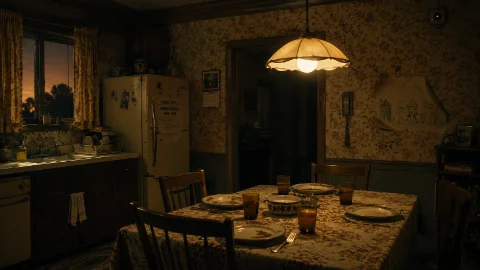
We tend to picture dystopia as spectacle. Boots marching in formation, screens looming over public squares, a hero raising a fist against a tower of glass and steel. It makes for a striking cover. It also lets the reader off the hook, because that kind of oppression is easy to spot and easy to hate.
The dystopias that truly disturb us work differently. They do not kick down the front door. They knock politely, get invited in, and quietly rearrange the furniture until the family no longer remembers how the room used to look. The horror lives in the ordinary. A new rule at dinner. A form that used to be optional. A word you are no longer supposed to say at home, and the odd fact that no one can quite remember when that started.
This is dystopia through domestic erosion, and it is one of the most powerful tools an indie author can learn. Here is how to write it.
Why the Home Is the Most Frightening Battleground
The home is where we let our guard down. It is supposed to be the one place that belongs to us, safe from the pressures of the outside world. That is exactly why it is so devastating when the world seeps in.
When you set your dystopia in the public square, the reader watches a stranger suffer. When you set it at the breakfast table, the reader recognizes their own life. The mug they drink from. The small negotiations of a marriage. The way a parent worries about a child. By locating oppression inside these familiar rhythms, you close the distance between the reader and the nightmare. It stops being a story about them and becomes a story about us.
Domestic erosion also solves a common problem in dystopian writing. Big, loud regimes require big, loud explanations, and those explanations often stall the story. A dystopia built in the home needs no lecture. The reader simply watches a family adapt, one small compromise at a time, and understands the cost without ever being told.
The Craft of the Slow Poison
The key word is slow. Domestic dystopia is not built on a single dramatic event. It is built on accumulation, on a hundred tiny concessions that each seem reasonable on their own. Your job as the author is to make each step feel small while making the sum feel monstrous.
Start from something the reader trusts
Begin with a home that feels genuinely warm and recognizable. A functioning family, a comfortable routine, small private jokes. The reader needs to love this ordinary life before you poison it. If the household is already grim on page one, there is nowhere to fall. The erosion only works if there was something whole to begin with.
Introduce change as improvement
The most chilling control never presents itself as control. It presents itself as safety, convenience, or good sense. A monitoring device is installed because the neighborhood is not what it used to be. A ration card is framed as fairness. A curfew is described as a kindness for tired workers. When the characters welcome each new restriction, or at least shrug at it, the reader feels the ground shift beneath their feet.
Track the vanishing of small freedoms
Freedom in a domestic dystopia does not disappear in a single decree. It disappears in the details. The record collection that quietly gets smaller. The recipe that can no longer be made because an ingredient is gone from the shelves and no one asks why. The photograph taken down and never rehung. Let the reader notice these absences before the characters do. That gap, between what the reader sees and what the family has stopped seeing, is where the dread lives.
Use language as a quiet weapon
Watch how the family talks. Early on they might call something by its honest name. Later they use the softer, official term without thinking. When your characters start speaking the language of the regime inside their own kitchen, you have shown the reader that the erosion has reached the mind, not just the household. Nothing signals a lost war more clearly than a family that no longer has the words to describe what they lost.
Making the Adaptation the Real Horror
Here is the heart of it. In a domestic dystopia, the frightening thing is not the regime. It is how easily good people adjust to it.
Give your characters real, understandable reasons to comply. Fear for a child. Exhaustion. The simple human wish to keep the peace at dinner. When compliance comes from love and tiredness rather than cowardice, the reader cannot look down on the family. They can only recognize themselves and wonder how many small compromises they would make to protect the people they love.
The most powerful moment in this kind of story is often the smallest. A character hesitates before saying grace the new approved way, then says it anyway. A mother folds a forbidden book into the bottom of a drawer and decides not to fight about it tonight. These quiet surrenders land harder than any battle scene, because the reader feels the exact weight of the choice.
Balancing Dread With Human Warmth
A domestic dystopia can easily become suffocating, a gray march of misery that readers put down out of sheer fatigue. To keep them turning pages, protect the warmth.
Let the family love each other. Let there be humor at the table, tenderness at bedtime, stubborn little acts of joy. The warmth is not a break from the horror. It is what makes the horror matter. Every laugh becomes precious because the reader knows what is being lost. A dystopia without love to threaten is just a list of bad rules. A dystopia full of love is a heartbreak in slow motion.
A Simple Exercise to Try Today
Take an ordinary domestic scene from your work in progress, something as plain as a family eating dinner. Now introduce one small new rule that everyone at the table quietly obeys without comment. Do not explain it. Do not have anyone object. Just let the meal continue as if nothing has changed. Read it back and notice how much colder the room feels with that single unspoken adjustment. That chill is the whole genre in miniature, and you can build an entire novel out of it, one dinner at a time.
Readers have seen the towering regime and the rebel hero more times than they can count. What still unsettles them is the suspicion that a dystopia would not feel like a dystopia from the inside. That it would feel like ordinary life, adjusted slightly, then adjusted again, until one day the family looks up and no longer recognizes their own home.
Write that. Build your oppression not from spectacle but from the slow poison of normalcy, and you will give your readers something they cannot shake. Not a distant warning about some other world, but the quiet, creeping fear that it could happen at their own kitchen table.