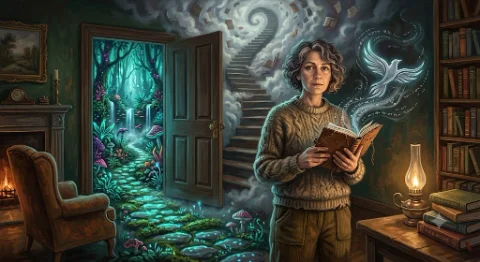
Mainstream fiction often relies on a strict architectural blueprint. The house is built exactly as expected. The front door opens reliably into a brightly lit living room, and the wooden stairs lead precisely to the bedrooms above. It is comfortable, but it is entirely predictable. Literary fiction that defies these tropes must behave differently. It must be a house where a closet door might open into a dense, bioluminescent forest, and the staircases might curl infinitely into the clouds.
When you sit down to draft a novel, the goal is rarely to create something that fits neatly on a crowded, algorithm-driven digital shelf. You are likely striving for stories with real depth and lasting resonance. You are looking to explore the beautiful, murky grey areas where genuine human nature actually resides. Escaping the gravitational pull of mainstream tropes requires a deliberate leap into the strange and the authentic.
Navigating the Grey Areas of the Human Psyche
Commercial tropes demand clear moral boundaries. The villains wear dark colors in their souls, and the heroes are polished until they shine. Defying this means allowing your characters to exist entirely within the fog of moral ambiguity.
Your protagonist should not always know what they want. Their desires should contradict each other, blooming like strange, mismatched flowers in the same garden. Perhaps they perform an act of profound cruelty out of deep, misguided love. Perhaps they save a life purely by apathetic accident. When you write characters who live authentically in these grey areas, they stop being archetypes and become living, breathing, unpredictable entities. The reader cannot guess their next move because the characters themselves do not know it.
Crafting Narratives That Feel Passed Down
The most profound literary fiction often abandons the rigid, formulaic beat sheets that dominate modern publishing. Instead, it aspires to a quality that feels organic, wild, and ancient.
You want to cultivate a narrative voice that feels passed down rather than meticulously written. Mainstream tropes feel manufactured in a brightly lit factory. Defiant literary fiction should feel like a secret whispered over a dying fire. It should carry the weight of folklore. To achieve this, loosen your grip on the strict, linear timeline. Allow your narrative to meander through memory, dreamscapes, and subjective realities. Let the history of the world you are building bleed naturally into the present moment, coloring the prose with a sense of inherited wisdom.
The Surreal Art of Leaving Things Unsaid
Mainstream tropes abhor a vacuum. They demand that every mystery is solved, every thematic question is explicitly answered, and every character arc is tied neatly with a ribbon.
To break this mold, you must become comfortable with the surreal power of the unresolved. Leave echoing spaces in your manuscript. Do not explain the strange, recurring symbol of the silver bird that haunts your protagonist's waking hours. Let it simply exist, casting a long, bizarre shadow over the text. Trust your readers to navigate the dark waters of your story without a map. When you refuse to spoon-feed the answers, the story lingers in the reader's mind long after the final page, transforming from a simple book into a haunting, unforgettable experience.