Epic fantasy is one of the most recognizable and beloved forms of fantasy fiction. It is the genre of grand adventures, legendary heroes, ancient magic, forgotten kingdoms, mythical creatures, and battles that determine the fate of entire worlds.
Unlike fantasy stories that stay close to everyday life, epic fantasy invites readers into completely imagined worlds where every mountain, river, kingdom, culture, religion, and magical tradition may have its own history.
The scale is what makes epic fantasy special. The story is rarely about solving a small personal problem. Instead, the characters often carry the future of nations, civilizations, or even the entire world on their shoulders.
Epic fantasy asks readers to step into a world far larger than their own and experience a journey unlike anything possible in reality.
What Is Epic Fantasy?
Epic fantasy is a type of fantasy fiction set in a fully imagined world where heroes face enormous challenges that affect kingdoms, civilizations, or the fate of the world.
In simple words, epic fantasy tells large stories with high stakes in magical worlds.
The setting usually includes original maps, unique cultures, powerful rulers, magical systems, mythical creatures, ancient histories, and conflicts between great forces.
The journey often begins with one character, but it gradually expands into something much larger.
Main Features of Epic Fantasy
Epic fantasy has several defining characteristics.
A Fully Imagined World
Perhaps the most important feature of epic fantasy is worldbuilding.
The author creates an entirely new world with its own geography, languages, history, politics, religions, cultures, races, creatures, and traditions.
Readers do not simply visit the world. They become immersed in it.
Mountains have legends. Forests hide ancient secrets. Oceans divide powerful kingdoms. Cities have centuries of history. Every place feels connected to a larger world.
High Stakes
Epic fantasy usually involves enormous consequences.
The story may determine:
The survival of a kingdom
The future of an empire
The balance between good and evil
The return of ancient darkness
The fate of magic itself
The future of an entire world
The conflict affects far more than the main character.
A Hero's Journey
Many epic fantasy stories follow a hero who begins as an ordinary person before growing into someone capable of changing history.
The hero may be:
A farmer
A young apprentice
A forgotten prince
An orphan
A reluctant warrior
A village girl
A scholar
A thief
A stable hand
Their journey often includes difficult choices, personal sacrifice, powerful allies, dangerous enemies, and steady growth.
Ancient Magic
Magic in epic fantasy often feels old, mysterious, and deeply connected to the history of the world.
Magic may come from:
Ancient artifacts
Lost civilizations
Sacred bloodlines
Dragons
Forgotten gods
Elemental forces
Powerful spells
Mystical creatures
Magic usually follows its own rules and often carries serious consequences.
Large Cast of Characters
Epic fantasy often includes many important characters.
Readers may follow:
Kings and queens
Warriors
Wizards
Healers
Assassins
Generals
Prophets
Dragons
Ancient beings
Rebels
Merchants
Common villagers
Each character contributes to the larger story, making the world feel rich and alive.
Multiple Storylines
Many epic fantasy novels follow several characters in different parts of the world.
One group may travel across dangerous mountains while another prepares for war. A third character may uncover an ancient prophecy, while another searches for a magical artifact.
Eventually, these separate stories often connect in surprising ways.
Epic Fantasy vs High Fantasy
The terms epic fantasy and high fantasy are often used interchangeably, but they are not always identical.
High fantasy generally refers to fantasy set in a completely invented world.
Epic fantasy refers to the scale of the story.
Most epic fantasy is also high fantasy because it takes place in an imaginary world with major worldbuilding.
However, a high fantasy story can be smaller and more personal, while an epic fantasy story usually involves world-changing events.
Epic Fantasy vs Urban Fantasy
Epic fantasy and urban fantasy are very different.
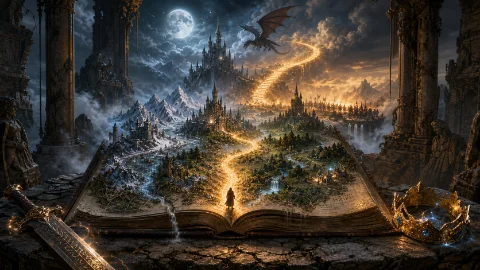
Epic fantasy usually takes place in a completely invented world filled with kingdoms, castles, dragons, ancient forests, magical races, and large scale wars.
Urban fantasy usually takes place in a modern city where magic exists alongside everyday life.
An ancient castle surrounded by dragons belongs to epic fantasy.
A wizard solving magical crimes in modern New York belongs to urban fantasy.
Epic Fantasy vs Sword and Sorcery
Sword and sorcery stories usually focus on personal adventures, treasure hunts, dangerous missions, or individual heroes.
Epic fantasy focuses on much larger conflicts involving kingdoms, civilizations, or the entire world.
A mercenary searching for a magical sword is often sword and sorcery.
A group of heroes trying to prevent the destruction of the world is usually epic fantasy.
Common Themes in Epic Fantasy
Epic fantasy explores timeless themes that resonate across cultures.
Some common themes include:
Good versus evil
Courage
Sacrifice
Destiny
Leadership
Hope
Friendship
Honor
Power and corruption
Faith
Legacy
Freedom
Redemption
Unity
Survival
These themes give epic fantasy emotional depth beyond its magical settings.
Why Do Readers Love Epic Fantasy?
Readers enjoy epic fantasy because it offers complete immersion.
The worlds feel enormous.
The history stretches back thousands of years.
The characters grow through incredible challenges.
The victories feel earned because the dangers are immense.
Readers often spend hundreds or even thousands of pages living inside these fictional worlds, making them feel almost real.
Epic fantasy also offers hope. Even when darkness seems overwhelming, the story often reminds readers that courage, friendship, and determination can overcome impossible odds.
Is Epic Fantasy Always Serious?
Not necessarily.
While many epic fantasy novels explore serious themes, they can also include humor, romance, adventure, wonder, and moments of joy.
Characters may celebrate victories, share friendships, fall in love, argue, laugh, and grow together.
These quieter moments often make the larger conflicts even more meaningful.
Can Epic Fantasy Be Part of a Series?
Yes.
Epic fantasy is famous for long series.
Because the worlds are so detailed and the conflicts so large, many stories require multiple books to tell the complete journey.
Series allow authors to develop:
Characters
Kingdoms
Political conflicts
Magic systems
Ancient history
Family dynasties
Wars
Legends
The world becomes richer with every installment.
How to Identify Epic Fantasy
You can often identify epic fantasy by asking these questions:
Does the story take place in a fully imagined world?
Are there kingdoms, empires, or civilizations?
Does magic play an important role?
Are the stakes world changing?
Does the story include legendary creatures or ancient history?
Is the journey long and transformative?
Does the cast include many important characters?
If the answer is yes to most of these questions, the book is likely epic fantasy.
Epic Fantasy for Writers
Epic fantasy requires careful planning.
A writer should think about:
The geography of the world
Its history
Its cultures
Political systems
Magic rules
Religions
Languages
Creatures
Economy
Legends
The central conflict
Character arcs
Although the world may be enormous, readers still connect most strongly with believable characters. Great worldbuilding supports the story, but characters give readers a reason to care.
The best epic fantasy balances breathtaking scale with deeply personal emotional journeys.
Common Epic Fantasy Story Ideas
A forgotten prince discovers he is the final heir to a broken kingdom.
A map hidden inside an ancient library reveals the location of a sleeping dragon.
Seven kingdoms must unite before an immortal enemy awakens.
A magical forest slowly spreads across the world, changing everything it touches.
A young healer discovers she carries the final piece of an ancient prophecy.
A legendary sword chooses the least likely hero.
A dying star begins draining all magic from the world.
These stories work because they combine personal journeys with enormous consequences.
Epic fantasy is the genre of legendary adventures, unforgettable heroes, magical worlds, and world changing conflicts.
Its stories transport readers beyond reality into places filled with wonder, danger, mystery, ancient magic, and timeless struggles between hope and darkness.
For beginners, the easiest way to understand epic fantasy is this: it tells the biggest stories imagination can create. Every journey matters, every choice echoes across kingdoms, and even the smallest hero can change the fate of an entire world.