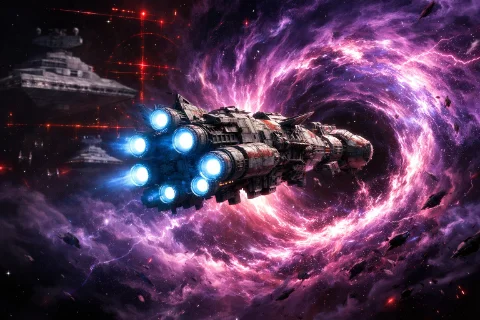
In the theatre of galactic conflict, a rebellion is defined less by its flagship battles than by its shadow pipelines. Against an autocratic empire that monitors every major hyperspace lane and controls every high-traffic trade port, mainstream celestial travel is suicide for an insurgency. To transport blasters, starfighter engines, and life-saving medical supplies, the resistance relies on the Dark Hyperspace. This covert operational system utilizes unmapped sub-dimensions, illegal navigation engines, and independent blockade runners to keep the spark of rebellion alive.
Navigating the Uncharted Abyss
Standard galactic commerce relies on hyperlanes, cosmic corridors thoroughly cleared of gravitational anomalies and strictly policed by imperial naval grids. To bypass these military choke points, blockade runners are forced to dive into uncharted, volatile sectors of subspace.
Entering the Dark Hyperspace requires illegal, cracked navigation computers capable of calculating vectors through unmonitored cosmic phenomena. Blockade runners must navigate dangerously close to the gravity wells of rogue black holes, volatile asteroid belts, and dense dark-matter nebulae. A single calculation error of a microsecond can cause a vessel to rip itself apart against a gravitational shear or emerge directly inside a sun. Within this pitch-black network of blind jumps, captains do not rely on standard imperial transponders; they navigate by memory, instinct, and independent deep-space beacons hidden by the underground resistance.
The Mechanics of Shadow Supply Chains
Operating a clandestine logistics network across light-years requires a hyper-compartmentalized relay system designed to avoid imperial surveillance and tracking loops.
Dead-Drop Depots: Blockade runners rarely deliver their illegal cargo directly to a planetary resistance cell. Instead, they drop container pods off at designated neutral coordinates, such as inside the hollow shell of a dead asteroid or adrift within a dense planetary ring system. Local smuggler skiffs then retrieve the containers, ensuring that the long-distance transport ship is never directly linked to the local cell.
The Ghost Manifest: To mask their true cargo, rebel logistical officers utilize forged corporate clearance codes and compromised imperial merchant manifests. A ship carrying high-grade military explosives might be digitally disguised as an imperial agricultural vessel hauling industrial fertilizer, allowing it to pass standard security scans at sector borders.
The Hyper-Siphon: Fuel is the lifeblood of a fleet. Because the empire tightly rations hyperdrive fuel canisters, rebel cells execute covert siphoning operations. Using specialized stealth tenders, they latch onto automated imperial refueling stations floating in remote deep-space sectors, harvesting fuel right under the noses of the imperial naval high command.
The Cost of the Fracture: The Blind Jump
The ultimate threat to the Dark Hyperspace is not the physical interception of a ship, but the compromise of a hyper-coordinate pathway. If an imperial intelligence agency captures a rebel nav-computer intact, they can trace the entire network of hidden beacons and dead-drop locations across multiple star systems.
To counter this threat, blockade runners operate under a brutal, mandatory protocol known as the Blind Jump. If a vessel is cornered by imperial interdictor cruisers and face certain capture, the navigation officer must execute an automated data-purge, instantly frying the ship’s mainframe. If escape is impossible, the captain is required to activate an unstable, uncalculated hyperjump. This final, desperate action flings the ship into a random, uncharted coordinate of the dark abyss, sacrificing the crew and the cargo to ensure that the secrets of the underground logistics lines remain permanently hidden in the deep dark of space.