
What Do a Mosque, a Synagogue, and a Christian Palace Have in Common?
The extraordinary architectural connections hidden in medieval Spain.
Imagine entering a medieval mosque in Córdoba, walking through a synagogue in Toledo, and finally discovering a royal palace in Seville.
Three buildings. Three different religious and political contexts.
Yet something remarkable connects them.
Look closely at their arches, geometric patterns, carved plasterwork, and ornamental traditions. Across these extraordinary monuments, architectural forms reveal a history far more complex than the boundaries separating religious communities.
What if architecture could tell us a different story about the cultural encounters of medieval Spain?
Córdoba: Where Architecture Preserves Layers of History
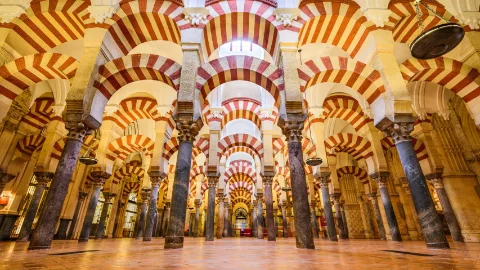
The Mosque-Cathedral of Córdoba is one of the most extraordinary monuments of the Iberian Peninsula.
Its celebrated forest of columns and alternating red-and-white arches creates a visual rhythm that has fascinated visitors for centuries.
Construction of the original Great Mosque began in the eighth century under Abd al-Rahman I. Successive expansions transformed it into one of the most significant architectural achievements of al-Andalus.
Following the Christian conquest of Córdoba in 1236, the building was consecrated as a cathedral. Later modifications, including the construction of a Renaissance cathedral nave, added new architectural layers.
Today, the monument embodies a complex history of religious transformation, artistic continuity, and changing political authority.
But the architectural story does not end in Córdoba.
Toledo: A Synagogue with an Unexpected Architectural Language
Travel north to Toledo, a city whose medieval history reflects centuries of interaction among Christian, Jewish, and Muslim communities.
Inside the Synagogue of Santa María la Blanca, visitors encounter rows of horseshoe arches, elegant columns, and intricate decorative elements.
At first glance, certain architectural features may evoke buildings associated with Islamic artistic traditions.
Yet this was a Jewish religious space.
Its architecture demonstrates how artistic forms could circulate beyond the religious communities with which they were originally associated.
The building also reminds us that cultural exchange did not necessarily imply social equality or uninterrupted coexistence. Medieval Iberia experienced periods of cooperation alongside discrimination, conflict, and political transformation.
Nevertheless, its architectural heritage preserves evidence of shared techniques, skilled craftsmanship, and artistic adaptation.
Seville: Why Did Christian Kings Embrace Islamic Artistic Traditions?
Our journey continues to Seville.
At the Royal Alcázar, the Palace of Pedro I offers one of the most remarkable examples of artistic exchange in medieval Iberia.
Commissioned during the fourteenth century by a Christian monarch, the palace incorporates architectural and decorative traditions associated with Islamic craftsmanship.
Its courtyards, geometric ornamentation, inscriptions, and elaborate plasterwork reveal the extraordinary prestige of these artistic forms.
The palace demonstrates that architecture was not merely a reflection of religious identity.
It was also an expression of royal authority, cultural ambition, artistic sophistication, and the movement of skilled artisans.
Christian patronage and Islamic-derived artistic traditions could converge in the creation of buildings intended to communicate political power and magnificence.
This convergence became one of the defining characteristics of Mudéjar artistic production.
The Artistic Legacy That Crossed Religious Boundaries
The term Mudéjar is commonly used in art history to describe architectural and decorative traditions associated with Islamic artistic techniques and forms developed under Christian rule in medieval Iberia.
However, this heritage cannot be reduced to a single community or a simple narrative of harmonious coexistence.
Its development involved complex relationships among patrons, artisans, political institutions, and cultural traditions.
Horseshoe arches, geometric ornamentation, carved plasterwork, decorative tilework, and elaborate wooden ceilings became part of a visual language that could be adapted to different architectural settings.
These forms appeared in palaces, churches, synagogues, and other buildings, sometimes acquiring new meanings in different historical contexts.
Their survival allows us to explore how artistic knowledge travels, changes, and becomes part of new cultural environments.
But the Story Did Not End in Spain
The architectural legacy of the Iberian Peninsula also crossed the Atlantic.
During the colonial period, building techniques and decorative traditions associated with Iberian architecture reached the Americas, where they were adapted to new materials, environments, artistic practices, and local traditions.
From wooden ceilings to geometric ornamentation, elements of this heritage acquired new expressions in Ibero-American architecture.
These transformations remind us that cultural history rarely remains confined within geographical boundaries.
Architecture can preserve the traces of movement, adaptation, and encounters across continents.
A Hidden History Written in Stone, Wood, and Geometry
What connects a mosque in Córdoba, a synagogue in Toledo, and a Christian palace in Seville?
Not a single religious identity or a uniform historical experience.
Rather, they reveal how architectural knowledge, artistic forms, and craftsmanship circulated across communities and political boundaries.
Their buildings invite us to reconsider the relationship between culture, identity, and artistic heritage.
Sometimes, the most fascinating historical connections are hidden in the buildings we think we already know.
Discover More
This exploration is inspired by my book, Our Secret Geometry: A Fascinating Journey through Ibero-American Mudéjar Art, which examines the circulation and transformation of architectural traditions between the Iberian Peninsula and Ibero-America.
Explore the book and watch its trailer on ShopIndieBooks:
Monserrat Díaz Ortega
Independent Researcher and Author | International Relations, Art History and Cultural Heritage