Introduction
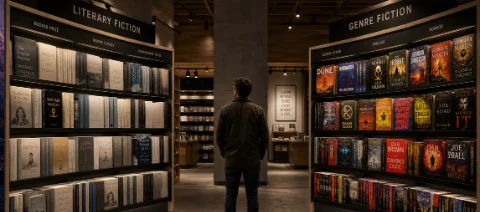
Few distinctions in the world of books generate more heat and less light than the one between literary fiction and genre fiction.
On one side, a familiar set of assumptions: literary fiction is serious, ambitious, and concerned with the deeper truths of human experience. Genre fiction is entertaining, formulaic, and concerned primarily with plot. Literary fiction is what serious readers read. Genre fiction is what everyone else reads. Literary fiction wins prizes. Genre fiction sells copies.
On the other side, an equally familiar set of objections: the literary versus genre distinction is snobbery dressed as criticism. Genre fiction can be just as complex, just as beautifully written, just as thematically rich as anything shelved under literary fiction. And literary fiction can be just as formulaic, just as predictable, just as empty of genuine insight as the worst genre novel.
Both sides of this argument contain genuine truth, and both contain genuine distortion. The distinction between literary and genre fiction is real in certain ways and significantly overstated in others. Understanding it clearly, without the defensiveness that tends to characterise discussions of it, is useful for writers thinking about their own work and for readers trying to understand what they are looking for when they choose a book.
This article examines what the distinction actually is, where it came from, how it operates in the publishing world, what it means for craft, and where the most interesting fiction tends to be found in relation to it.
Where the Distinction Comes From
The separation of fiction into literary and genre categories is a relatively recent phenomenon in the history of storytelling.
For most of literary history, the distinction did not exist in any meaningful form. Homer wrote adventure stories populated by monsters, gods, and epic battles. Shakespeare wrote thrillers, comedies, romances, and supernatural tales. Dickens wrote serialised popular fiction that was consumed by the mass reading public with the same enthusiasm that contemporary readers bring to popular genre fiction. The Brontës wrote romances. Poe wrote horror and detective stories. Conan Doyle wrote mysteries. These writers were not considered lesser artists for working in popular forms. Many of them were considered the greatest artists of their time precisely because their popular appeal and their artistic ambition were not understood to be in conflict.
The literary versus genre distinction began to crystallise in the late nineteenth and early twentieth centuries, when the professionalisation of literary criticism and the establishment of academic literary study created institutional pressure to identify a canon of serious works worthy of study and analysis. This institutional project required distinction and hierarchy. Some books were worth serious attention. Others were entertainment and nothing more.
Genre fiction, with its explicit commercial orientation, its adherence to recognisable formulas, and its prioritisation of reader pleasure over artistic ambition, became the category against which serious literary fiction defined itself. The distinction was not purely aesthetic. It was institutional, commercial, and social, bound up with questions of class, education, and cultural authority in ways that its purely aesthetic framing concealed.
Understanding this history does not dissolve the distinction. But it does suggest that the distinction is more contingent and more culturally constructed than its defenders sometimes acknowledge. It is a distinction made by people with particular interests in particular historical contexts, not a distinction given by the nature of fiction itself.
What Literary Fiction Actually Is
Literary fiction is easier to recognise than to define, which is itself revealing.
The most common definition centres on priorities. Literary fiction prioritises the quality of the prose, the depth of the characterisation, the complexity of the thematic exploration, and the integrity of the artistic vision over the satisfaction of genre conventions or commercial expectations. It is, in this definition, fiction that asks to be evaluated primarily on artistic grounds rather than on the grounds of how effectively it delivers the specific pleasures associated with a particular genre.
This definition is useful as far as it goes, but it has significant limitations. It defines literary fiction primarily by what it is not: not genre, not commercial, not primarily concerned with entertainment. This negative definition tells us something about literary fiction's self-understanding but not very much about what it positively is.
A more positive definition might focus on certain characteristic emphases. Literary fiction tends to be more interested in interiority than in plot, more concerned with how characters think and feel than with what they do. It tends to prioritise language itself as a source of meaning and pleasure, treating the prose as something to be savoured rather than a transparent vehicle for story. It tends to resist neat resolution, preferring endings that feel true to the complexity of experience over endings that satisfy the reader's desire for closure. It tends to be more concerned with moral ambiguity than moral clarity, more interested in the difficulty of human experience than in the triumph over it.
These tendencies are real and they are useful for understanding what literary fiction characteristically does. But they are tendencies, not laws. Literary fiction that is plotless and unresolved exists, but so does literary fiction with gripping plots and satisfying endings. Literary fiction that prizes prose above all else exists, but so does literary fiction whose primary achievement is psychological depth or thematic originality rather than sentence-level beauty.
The safest definition of literary fiction may be the most circular: literary fiction is fiction that the literary establishment treats as literary fiction. It is fiction that is published by literary imprints, reviewed in literary publications, submitted for literary prizes, taught in university literature courses, and discussed in the critical discourse that surrounds serious fiction. This circular definition is unsatisfying but honest. Literary fiction is partly a social category as much as an aesthetic one, and the social category is maintained by institutions with their own interests and their own blind spots.
What Genre Fiction Actually Is
Genre fiction is fiction that belongs to a recognisable category defined by its conventions, its characteristic pleasures, and its implicit contract with the reader.
The major genre fiction categories, romance, mystery and crime, thriller, science fiction, fantasy, horror, western, and their various subcategories and hybrids, each have their own conventions. These conventions are not arbitrary restrictions. They are the accumulated understanding of what readers who love a particular genre love about it, translated into formal requirements.
The romance novel must centre a romantic relationship and must resolve it satisfyingly. The mystery must pose a puzzle and solve it fairly. The thriller must generate and sustain tension. The fantasy must create a coherent alternative world. These are not formulaic constraints in the pejorative sense. They are the defining features of what each genre is, the elements that make romance recognisably romance and thriller recognisably thriller.
Genre fiction is sometimes characterised as formulaic, and it is true that the conventions of genre fiction create predictability at a structural level. The romance reader knows before they open the book that the central relationship will be resolved happily. The mystery reader knows the crime will be solved. This predictability is not, for most genre readers, a defect. It is part of the pleasure. Knowing roughly where the story is going allows the reader to focus on and enjoy the journey, the specific way this writer navigates toward the expected destination.
What distinguishes good genre fiction from bad genre fiction is not the presence or absence of convention but the quality of execution within convention. The romance that arrives at its happy ending through characters and situations and emotional dynamics that feel genuinely alive is a better romance than the one that arrives at the same ending through cardboard characters and mechanical plot. The mystery that solves its puzzle through genuinely clever construction and fair clues is a better mystery than the one that cheats its way to a solution. Convention is the container. Quality is what fills it.
Genre fiction is also, importantly, a commercial category. Genre fiction exists within a market that knows its audience and serves them. Genre readers know what they like and they read a lot of it. The commercial infrastructure of genre publishing, with its genre-specific imprints, its genre-aware marketing, and its reader communities built around specific genre enthusiasms, is highly developed precisely because genre readers are among the most loyal and the most voracious readers in the market.
The Real Differences Between Them
Setting aside the cultural politics of the distinction, there are genuine aesthetic differences between what literary fiction and genre fiction characteristically do, and those differences are worth understanding clearly.
The Role of Plot
The most significant and consistent difference between literary and genre fiction is the role of plot.
In genre fiction, plot is primary. The genre reader's engagement is driven primarily by what happens and what will happen next. Plot provides the forward momentum that carries the reader through the book and delivers the genre-specific pleasures they are seeking. Character, prose, and theme serve the plot in genre fiction, enriching it and deepening it without replacing it as the primary driver of reader engagement.
In literary fiction, plot is typically secondary. The literary fiction reader's engagement is driven primarily by character interiority, prose quality, and thematic depth. What happens is less important than what it means to the character experiencing it and how the writer renders that meaning in language. Plot in literary fiction tends to be quieter, less eventful by genre standards, more concerned with the inner weather of characters than with the external storms of event.
This difference is genuine and significant. It produces genuinely different reading experiences. The literary fiction reader who expects genre pace and plot momentum from a literary novel will be frustrated. The genre reader who expects the quiet interiority of literary fiction from a thriller will be equally frustrated. Both types of fiction are doing what they are supposed to do. They are just doing different things.
The Role of Language
Literary fiction tends to treat language itself as a primary source of meaning and pleasure. The sentence is a unit of aesthetic achievement as well as a unit of communication. A beautifully constructed sentence, one with the right rhythm, the right word choices, the right balance of compression and elaboration, is something to be appreciated for its own sake rather than simply parsed for its informational content.
This does not mean genre fiction cannot have beautiful prose. Many genre writers write with extraordinary care and skill at the sentence level. But genre fiction tends to treat language as a vehicle for story rather than as something that carries meaning independently of the story it conveys. The prose is expected to be good but not to draw attention to itself. Transparency is the ideal: prose that the reader processes automatically while their attention remains on the story.
In literary fiction, opacity, in the sense of prose that rewards attention and resists purely automatic processing, is often valued. The reader who slows down to appreciate the sentence is doing what literary fiction invites them to do.
The Role of Resolution
Genre fiction almost always resolves its central conflict in a way that satisfies the reader's expectations. The mystery is solved. The romance reaches its happy ending. The hero defeats the villain. The resolution delivers the pleasure the genre promises.
Literary fiction is more ambivalent about resolution. Many literary novels end without resolving their central tensions cleanly. Characters arrive somewhere at the end but not necessarily somewhere that feels like triumph or even closure. The ending reflects the complexity and ambiguity of actual human experience rather than the satisfying arc of a well-constructed plot. Readers who come to literary fiction expecting genre resolution are often frustrated. Readers who come expecting complexity and ambiguity find what they are looking for.
The Role of Originality
Literary fiction places a higher premium on originality, on departing from established conventions, on doing something that has not been done before. Literary fiction that feels too familiar, too dependent on established forms, risks being dismissed as genre fiction in thin disguise.
Genre fiction values originality differently. Within genre, originality means finding new variations on established conventions, new ways of delivering the genre's characteristic pleasures, new combinations of familiar elements. Complete departure from genre convention risks confusing or alienating the genre's readership.
This difference in the relationship to convention is one of the most significant practical differences for writers. A literary fiction writer who works within established conventions risks being seen as unambitious. A genre fiction writer who departs too far from established conventions risks losing their audience.
Where They Overlap
The most interesting contemporary fiction often refuses to stay on one side of the literary versus genre divide.
Genre fiction has always produced work that transcends its category in the way that the distinction implies it cannot. Raymond Chandler wrote crime fiction whose prose is as carefully crafted as anything in the literary canon. Ursula K. Le Guin wrote science fiction and fantasy of extraordinary philosophical depth and literary quality. Stephen King has written horror that explores the human condition with as much seriousness and insight as any literary novelist. Toni Morrison incorporated elements of the ghost story into novels that are unambiguously literary in their ambition and achievement.
These writers demonstrate that the pleasures of genre and the ambitions of literary fiction are not mutually exclusive. A novel can have a compelling plot and beautiful prose. A novel can satisfy genre expectations and explore complex themes. A novel can be entertaining and serious simultaneously.
Literary fiction has also increasingly incorporated genre elements as the critical and cultural authority of the genre versus literary distinction has weakened. Contemporary literary fiction is full of novels that use mystery, thriller, science fiction, or fantasy elements to drive their plots while maintaining the prose quality, character depth, and thematic ambition associated with literary fiction. The term literary thriller has become a recognised category precisely because the combination of literary ambition and thriller momentum has proven popular enough to constitute its own market segment.
The most honest description of the contemporary fiction landscape is not a clean division between literary and genre but a spectrum with work of genuine literary ambition at one end, work of pure genre entertainment at the other, and an enormous amount of interesting, valuable fiction distributed across the space between them.
The Craft Implications
For writers, the literary versus genre distinction has real craft implications, and understanding them helps in making deliberate choices about what kind of writer you are and what kind of book you are writing.
If you are writing genre fiction, your primary craft obligation is to the genre's conventions and the pleasures they are designed to deliver. Your reader has entered a contract with you, and you must honour it. This does not mean your work cannot be beautifully written, thematically rich, or psychologically complex. It means that all of those additional qualities must be in service of the genre experience rather than replacing it.
A romance novel that is beautifully written but does not deliver on its romantic arc has failed as a romance, whatever its other qualities. A mystery that is thematically profound but does not construct its puzzle fairly has failed as a mystery. The genre's primary obligations come first. Everything else enhances rather than substitutes.
If you are writing literary fiction, your primary craft obligation is to the integrity of your artistic vision. This is a more demanding and less clearly defined obligation because it is internal rather than external, determined by your own artistic conscience rather than by a genre's established conventions. It requires a clearer understanding of what you are actually trying to achieve and a greater willingness to resist the temptations of conventional resolution or conventional narrative momentum when they are not serving your actual purpose.
If you are writing in the space between, which is where a great deal of the most interesting contemporary fiction lives, you need to be conscious of what you are taking from each side and what obligations each element creates. A novel with genre plot mechanics operating within a literary ambition must honour both. The plot must work as plot. The literary ambition must be genuine and not merely decorative.
The Reader's Perspective
From a reader's perspective, the literary versus genre distinction matters primarily as a tool for finding what you are looking for.
Readers who know they want the specific pleasures of a particular genre are best served by fiction that delivers those pleasures reliably. The romance reader who wants a happy ending, the mystery reader who wants a fairly clued puzzle, the thriller reader who wants sustained tension, should look for fiction that takes its genre obligations seriously rather than fiction that treats genre conventions as constraints to be transcended.
Readers who want primarily the pleasures of literary fiction, beautiful prose, complex characterisation, thematic depth, resistance to easy resolution, are best served by fiction that prioritises those qualities rather than fiction that delivers them as incidental to its genre ambitions.
But many readers want both, and for those readers the binary distinction is the least useful framework. The reader who wants a compelling plot and beautiful prose, who wants to be entertained and intellectually engaged simultaneously, who finds pure genre fiction too thin and pure literary fiction too slow, is the reader for whom the space between the categories is most valuable.
This reader is not confused about what they want. They want something specific that the literary versus genre binary makes artificially difficult to find. They want fiction that is both. And there is more of it than the binary suggests.
The Publishing Reality
For writers navigating the publishing world, the literary versus genre distinction has practical commercial implications that cannot be ignored even by writers who find the distinction aesthetically unpersuasive.
Traditional publishing is organised around the distinction in ways that affect how books are acquired, marketed, and sold. Genre fiction is acquired by genre imprints with genre-specific editors who understand their market. Literary fiction is acquired by literary imprints whose editors are oriented toward critical reception and prize consideration. The marketing, the cover design, the distribution, the review attention, and the reader community around each category are distinct.
A novel that does not fit clearly into either category faces real practical challenges in traditional publishing. It is harder to position, harder to market, and harder to find the right editor for. This is not an argument for writing to categories rather than writing the book you want to write. It is an argument for understanding the practical landscape you are navigating and making conscious decisions about how to position your work within it.
For indie authors, the category distinction operates differently but is no less real. Readers browsing online platforms use genre categories to find what they want. A novel that sits between categories may struggle to find its audience not because no reader would love it but because the discovery infrastructure is built around clearer categorisation. Metadata, cover design, and description all need to signal to the right readers that this book is for them, and that signalling is harder when the category is ambiguous.
Does the Distinction Matter?
After all of this, the question worth asking directly is whether the literary versus genre distinction actually matters.
For writers, it matters as a set of craft obligations and commercial realities rather than as a measure of worth. Understanding what kind of fiction you are writing helps you understand what you owe your reader and how to serve them well. It helps you position your work in the market and find the readers who are looking for what you have written. It does not tell you whether your work is valuable, important, or good.
For readers, it matters as a discovery tool and nothing more. Knowing that you tend to prefer literary fiction or genre fiction is useful information for finding books you will love. It is not a judgment on the intelligence or sophistication of your taste.
For critics and the culture at large, the distinction has been allowed to carry more weight than it should. The assumption that literary fiction is serious and genre fiction is not, that literary fiction is for educated readers and genre fiction is for everyone else, that literary ambition and genre pleasure are fundamentally incompatible, is both historically unfounded and aesthetically reductive. It has caused literary culture to dismiss work of genuine importance because it wore genre clothes and to celebrate work of genuine emptiness because it wore literary ones.
The distinction matters when it is helping someone find what they are looking for. It does not matter as a hierarchy of value, a measure of seriousness, or a predictor of literary importance.
The best fiction is the fiction that does what it sets out to do with the most skill, the most honesty, and the most genuine engagement with the human experience it is exploring. That standard applies equally to a genre thriller and a literary novel. It applies to work that sits clearly in one category and work that refuses both. It is the only standard that actually tells you whether a book is worth reading.
Conclusion
Literary fiction and genre fiction are different things, and the difference is real. They have different priorities, different conventions, different relationships with their readers, and different craft obligations. Understanding those differences clearly is useful for writers and readers alike.
But different does not mean unequal. The hierarchy that the literary versus genre distinction has traditionally implied, the assumption that literary fiction is inherently more serious, more valuable, and more worthy of attention than genre fiction, is a cultural prejudice rather than a critical truth. It has been used to dismiss work of genuine importance and to elevate work of genuine mediocrity, and its authority has rightly weakened as readers and critics have become more willing to evaluate fiction on its actual merits rather than its categorical positioning.
The fiction that matters is the fiction that does something true about human experience with enough skill and enough honesty that the reader is changed by the encounter. That fiction exists across the full spectrum of the literary versus genre divide. It exists in clear genre fiction. It exists in unmistakable literary fiction. And it exists in the space between them, which is where much of the most interesting contemporary writing lives.
Read widely. Evaluate honestly. Let the work speak for itself rather than its category.
The best books have always been the ones that outgrew whatever category they were placed in.
Indie Reading Community is where independent authors and the readers who love discovering them come together. Explore books across every genre, read author interviews, and browse craft articles built for writers and readers at indiereadingcommunity.com