
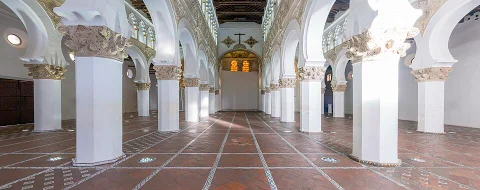
The Synagogue That Looks Like a Mosque: Toledo's Architectural Surprise
An unexpected architectural encounter in the heart of medieval Spain.
Imagine walking into a medieval synagogue and finding yourself surrounded by horseshoe arches, elegant columns, and ornamental forms that seem to belong to an entirely different architectural tradition.
You are not in a mosque.
You are inside Santa María la Blanca, one of Toledo's most remarkable historic buildings.
Its architecture raises a fascinating question: why would a Jewish religious building incorporate forms so closely associated with Islamic artistic traditions?
The answer reveals a complex world of cultural exchange, craftsmanship, and political relationships in medieval Iberia.
A Building That Challenges Expectations
Santa María la Blanca is traditionally associated with Toledo's medieval Jewish community. Its precise origins and early construction history remain subjects of scholarly discussion, although the surviving building is generally associated with the late twelfth or early thirteenth century.
The interior is organized into five aisles separated by rows of columns supporting horseshoe arches.
Its white surfaces, carved capitals, and rhythmic architectural composition create a striking impression of unity and elegance.
But the most intriguing aspect is not simply its beauty.
It is the architectural language through which that beauty was expressed.
Why Do Its Arches Look Familiar?
The horseshoe arch is among the most recognizable forms associated with the architecture of al-Andalus.
Yet it was not exclusive to Islamic buildings. Its history in the Iberian Peninsula predates the arrival of Muslim rule, and its forms evolved through different architectural traditions.
In Santa María la Blanca, these arches form part of a building associated with Jewish worship.
This reminds us that architectural forms do not always correspond neatly to religious identities.
Artisans could employ established techniques and decorative conventions for patrons belonging to different communities.
A visual language associated with one cultural environment could acquire new functions and meanings in another.
The Artisans Behind the Architecture
Medieval architecture was not created by patrons alone.
It depended on builders, carpenters, plasterworkers, and other skilled artisans whose knowledge could move across political and religious boundaries.
In Christian-ruled Toledo, artistic techniques associated with Andalusi traditions remained influential.
The building of Santa María la Blanca reflects this wider architectural environment, although the identities of its individual craftsmen cannot be established with certainty.
Its forms demonstrate the importance of technical knowledge and artistic continuity in the development of medieval Iberian architecture.
Cultural Exchange Was Not Always Peaceful
The architecture of Santa María la Blanca is sometimes presented as evidence of harmonious coexistence among Muslims, Christians, and Jews.
The historical reality was more complicated.
Medieval Toledo experienced cultural interaction, but also legal inequalities, religious tensions, persecution, and profound political changes.
The synagogue's later transformation into a Christian religious building reflects part of that history.
Its architectural significance therefore lies not in proving an idealized vision of medieval tolerance, but in revealing how artistic traditions could circulate even within societies marked by unequal power relations.
The Broader World of Mudéjar Art
Santa María la Blanca is frequently discussed in relation to Mudéjar architecture, a term commonly used to describe artistic traditions associated with Islamic-derived techniques and forms developed in territories under Christian rule.
These traditions were not confined to a single type of building.
Related decorative languages appeared in churches, palaces, synagogues, and domestic architecture.
Their presence across different settings invites us to think beyond rigid categories.
What mattered was not only the religious identity of a building's occupants, but also the availability of skilled artisans, established construction practices, regional artistic preferences, and the ambitions of patrons.
A Shared Visual Language, Different Histories
Santa María la Blanca does not erase the distinctions between Judaism, Christianity, and Islam.
Nor does it suggest that their historical experiences were interchangeable.
Instead, it reveals something more subtle.
Architectural forms can cross boundaries while retaining traces of the environments in which they developed.
A horseshoe arch may become part of a mosque, a synagogue, or a palace, but its meaning changes with the building's function, patronage, and historical circumstances.
That is precisely what makes the architecture of medieval Spain so fascinating.
The Hidden Connections of Toledo
Visitors often remember Santa María la Blanca for its graceful arches and luminous interior.
Yet its deeper significance lies in the questions it invites us to ask.
Who built these structures? How did artisans acquire and transmit their knowledge? Why did different communities adopt related architectural forms?
And what can those choices reveal about the societies that produced them?
Sometimes, the most revealing evidence of cultural exchange is not found in written declarations, but in the buildings that have survived.
Discover More
This article forms part of a series exploring the architectural connections behind Our Secret Geometry: A Fascinating Journey through Ibero-American Mudéjar Art, by Monserrat Díaz Ortega.
Discover the book and watch its trailer:
Monserrat Díaz Ortega
Independent Researcher and Author | International Relations, Art History and Cultural Heritage