In the whimsical landscape of children's literature and early readers, the space beneath our furniture is not just an empty void collecting lint. It is a highly active, underground territory governed by its own laws, citizens, and revolutionary movements. The Shadow Under the Rug represents a charming exploration of domestic magical realism, turning the mundane chore of vacuuming into a high-stakes border dispute between the tidy world of the bedroom floor and the secret society of the Dust Bunny Rebellion.
The Geography of the Dusty Corners
To a grown-up, the dark gap beneath a heavy oak dresser or a fringed rug is simply a place that needs sweeping. But to a lost toy or a stray button, crossing into the shadow under the rug is equivalent to stepping over a magical border into an untamed wilderness.
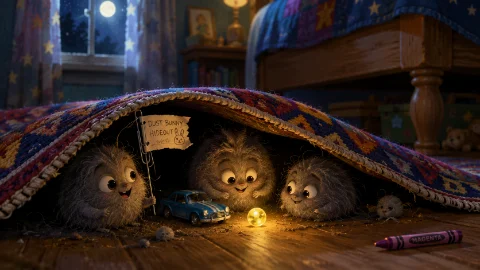
This subterranean world is built from the things humans discard or forget. The landscape is shaped by rolling hills of grey lint, valleys of lost crayon stubs, and mountains of stray puzzle pieces. The permanent residents of this realm are the Dust Bunnies, tiny, fluffy creatures born from static electricity, wool coat fibers, and the soft whispers of children sleeping soundly at night. They are the natural stewards of the shadows, building elaborate, soft fortresses inside the fringe of the carpet and guarding the forgotten treasures that slip away from the brightly lit world above.
The Accidental Alliances of the Lost
The economy of the under-rug world relies entirely on the steady influx of lost items. When a shiny silver marble rolls beneath the bed, or a missing plastic dinosaur slides into a dark corner, they do not remain static objects. They are adopted into the under-rug community.
The Plushie Outcasts: Stuffed animals that have lost an eye or a limb often find sanctuary in the dusty corners. They act as the elder statesmen of the shadows, offering wisdom to newly dropped toys who are still crying out for their human owners.
The Stationary Smugglers: Missing paperclips, rubber bands, and broken pencil tips serve as the building blocks for under-rug technology. The Dust Bunnies use rubber bands to construct miniature catapults and paperclips to bridge the wide gaps between floorboards, creating a complex network of pathways right beneath human feet.
The Great Midnight Rebellion
The central conflict of the under-rug world is the constant, terrifying threat of the Great Broom, a loud, sweeping storm deployed by parents that threatens to wipe out entire dust bunny civilizations in a single pass. To survive, the Dust Bunnies have organized themselves into a clandestine network known as the Midnight Rebellion.
When the house goes completely dark and the humans are asleep, the Rebellion wakes up. Operating with tiny flashlights made from glowing firefly husks, the Dust Bunnies march across the carpet borders to reclaim lost territory and gather supplies. Their mission is one of strategic relocation. If they find a small toy left in the middle of the floor, they work collectively to drag it beneath the rug, transforming it into a defensive wall against the next morning's cleaning routine. It is a playful, imaginative war of attrition fought between the laws of household neatness and the raw, creative chaos of childhood imagination, proving that the things we think are lost are simply living a very busy second life just out of sight.