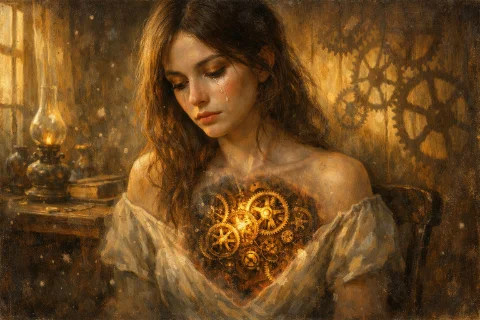
The passing of time rarely heals a true family wound; instead, it often gives the sorrow a physical shape. In the realm of magical realism, emotional trauma is never a abstract psychological concept to be discussed and forgotten. It is an active, physical inheritance that reshapes the flesh and blood of future generations. The phenomenon of the clockwork heartbeat represents the literal mechanics of sorrow, where the heart becomes a complex nest of brass gears that tick away the remaining hours of a family line.
The Anatomy of Nested Brass Gears
When a member of the family line suffers a catastrophic heartbreak, their anatomical heart undergoes a permanent transformation. The biological muscle slowly hardens, spinning out intricate, interlocking clockwork components beneath the ribcage.
The Primary Spring: The main tension coil of the heart winds tighter with every unexpressed tear or buried secret.
Sympathetic Chimes: When an ancestor passes away, the internal gears of their living children strike a resonant, mournful chord across great distances.
The Rust Spread: Deep, unresolved resentment introduces a literal oxidized layer that slows the mechanical movement, causing physical fatigue.
This physical machinery ensures that the children carry the exact weight, rhythm, and tempo of their parents' unhealed traumas.
The Transmission of the Mechanical Curse
The mechanical heart is not born fully formed; it develops as the child grows and encounters the historic boundaries of the family curse. The internal clockwork activates during specific milestones of emotional maturity.
[Ancestral Trauma Event] ➔ [Genetic Melancholy Activation] ➔ [Internal Gear Forging] ➔ [Chimed Heartbeat Initialization]
As the child encounters their first profound disappointment, the first brass gear clicks into place behind their sternum. The rhythm of their pulse permanently changes, abandoning the soft thud of human flesh for the sharp, rhythmic tick of an old watch. From that moment forward, their emotional capacity is strictly governed by the physical limitations of the machinery. They can only love, grieve, or dream as much as the nested gears allow before the mainspring threatens to snap.
The Final Winding of the Line
The true burden of the clockwork heartbeat is the absolute predictability of the family's collective emotional decline. Every generation adds more gears to the mechanism, making the internal structure increasingly complex and fragile.
Eventually, the machinery becomes too heavy for the human chest to sustain, leading to a quiet, rhythmic cessation of life. The family line does not end with a dramatic explosion, but with a final, delicate chime that echoes softly through an empty room.