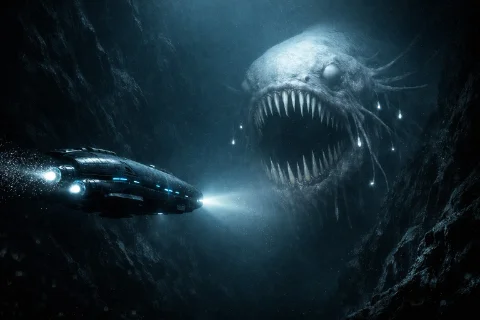
Venturing into the deepest oceanic trenches shifts the human experience from traditional exploration to a desperate fight for survival. At depths where the water pressure can easily crush standard steel hulls, traditional defense mechanisms are entirely useless. The deep ocean is ruled by massive, blind apex predators that have evolved to hunt by sensing microscopic vibrational changes in the water. To survive, deep-sea research stations and resource mining operations must use advanced acoustic engineering to hide from these prehistoric monsters.
The Danger of Sub-Surface Cavitation
In the deep ocean, the greatest threat to a submarine or stationary facility is often the sound of its own machinery. High-speed propeller rotation or sudden pressure shifts create sub-surface cavitation, generating tiny vapor bubbles that collapse with violent force.
Acoustic Flares: The collapse of cavitation bubbles produces sharp, metallic popping sounds that echo for miles through the dense water.
Dinner Bells: To a blind leviathan, these unique micro-explosions act as a clear directional signal indicating nearby prey.
Hull Erosion: Beyond attracting monsters, constant cavitation quickly pits and weakens the outer titanium plating of deep-sea structures.
Managing fluid dynamics to eliminate these acoustic signatures is the primary objective of every deep-sea engineering crew.
Echo-Location Traps and Sonic Redirection
Because these apex predators possess highly sensitive bio-sonar, physical weapons are largely ineffective in the dense water. Sub-surface security teams instead rely on echo-location traps to confuse and divert incoming threats.
[Leviathan Sonar Ping] ➔ [Hydrophone Detection] ➔ [Decoy Array Activation] ➔ [Sonic Trap Redirection]
When monitoring systems detect a massive biological sonar ping, automated decoy grids instantly fire high-frequency acoustic pulses. These sound waves bounce off natural rock formations and deep-sea thermal vents, creating massive phantom targets. The confused creature attacks the empty, noisy water column, allowing nearby research vessels to quietly slip away into the dark. By cycling these frequencies, security teams can trap a monster in a localized sonic loop for hours.
The Grim Reality of the Midnight Zone
Life inside an abyssal trench facility is defined by a constant, heavy reliance on absolute mechanical silence. A single faulty valve or an uncalibrated pump can generate enough noise to draw a leviathan directly out of the trenches.
Humanity down here exists entirely on borrowed time, separated from absolute terrors by a few inches of alloy and careful acoustic math. The deep ocean does not compromise, and it never forgives a single loud mistake.