Have you ever closed a book and felt a profound sense of awe, not just for the story, but for the mind that invented it? The kind of story that feels wholly unique, that pushes against the very edges of narrative possibility? That feeling is the product of true creative audacity. It’s a book that others couldn't imagine.
In a world saturated with standard tropes and predictable formulas, the challenge for modern writers isn't just to write well, but to write unconventionally. It’s about generating work that defies easy classification and creates a singular experience for the reader.
But how do you cultivate that specific kind of creativity? How do you push past the expected and produce something genuinely original? Here is a guide to help you dismantle the norms and write the unimaginable.
Dismantle the Formulas (To Build Your Own)
Formulas exist for a reason: they work. A predictable structure provides a comfortable safety net for both writer and reader. But true innovation doesn’t happen inside a safety net. To write something unimaginable, you must first become conscious of the invisible fences you are working within.
Start by listing the tropes, structures, and character archetypes of your favorite genres. Then, systematically decide to break one. If romance is always linear, tell it backward. If fantasy always features a chosen one, make your protagonist the chosen one’s incompetent sibling who just wants to sell pastries. Breaking even a small rule forces you to find new, creative solutions for old problems.
The Art of Cross-Pollination
Originality is rarely about inventing something completely new, but rather about connecting existing ideas in ways that haven't been tried before. The most striking 'unimaginable' works often blend disparate elements with surprising harmony.
Ask yourself: What if my sci-fi space opera was told as an oral folk history by an alien species with a radically different concept of time? What if a hard-boiled noir detective novel was set inside the collective unconscious of a hive-mind artificial intelligence? When you force contrasting genres, settings, and philosophies together, the resulting tension creates new creative ground that a standard template simply cannot access.
Deep Dive into the 'What If'
Many unique stories begin with a simple "what if." But to reach the realm of the unimaginable, you must push this hypothetical to its absolute, chaotic, and unexpected conclusion.
Don’t stop at the first answer.
- What if humans could only communicate through musical notes? (Okay, musical novel).
- But what if those notes had a physical effect on the world, like growing trees or summoning storms? (Getting interesting).
- And what if different languages created entirely different ecosystems? (Now we're pushing boundaries).
This process, sometimes called "progressive speculation," forces you to follow a logic that leads away from convention and into worlds built on your specific creative terms.
The Voice of the Unseen and Impossible
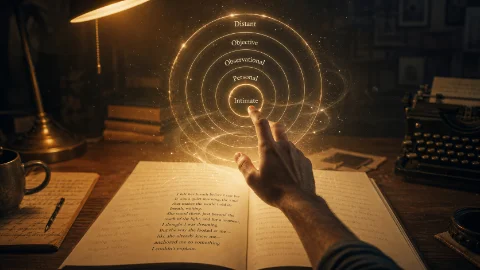
A predictable narrator offers a predictable window. To create something unimaginable, change the window. Consider narrative perspectives that are inherently difficult or unconventional.
- A character who experiences all time simultaneously.
- A story narrated by a city itself, or by a statistical anomaly.
- The internal monologue of a sentient disease during an outbreak.
An "impossible perspective" forces a writer to invent new linguistic rules and ways of expressing experience. The constraint itself generates creativity, demanding solutions that a standard first-person human narrator doesn't require.
Embrace Creative Chaos (Write Without a Map)
The final key is often the hardest for writers: surrender the need for complete control. To write something truly unimaginable, you must be willing to let the story dictate its own rules, even if they initially make you uncomfortable.
Allow yourself periods of free-form, stream-of-consciousness writing. Follow a character down a seemingly useless path. Listen to a voice that seems to contradict everything else in the book. This isn’t a recommendation to never edit; rather, it’s a plea to allow the messy, unpredictable, unimaginable core of your creativity space to breathe before you apply logic. Sometimes, the most groundbreaking idea is the one you were trying to fix.
Conclusion:
Writing a book that others can’t imagine isn’t magic. It’s the disciplined practice of dismantling the expected, fusing the incompatible, and deep-diving into speculatively extreme ideas. It requires audacity and a willingness to embrace creative chaos. The next time you feel stuck, don't ask how to make the story work; ask how to break it in the most interesting way possible. That’s where the truly unimaginable lives.