Introduction
Every story that has ever stayed with you was built on a structure you probably never noticed.
That is the mark of structure working as it should. When the three-act structure is applied well, readers do not see it. They simply feel the story pulling them forward, building toward something, delivering on promises made early and forgotten consciously but retained somewhere deeper. The structure is invisible because it is doing its job.
When it is applied badly, or ignored entirely, readers feel that too. They describe the experience as a story that lost its way, or a middle that dragged, or an ending that did not land. They rarely diagnose the structural problem because most readers are not thinking about structure. But the absence of it, or the misapplication of it, registers as dissatisfaction in a way that is hard to shake.
The three-act structure is not a formula. It is a framework that reflects something true about how human beings experience and process stories. It has survived thousands of years of storytelling across cultures, formats, and genres because it works. Not because someone decided it should, but because stories built around it tend to satisfy readers in a way that stories without it often do not.
This guide breaks down each act, explains the key structural beats within them, and shows you how to apply the framework to your own fiction in a way that serves your story rather than constraining it.
What the Three-Act Structure Actually Is
At its most basic, the three-act structure divides a story into three sections: a beginning, a middle, and an end. That description sounds almost too simple to be useful, but the value of the framework is not in the division itself. It is in understanding what each section needs to accomplish and why.
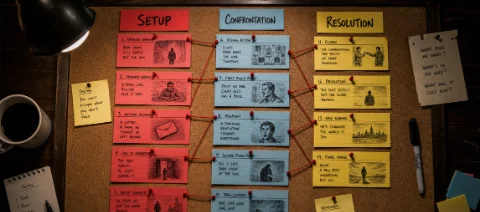
Act One is setup. It establishes the world, introduces the protagonist, and creates the conditions for the story to begin.
Act Two is confrontation. The protagonist pursues a goal, encounters escalating obstacles, and is changed by the struggle.
Act Three is resolution. The central conflict reaches its climax and the story delivers on everything it has been building toward.
These three sections are not equal in length. In a conventional novel, Act One takes up roughly the first quarter of the story. Act Two fills the middle half. Act Three covers the final quarter. That distribution reflects the reality of what each section needs to do. Setup can be accomplished relatively quickly. The struggle takes the longest because it is where character is revealed and stakes are established. Resolution needs enough space to feel earned but not so much that it overstays its welcome.
Within this broad framework, specific structural beats function as turning points that shift the direction and raise the stakes of the story. Understanding those beats is where the practical work of plotting begins.
Act One: Setting the Stage
Act One has one primary job: make the reader care enough to keep going.
Everything else, the world-building, the character introduction, the establishment of tone, the setup of the central conflict, is in service of that single goal. A reader who does not care about the character or the situation by the end of Act One is a reader who will not reach Act Two.
The Opening Image
Many writers and story theorists talk about the opening image as the first thing a reader encounters, the snapshot of the protagonist's world before the story changes it. It does not have to be an image in the visual sense. It is the initial impression of who this person is and what their life looks like at the point where the story begins.
The opening image matters because it establishes the baseline. By the end of the story, something fundamental will have changed. The opening image is what you are measuring that change against. A powerful ending is often most powerful in relation to what the beginning established.
The Ordinary World
Before the story disrupts your protagonist's life, the reader needs a sense of what normal looks like for them. This is the ordinary world, the status quo that the inciting incident is about to shatter.
The ordinary world should not be presented as perfect. Most protagonists are already living with some degree of tension, dissatisfaction, or unresolved conflict before the story begins. The ordinary world is not a happy place. It is a familiar one. The protagonist has adapted to it, even if that adaptation is not serving them well.
Spending too long in the ordinary world is one of the most common structural mistakes in debut fiction. Readers need enough to orient themselves and care about what is at stake, but they do not need a comprehensive tour of normal life before something happens to disrupt it. Get in, establish what matters, and move toward the inciting incident.
The Inciting Incident
The inciting incident is the event that sets the story in motion. It is the thing that happens to or because of the protagonist that makes the rest of the story necessary.
A strong inciting incident does three things. It disrupts the ordinary world in a way that cannot be ignored. It raises a central question that the story will spend the rest of its length answering. And it puts the protagonist in a position where they must eventually make a choice about how to respond.
The inciting incident is not always dramatic in the conventional sense. It does not have to be an explosion or a death or a sudden revelation, though it can be any of those things. What it has to be is significant enough to the protagonist that their life cannot simply continue as it was.
The End of Act One: The First Plot Point
The first major structural turning point comes at the end of Act One. This is the moment the protagonist commits to the journey ahead, whether by choice or by circumstance. The door to the ordinary world closes behind them, and the real story begins.
This turning point is sometimes called the first plot point, the lock-in, or the point of no return. Whatever you call it, it needs to do one essential thing: make it impossible for the protagonist to go back to the life they had before.
That impossibility can be external, something in the world has changed so dramatically that the old life no longer exists. Or it can be internal, the protagonist has made a decision or learned something that makes returning to the ordinary world feel unthinkable. Often it is both. The best first plot points work on multiple levels simultaneously.
Act Two: The Long Middle
Act Two is where most novels live and where most novels struggle.
It is the longest section of the story, typically covering half the total length, and it is the hardest to sustain. The novelty of the setup has worn off. The resolution is still far away. The writer has to keep the story moving, the stakes escalating, and the reader engaged across a stretch of narrative that has no natural end point until the climax of Act Two arrives.
The key to a strong Act Two is understanding that it is not one continuous rising action. It has its own internal structure, its own turning points, and its own emotional arc. Breaking Act Two into two halves, separated by a midpoint, makes it far more manageable to plot and far more satisfying to read.
Rising Action and Escalating Obstacles
The early part of Act Two follows the protagonist as they pursue their goal in response to the first plot point. They have committed to the journey. Now they are navigating it.
The obstacles they encounter should escalate in difficulty and personal cost as the act progresses. Early obstacles test the protagonist's capabilities and resolve. Later obstacles test something deeper: their values, their relationships, their fundamental beliefs about who they are and what they are willing to do.
Each obstacle should feel like a consequence of the ones before it. The protagonist makes a choice, that choice has consequences, those consequences create new problems, and the new problems demand new choices. This chain of cause and effect is what creates the feeling of a story that is going somewhere, building toward something, rather than simply presenting a series of events.
The Midpoint
Roughly halfway through the novel, something significant happens that shifts the direction or raises the stakes of the story. This is the midpoint, and it is one of the most important structural beats in the entire framework.
The midpoint is not just any scene. It is a turning point that changes the nature of the protagonist's pursuit. Sometimes it is a false victory, a moment where things seem to be going well before the situation worsens dramatically. Sometimes it is a revelation that reframes everything the protagonist thought they understood. Sometimes it is a significant loss that raises the personal cost of the journey.
What the midpoint must do is prevent Act Two from feeling like a flat line between the first plot point and the climax. It creates a pivot, a moment where the story changes gear and the protagonist is forced to respond to new information or a new reality.
After the midpoint, the obstacles become more serious, the stakes more personal, and the protagonist's resources more depleted. The story is moving toward its darkest moment.
The Dark Night of the Soul
Near the end of Act Two, the protagonist hits their lowest point. Everything they have been working toward seems lost. The goal appears unachievable. Their resources are exhausted, their relationships strained or broken, their belief in themselves shaken. This is sometimes called the dark night of the soul, the all-is-lost moment, or simply the low point.
The dark night of the soul is not just a plot device. It is the emotional core of the story. This is the moment that makes the resolution meaningful, because without genuine despair, triumph has no weight. Without the real possibility of failure, success carries no emotional charge.
The protagonist's response to their lowest point is the most revealing thing about who they are. Do they find something within themselves they did not know was there? Do they receive help they did not expect or feel they deserved? Do they make a choice that costs them something real but reflects the person they have become through the struggle?
The answer to that question is the beating heart of your story.
The End of Act Two: The Second Plot Point
The transition from Act Two to Act Three is marked by the second plot point, the moment that sets the climax in motion. The protagonist, having survived their lowest point, finds something, a piece of information, a renewed sense of purpose, a decision they can no longer avoid, that propels them toward the final confrontation.
The second plot point should feel like an earned transition. The protagonist is not the same person they were at the end of Act One. They have been changed by everything Act Two put them through. The choice or discovery that launches them into Act Three should reflect that change, should feel like something only this version of the character, the one forged by the struggle, could do.
Act Three: The Resolution
Act Three is the payoff. Everything built across Acts One and Two comes due here.
The climax, the final confrontation with the central conflict, needs to resolve the central question raised by the inciting incident. Not necessarily in the way the protagonist hoped at the beginning, stories that deliver exactly what the protagonist originally wanted often feel less satisfying than stories where the answer to the central question is more complex than the character initially understood. But the question must be answered, and the answer must feel inevitable given everything that came before.
The Climax
The climax is the moment of maximum tension, the scene or sequence where the outcome of the central conflict is decided. It should be the most intense moment in the story, not necessarily in terms of action or spectacle, but in terms of what is at stake for the protagonist and what the resolution will cost.
A strong climax forces the protagonist to use everything they have learned and become through the story. It should not be solvable by the person they were at the beginning. The whole point of the journey is that the protagonist has changed, and the climax is the test that proves the change is real.
The climax should also be active. The protagonist must do something. A passive climax, where things simply happen around the protagonist and the conflict resolves without their meaningful contribution, is one of the most common and most damaging structural failures in fiction. Readers invest in protagonists who drive their own stories toward resolution.
The Falling Action and Resolution
After the climax, the story needs space to breathe. The falling action is the period where the immediate consequences of the climax play out, where the dust settles and the shape of the new reality begins to emerge.
This section is often shorter than writers expect it needs to be. Readers who have been carried through a satisfying climax do not need a lengthy denouement. They need enough to feel that the story has genuinely ended, that the world of the novel has found its new equilibrium, and that the characters have arrived somewhere meaningful.
The Closing Image
Many writers and story theorists talk about the closing image as the mirror of the opening image. Where the opening showed the protagonist's world before the story changed it, the closing shows who they have become and what their world looks like now.
The closing image does not have to be literal. It is the final impression the reader is left with, the last thing the story says before it ends. When it rhymes with the opening in a way the reader feels even if they cannot articulate why, it creates the sense of a complete story, a circle closed, a journey fully made.
Common Mistakes When Using the Three-Act Structure
Understanding the framework is one thing. Applying it without falling into common traps is another.
The most frequent mistake is treating structural beats as boxes to check rather than organic story moments. A midpoint that exists because the midpoint should happen here, rather than because it grows naturally from the story, will feel mechanical to readers even if they cannot identify why.
Structural beats should feel inevitable, not imposed. The best way to achieve that is to work backwards from your character. If you know who your protagonist is, what they want, what they need, and what they fear, the story events that test those things most powerfully will suggest themselves. Structure follows character. When you try to force character into a predetermined structure, the story fights you.
The other common mistake is rushing Act Three. After the hard work of sustaining Act Two, writers often want to move quickly to the end. But a climax that arrives before the reader is fully ready for it, or a resolution that resolves too quickly or too neatly, undermines everything that came before. Give Act Three the space it needs to land with the weight the story has earned.
The Three-Act Structure Across Genres
One of the most useful things about the three-act structure is how adaptable it is across different genres and forms.
A literary novel, a commercial thriller, a romance, a fantasy epic, and a science fiction story all have different conventions, different pacing expectations, and different reader promises to keep. But all of them, when they work, follow the same fundamental arc. Something disrupts the ordinary world. The protagonist struggles through escalating conflict. The conflict reaches a climax that resolves the central question.
The content changes. The emotional register changes. The specific beats look different in a cozy mystery than they do in an epic fantasy. But the underlying structure is the same because it reflects something true about how readers experience stories, regardless of genre.
Understanding the three-act structure does not mean writing the same story everyone else is writing. It means understanding the framework well enough to use it deliberately, to know when to follow it closely and when the story you are telling calls for a variation, and to make those choices consciously rather than accidentally.
Plotting Your Novel Using the Framework
When you sit down to plot your novel using the three-act structure, start with the four most important moments: the inciting incident, the first plot point, the midpoint, the dark night of the soul, and the climax. If you know those five anchors, you have the skeleton of your story.
Everything else, the scenes and sequences that connect those anchors, can be discovered in the writing itself or filled in during a more detailed outlining process. But having the anchors gives you something to write toward at every stage of the draft. You know where you are going even when you are not sure exactly how you will get there.
Ask the following questions for each anchor point. What happens? Why does it matter to this specific character? What does it cost? What does it change? How does it connect to what came before and what comes after?
When you can answer those questions for each major structural beat, you have a plot that is ready to be written.
Conclusion
The three-act structure has endured because it works. Not as a rigid formula that produces identical stories, but as a framework that reflects how readers naturally engage with narrative, how they build investment, sustain attention, and find satisfaction in resolution.
Used well, it is invisible. The reader never thinks about setup or midpoints or climax. They think about the character they love, the situation they are desperate to see resolved, and the ending that made them feel something real.
That is the goal. Not a perfectly structured novel, but a story that earns its reader's trust from the first page and repays it on the last.
Structure is the means. Story is the end. The three-act framework, understood deeply and applied thoughtfully, is one of the most reliable ways to get from one to the other.
Indie Reading Community is home to independent authors and the readers who love discovering them. Explore books across every genre, read author stories, and find your next great read at indiereadingcommunity.com