
Why Did Christian Kings Build Palaces Inspired by Islamic Art?
The extraordinary story of royal power, artistic prestige, and cultural exchange in medieval Seville.
Imagine entering a royal palace commissioned by a Christian king.
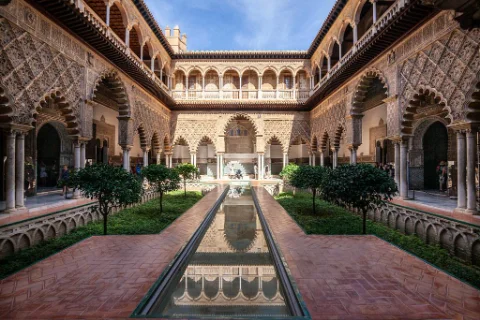
Its walls are covered with intricate geometric patterns. Arabic inscriptions decorate architectural surfaces. Elaborate plasterwork frames elegant arches, while courtyards and ornamental details recall the artistic traditions of al-Andalus.
Where are you?
Inside the Royal Alcázar of Seville, one of Spain's most fascinating architectural complexes.
But why would a Christian monarch choose an artistic language so strongly associated with Islamic courts?
The answer reveals an unexpected relationship between architecture, political authority, and cultural prestige.
A Christian King and an Andalusi Architectural Legacy
During the fourteenth century, King Pedro I of Castile commissioned an extraordinary palace within the Alcázar complex.
Its construction took place in a Christian kingdom, yet many of its decorative traditions drew upon artistic practices developed in Islamic Iberia.
This was not simply an imitation of a foreign architectural style.
It reflected a long history of artistic exchange, the prestige of Andalusi craftsmanship, and the availability of highly skilled artisans.
The palace demonstrates how rulers could adopt artistic languages associated with other political and religious traditions to express their own authority.
Architecture as a Language of Power
Medieval royal palaces were more than residences.
They were carefully designed environments in which architecture communicated hierarchy, legitimacy, magnificence, and political ambition.
Decorative richness helped establish the prestige of a court.
In the Palace of Pedro I, intricate ornamentation and sophisticated spatial arrangements contributed to an image of royal splendor.
Islamic-derived artistic forms were not necessarily perceived as incompatible with Christian kingship.
They could be appropriated, adapted, and transformed within a new political setting.
The Artisans Who Connected Different Worlds
The creation of such buildings depended upon skilled craftsmen.
Plasterworkers, carpenters, ceramic specialists, and other artisans possessed technical knowledge transmitted through workshops and established building traditions.
Their expertise could serve different patrons, including Christian monarchs.
The Alcázar also reflects connections with the artistic world of Nasrid Granada, whose courtly architecture was admired for its refinement.
These relationships reveal that political and religious boundaries did not prevent the movement of artistic ideas.
Yet such exchanges occurred within unequal and sometimes conflictive political environments.
Geometry, Inscriptions, and Ornament
One of the most striking features of the palace is its decorative complexity.
Geometric patterns organize surfaces into carefully balanced compositions.
Carved plasterwork creates an extraordinary interplay of light, shadow, and texture.
Arabic inscriptions form part of the architectural decoration, demonstrating the prestige and adaptability of written ornament.
These elements were not merely decorative additions.
They helped construct a sophisticated visual environment through which the monarchy projected its status.
The palace's architecture communicated political authority through artistic forms whose histories extended beyond the Christian court.
What Makes This Architecture Mudéjar?
The term Mudéjar is frequently used to describe architectural and decorative traditions associated with Islamic-derived craftsmanship under Christian rule in medieval Iberia.
However, the term covers a broad range of regional and historical circumstances.
The Palace of Pedro I is particularly significant because it illustrates the direct relationship between royal patronage and these artistic traditions.
Its architecture demonstrates that cultural influence does not always follow the same boundaries as political allegiance or religious identity.
A Christian ruler could commission a palace that drew heavily upon artistic practices associated with Islamic courts.
A Monument with Many Historical Layers
The Royal Alcázar is not a building created during a single historical moment.
It is an architectural complex transformed across centuries.
Its successive structures and modifications reflect changing rulers, political circumstances, artistic preferences, and architectural technologies.
This layered history is essential to understanding the monument.
Rather than representing one fixed cultural identity, the Alcázar preserves evidence of multiple periods of construction and adaptation.
What the Alcázar Reveals
Why did Christian kings build palaces inspired by Islamic art?
Because architecture was a language of prestige and power, and artistic traditions could transcend the political and religious environments in which they had developed.
The Palace of Pedro I reminds us that cultural exchange can involve admiration, adaptation, competition, and appropriation.
Its beauty is inseparable from the complex historical relationships that made its construction possible.
Sometimes, the most revealing expression of political power is the artistic language a ruler chooses to adopt.
Discover More
This article is part of a series exploring the architectural connections behind Our Secret Geometry: A Fascinating Journey through Ibero-American Mudéjar Art, by Monserrat Díaz Ortega.
Explore the book and watch its trailer:
Monserrat Díaz Ortega
Independent Researcher and Author | International Relations, Art History and Cultural Heritage