Many indie authors promote their books in bursts.
They post heavily for a few days, send one launch email, share a few links, and then wonder why sales slow down.
The problem is not always the book.
Sometimes the problem is timing.
Book marketing works better when it follows a clear path. Readers usually do not buy the first time they see a book. They notice it, become curious, see it again, understand why it fits them, trust the author a little more, and then decide whether to buy.
That process takes time.
A strong book marketing timeline helps you guide readers through that journey instead of hoping one announcement will do all the work.
The goal is not to be loud every day. The goal is to be visible at the right moments with the right message.
Why Indie Authors Need a Marketing Timeline
A marketing timeline gives structure to your book promotion.
Without one, promotion can feel scattered. You may post randomly, forget important launch tasks, miss review opportunities, or start talking about the book too late.
With a timeline, every stage has a purpose.
You know when to build awareness, when to invite readers, when to send ARCs, when to ask for reviews, when to promote the launch, and when to keep momentum going after release.
A marketing timeline helps you:
- reduce launch stress
- prepare content early
- warm up readers before release
- organize ARC readers
- plan newsletter emails
- create better promotional angles
- avoid repetitive selling
- support long term book sales
- keep your backlist alive after launch
Book marketing is not one message. It is a sequence.
Real Sales Come from Reader Readiness
A reader may need several touchpoints before buying a book.
They might first see your cover. Later, they read your description. Then they notice a sample chapter. Then they see a review. Then they receive your newsletter. Then they finally click the buy link.
That is why a timeline matters.
You are not just promoting a product. You are helping readers become ready.
Reader readiness comes from:
- awareness
- interest
- trust
- clarity
- timing
- urgency
- confidence
If your marketing only appears on launch day, you are asking readers to move from zero awareness to purchase in one step.
Some will do it. Many will not.
A timeline gives them more reasons and more chances to act.
Start with Your Launch Date
Every marketing timeline begins with one clear date: publication day.
Once you know your launch date, you can work backward.
Ask yourself:
- When should readers first hear about the book?
- When should ARC readers receive copies?
- When should my newsletter be warmed up?
- When should preorder promotion begin?
- When should review requests go out?
- When should launch week emails be sent?
- What happens after launch?
The launch date is not the whole plan. It is the center point.
Your marketing should begin before it and continue after it.
90 Days Before Launch: Build the Foundation
If you have 90 days before launch, this is the best time to prepare the foundation.
At this stage, you are not pushing hard for sales yet. You are making sure your book has the right structure around it.
Focus on:
- finalizing your book positioning
- clarifying your target reader
- improving your book description
- preparing your author bio
- planning your cover reveal
- setting up your newsletter signup
- creating a reader magnet if needed
- identifying ARC readers
- researching reviewers and book bloggers
- planning launch content
This stage is about clarity.
Before you ask readers to care, you must know how to explain the book.
Define Your Target Reader
A strong marketing timeline begins with knowing who the book is for.
Do not market to everyone.
A book for everyone usually feels unclear to everyone.
Ask:
- What genre is this book?
- What mood does it offer?
- What type of reader will enjoy it most?
- What similar books or authors might they like?
- What promise does this book make?
- What problem does it solve or what experience does it create?
For fiction, your reader may want suspense, comfort, romance, wonder, fear, escape, mystery, laughter, or emotional depth.
For nonfiction, your reader may want clarity, guidance, transformation, knowledge, motivation, or practical steps.
The clearer your reader is, the stronger your marketing becomes.
75 Days Before Launch: Prepare Your Sales Assets
Sales assets are the materials that help readers decide whether to buy.
They include:
- book cover
- book description
- author bio
- preorder page
- website page
- launch graphics
- sample chapter
- review copy
- newsletter signup page
- social media copy
- book listing copy
Do not wait until launch week to create these.
Your book page should be ready before you send traffic to it. Your newsletter signup should be ready before readers start discovering you. Your sample chapter should be prepared before you invite people to preview the book.
A strong timeline prevents last-minute confusion.
60 Days Before Launch: Begin Soft Awareness
Two months before release, you can begin introducing the book softly.
This is not the time to shout “buy now” every day.
Instead, start building curiosity.
You can share:
- the idea behind the book
- the genre and mood
- a character introduction
- a behind-the-scenes note
- a short writing update
- a cover teaser
- a theme from the book
- a question related to the story
- a small excerpt
The goal is simple: let people know something is coming.
Soft awareness makes launch promotion feel less sudden.
45 Days Before Launch: Invite ARC Readers
Around six weeks before launch, begin organizing your ARC team.
ARC readers need time to read. If you invite them too late, you may create pressure and get fewer reviews.
Your ARC invitation should be clear and respectful.
Include:
- book title
- genre
- short description
- expected review date
- format available
- review platforms
- honest review reminder
Do not ask for positive reviews. Ask for honest reviews.
A thoughtful ARC team can help create early social proof, but only if readers have enough time and a clear process.
40 Days Before Launch: Send the ARC Copy
Once your ARC team is ready, send the book with simple instructions.
Include:
- download link
- launch date
- review date
- review links if available
- contact information
- thank-you note
- reminder that short honest reviews are helpful
Keep the email easy to follow.
Readers are more likely to help when the process is simple.
30 Days Before Launch: Shift into Active Promotion
One month before launch, your marketing becomes more visible.
Now you can begin talking about the book more directly.
This is a good time to:
- reveal the cover
- share the book description
- announce preorder links
- send a newsletter update
- post a sample chapter
- schedule newsletter swaps
- reach out to reviewers
- prepare launch week emails
- update your website
- list the book on discovery platforms
This stage should connect curiosity with action.
Readers should now have somewhere to go if they want to learn more.
Use Book Discovery Platforms Strategically
A marketing timeline works best when readers can find your book in more than one place.
Your website and newsletter are important, but they should not be the only discovery points.
You can also use:
- book listing websites
- author interview platforms
- reader communities
- genre groups
- book blogs
- newsletter swap networks
- sample chapter platforms
- social media communities
For indie authors, a platform like IndieReadingCommunity.com can be useful as part of a broader visibility plan. Authors can use book listings, author content, interviews, and reader-facing discovery to create more ways for readers to notice their work before and after launch.
The goal is not to depend on one platform.
The goal is to create multiple doors into your book.
21 Days Before Launch: Warm Your Email List
Your email list should not hear from you only on launch day.
Start warming your subscribers a few weeks before release.
Send emails that build interest without overwhelming them.
You might send:
- a personal note about the book
- a behind-the-scenes story
- a sample chapter
- a cover reveal
- a preorder reminder
- a reader-focused description
- a launch week heads-up
Each email should have a purpose.
Do not send the same message repeatedly. Give readers different reasons to care.
14 Days Before Launch: Strengthen the Book Promise
Two weeks before launch, focus on the reader promise.
Tell readers exactly what kind of experience the book offers.
For fiction, explain the emotional or genre promise.
Examples:
- for readers who love slow-burn mystery and family secrets
- for fans of cozy small-town romance
- for readers who enjoy dark fantasy with political tension
- for anyone who likes fast thrillers with moral dilemmas
For nonfiction, explain the practical promise.
Examples:
- for authors who want a calmer launch plan
- for beginners who need simple marketing steps
- for readers who want clear productivity habits
- for creators who want to build consistent income
A strong promise helps the right reader say, “This is for me.”
10 Days Before Launch: Prepare Your Sales Path
A sales path is the journey from interest to purchase.
Make sure it is clear.
Check:
- buy link
- preorder link
- book page
- newsletter link
- sample chapter link
- author bio
- social media bio
- pinned post
- review links
- reading order if it is a series
Readers should not have to search.
If a reader is ready to buy but cannot find the right link quickly, you may lose the sale.
Make the next step easy.
7 Days Before Launch: Create Launch Week Momentum
Launch week should not be random.
Plan each day with a slightly different angle.
For example:
Day 7 before launch
Share the book promise and who the book is for.
Day 6 before launch
Share a short excerpt or sample chapter.
Day 5 before launch
Send a pre-launch newsletter.
Day 4 before launch
Share a behind-the-scenes post.
Day 3 before launch
Remind ARC readers that launch is close.
Day 2 before launch
Post a preorder or release reminder.
Day 1 before launch
Share a final “tomorrow” message.
This creates momentum without repeating the exact same announcement every day.
Launch Day: Make Action Easy
On launch day, your message should be clear.
Tell readers:
- the book is available
- what it is about
- who it is for
- where to buy it
- how they can support it
Do not make the launch post too complicated.
A simple launch message can work well:
“My new book is now available. If you enjoy [genre or reader promise], this story may be for you. You can read it here: [link].”
Send your launch email. Post your launch announcement. Update your website and social links. Send review links to ARC readers. Thank people who support you.
Then breathe.
Launch day matters, but it is not the whole marketing plan.
3 Days After Launch: Keep the Conversation Moving
After launch day, many authors go silent.
That is a mistake.
Some readers miss the first announcement. Others need another reminder. Some are still deciding.
Continue the conversation with fresh angles.
You can share:
- early reader reactions
- a review snippet
- a character spotlight
- a theme from the book
- a quote
- a behind-the-scenes note
- a reminder of the reading experience
- a thank-you post
Do not simply repost “buy my book” every day.
Give people new reasons to pay attention.
7 Days After Launch: Request Reviews Politely
One week after launch, send a review request to readers who may have finished the book.
Keep it respectful.
Say:
- thank you for reading
- honest reviews help other readers
- even a few sentences are useful
- include direct review links
- no pressure
Do not guilt readers.
Reviews are important, but reader trust is more important.
A kind review request can build goodwill. A demanding one can damage it.
14 Days After Launch: Promote to New Audiences
After your immediate audience has heard about the book, look outward.
This is a good time to reach new readers through:
- newsletter swaps
- book blogs
- author interviews
- discovery sites
- reader groups
- guest posts
- podcast pitches
- genre communities
- sample chapter sharing
The goal is to extend visibility beyond your existing circle.
A launch should ripple outward.
30 Days After Launch: Review Results and Adjust
One month after launch, study what happened.
Look at:
- sales
- reviews
- newsletter clicks
- social engagement
- website traffic
- preorder results
- ARC participation
- reader replies
- strongest content
- weakest content
Ask:
- Which messages got attention?
- Which emails got clicks?
- Which platforms sent traffic?
- Which reader groups responded?
- Did the book description convert?
- Did reviews mention the same strengths or weaknesses?
- What should change for the next launch?
This review stage helps you improve future marketing.
Every launch teaches you something.
60 Days After Launch: Keep the Book Alive
A book is not old just because launch month is over.
Many readers will discover it later.
After the first month, shift from launch marketing to long term marketing.
You can continue promoting through:
- backlist emails
- seasonal angles
- reader recommendations
- series reading order posts
- book club outreach
- review follow-ups
- author interviews
- blog articles
- social media excerpts
- newsletter swaps
- platform listings
Your book can keep selling if you keep creating relevant discovery points.
Build a Timeline for Your Backlist Too
Marketing timelines are not only for new releases.
You can also create timelines for older books.
For example, you might plan:
- a 7-day backlist spotlight
- a seasonal promotion
- a series catch-up campaign
- a book anniversary campaign
- a review push
- a newsletter feature
- a reader recommendation campaign
Backlist books often sell when authors remember to talk about them again.
A reader who never saw the book at launch may be ready for it months later.
Match Each Timeline Stage to a Reader Question
At every stage, readers have different questions.
Your marketing should answer them.
Early awareness
What is this book?
Interest stage
Why might I care?
Preorder stage
Is this my kind of book?
Launch stage
Where can I get it?
Review stage
Do other readers like it?
Post-launch stage
Why should I read it now?
A good timeline moves readers from question to answer.
That is how marketing becomes more than noise.
Avoid These Book Marketing Timeline Mistakes
Starting too late
If readers first hear about the book on launch day, you are making the sale harder.
Promoting without a clear message
If readers cannot understand the book quickly, many will move on.
Repeating the same post too often
Use different angles instead of copying the same announcement.
Ignoring email marketing
Your newsletter can be one of your strongest sales tools.
Forgetting review follow-up
Reviews help future readers trust the book.
Stopping after launch week
Many sales happen after the first wave of promotion.
Trying to do everything
A focused timeline is better than an exhausting one.
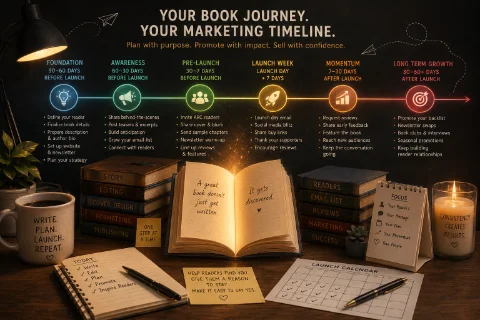
A Simple Book Marketing Timeline Template
Here is a basic structure you can adapt.
90 days before launch
Clarify target reader, book promise, description, author bio, and launch goal.
60 days before launch
Begin soft awareness with behind-the-scenes content, reader questions, and early book updates.
45 days before launch
Invite ARC readers, contact reviewers, and prepare launch materials.
30 days before launch
Start active promotion, cover reveal, preorder messaging, sample chapter sharing, and discovery listings.
21 days before launch
Warm up your newsletter and begin stronger reader-focused messaging.
14 days before launch
Highlight the book promise and prepare launch week content.
7 days before launch
Build daily launch momentum with varied posts and emails.
Launch day
Announce clearly, send email, update links, thank readers, and send review instructions.
7 days after launch
Request honest reviews and share early reader reactions.
30 days after launch
Review results, adjust messaging, and continue wider promotion.
60 days after launch
Move into long term discovery, backlist promotion, interviews, swaps, and reader engagement.
This timeline is flexible. The important thing is having a plan before you need one.
Final Thoughts
A book marketing timeline helps indie authors promote with purpose.
Instead of posting randomly and hoping for sales, you guide readers through a clear journey. You build awareness before launch. You create interest before asking for action. You make buying easy when the book is ready. You continue visibility after launch day has passed.
Real sales rarely come from one announcement.
They come from repeated, relevant moments that help readers understand why the book is worth their attention.
Plan those moments.
That is how your marketing becomes calmer, smarter, and more effective.
Conclusion
A strong book marketing timeline gives your book a better chance to be discovered, understood, purchased, reviewed, and remembered.
Start with your launch date. Work backward. Build awareness early. Warm up your audience. Make the sales path clear. Keep promoting after launch.
The best timeline does not pressure readers.
It prepares them.