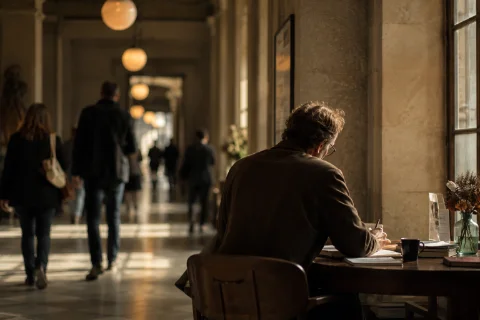
You're sitting behind your table, books neatly arranged, and people keep walking past. Not rudely, not even noticeably slowing down, just a steady stream of eyes that glance and move on. After half an hour of this, the silence starts to feel personal, and the temptation to say something, anything, to break it becomes hard to resist.
What you say in that moment matters more than almost anything else about the table itself. The right line can turn a glance into a pause, and a pause into an actual conversation. The wrong one, said with the best of intentions, can make people walk a little faster than they already were.
Why Silence Feels Worse Than It Is
A quiet table doesn't necessarily mean people aren't interested. It often just means nobody has been given a reason to stop yet. Readers walking past a fair or through a bookshop are usually in browsing mode, half paying attention, not actively looking to be sold to. A quiet table is simply the default state until something interrupts that browsing mode enough to make someone pause.
The mistake most authors make is treating the silence as an emergency that needs an immediate, urgent response, which tends to produce exactly the kind of line that pushes people further away rather than drawing them in.
What Never to Say
"Would you like to buy a book today?" This is the single most common line authors reach for in a quiet stretch, and it's also one of the most reliable ways to get a polite decline. It frames the interaction as a transaction before the person has even decided whether they're interested in what you write, which triggers the instinct to protect themselves from a pitch they didn't ask for.
"It's really good, I promise." Said out of nervousness more than anything else, this line asks someone to trust your opinion of your own work, which is a much harder sell than letting the work speak for itself through a specific detail instead.
"Everyone's been loving it." Vague claims like this tend to read as unconvincing rather than persuasive, since there's no way for the person to verify it and it sounds like something said to every single passerby, which it usually is.
Nothing at all, paired with a hopeful stare. Saying nothing and simply watching someone approach can feel safer than risking an awkward line, but a silent, expectant look often reads as pressure rather than warmth, and tends to make people glance away and keep walking rather than stop.
What to Say Instead
Lead with a specific, slightly odd detail. Rather than a general greeting, try something like "this one started as a story about a lighthouse keeper who refuses to leave during a storm." A specific detail gives a passerby something concrete to react to, and a reaction is the first step toward an actual conversation, rather than just a polite acknowledgement.
Ask a light, low-stakes question rather than a sales question. "Are you more of a thriller reader or do you read a bit of everything?" invites a response without asking for anything in return. It treats the person as someone worth a quick chat, not someone you're trying to close a sale with, which tends to put people at ease rather than on guard.
Comment on something they're already doing. If someone picks up your book and turns it over to read the back, a simple "that one's a bit of a slow burn, takes about two chapters before things really kick off" responds to their actual action rather than interrupting it with an unrelated pitch.
Use humour about the quiet table itself, if it fits your personality. A light, self-aware comment like "feel free to judge a book by its cover, that's honestly what it's there for" can disarm the awkwardness of a quiet stretch and often gets a genuine smile, which is usually enough to make someone pause a little longer than they intended to.
What to Do When Genuinely Nobody Is Walking By
Sometimes the issue isn't what you're saying, it's that there's simply nobody nearby to say it to. In that case, resist the urge to call out across an empty aisle, which tends to feel desperate rather than inviting. Instead, use the quiet stretch productively, rearrange your table slightly, read a few pages of your own book, or chat naturally with the author at the table next to you. A quiet, relaxed presence is far more inviting to anyone who eventually walks past than a tense, eager one waiting for the next passerby.
Reading the Room Before You Speak
Not every passerby wants to be spoken to at all, and pushing a line on someone who's clearly just passing through without making eye contact tends to backfire. Save the opener for people who slow down even slightly, glance at the table, or make brief eye contact, since that small signal is usually an invitation to say something, while someone walking briskly past with their eyes elsewhere generally isn't.
The Part Worth Remembering
The silence at a quiet table isn't a verdict on your book. It's just an absence of a reason to stop, and that reason has to come from something specific and genuine rather than a generic sales line reached for out of nervousness. The right opener doesn't need to be clever or rehearsed. It just needs to sound like something a person would actually say to another person, rather than something a table says to a customer.