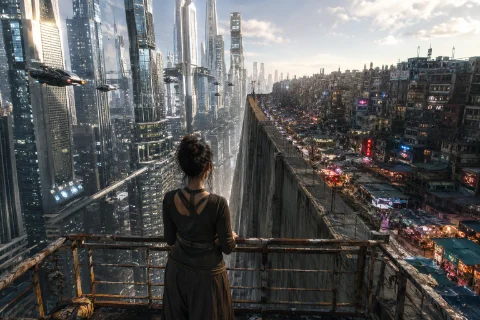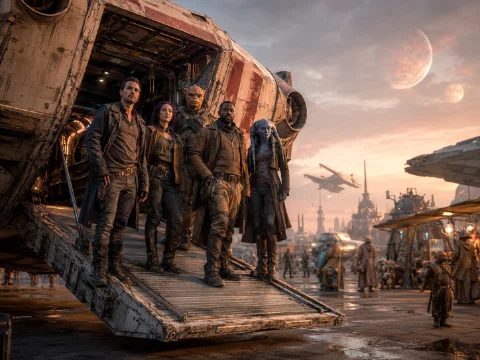
Space opera is a subgenre of science fiction defined by scale, drama, and adventure rather than scientific precision. It typically features sprawling interstellar settings, galactic empires, sweeping conflicts, and bold heroic or tragic arcs, often spanning multiple worlds, alien species, and generations. The science is usually present but rarely the point. What drives space opera is story, big emotions, big stakes, and a sense that the fate of entire civilisations hangs in the balance.
The name itself is a clue to the genre's spirit. It borrows from "soap opera," originally a slightly dismissive term suggesting melodrama and sprawling, larger-than-life storytelling. Over time, space opera shed the dismissive connotation and became one of science fiction's most popular and enduring subgenres.
Space Opera vs Hard Science Fiction
These two subgenres sit at opposite ends of the science fiction spectrum.
Hard science fiction prioritises scientific plausibility, often grounding its plot in real or carefully extrapolated physics, technology, and consequences. The "what if" tends to be tightly reasoned.
Space opera prioritises story and spectacle over scientific rigour. Faster-than-light travel, sentient alien empires, and improbable technology are accepted as part of the furniture, useful tools for telling a sweeping story rather than something the plot needs to justify in detail.
Neither approach is more "valid" than the other, they're simply built around different promises to the reader. Hard science fiction asks readers to follow rigorous extrapolation. Space opera asks readers to enjoy the ride.
Core Features of Space Opera
A few elements appear consistently across the genre.
Vast scale. Stories often span multiple planets, star systems, or even galaxies, with conflicts large enough to threaten entire civilisations.
Political and military conflict. Empires, rebellions, and interstellar wars are genre staples, frequently with complex factions and shifting allegiances.
Larger-than-life characters. Protagonists tend to be heroic, tragic, or both, often carrying weight beyond their individual story, a chosen one, a reluctant leader, a rebel against an empire.
Found family and crews. Many space operas centre on a ship's crew or a small group bound together, which gives the vast scale of the setting a more intimate emotional anchor.
Advanced but loosely explained technology. Spaceships, weapons, and alien tech exist to enable the story rather than to be scientifically dissected.
A Brief History of the Genre
Space opera's roots trace back to early twentieth-century pulp science fiction, where serialised adventure stories set among the stars built the genre's appetite for scale and drama. It grew steadily through the mid-century and exploded into mainstream culture from the 1970s onward, when major film and television franchises brought space opera's sweeping conflicts and mythic storytelling to a massive audience.
Since then, the genre has continued evolving, branching into darker, more politically complex variations, often described as New Space Opera, which keep the scale and drama of classic space opera while engaging more directly with themes like colonialism, identity, and the cost of empire.
Why Readers Love Space Opera
Part of the appeal is pure scale. Few genres offer the same sense of sweeping consequence, entire worlds and civilisations at stake, paired with personal, character-driven stories that keep the vastness from feeling cold or abstract.
The genre also offers a flexible canvas for big themes. Empire, rebellion, identity, and belonging all map naturally onto interstellar conflict, giving space opera room to explore weighty ideas while still delivering pure adventure and spectacle.
Found family dynamics play a major role too. A diverse crew bound together against overwhelming odds is one of the genre's most reliable emotional engines, giving readers people to root for amid the scale of galaxy-spanning conflict.
Common Mistakes Writers Make With the Genre
A frequent stumble is overloading the story with world-building at the expense of character. Space opera lives or dies on its people, the empire and the technology are backdrop, not substitute, for genuine character stakes.
Another common issue is confusing scale with stakes. A galaxy-spanning conflict means little if the reader isn't anchored to specific characters whose fates feel personal. The biggest space operas tend to succeed by keeping at least one storyline intimate, even while the wider conflict spans star systems.
Exploring Space Opera Further
Independent science fiction authors have found considerable room to experiment within this genre, often blending classic space opera scale with fresher perspectives on empire, identity, and found family. Readers new to the genre are usually well served by starting with a series built around a strong central crew, since that human anchor tends to make the vastness of the setting land with real emotional weight.