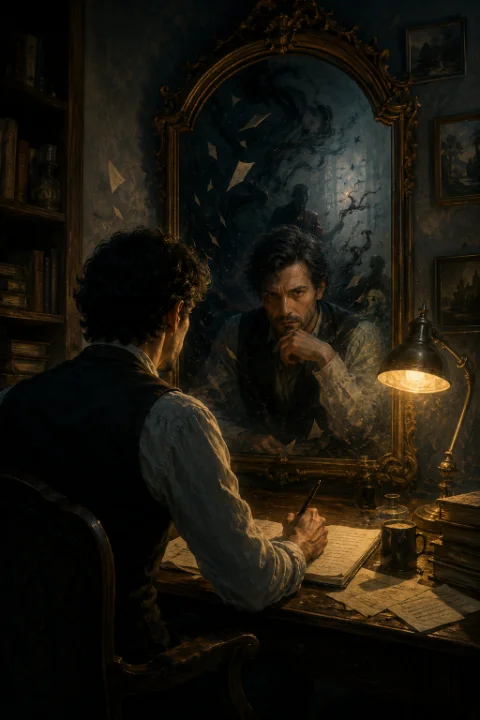
Every time a writer sits down to work, they create a version of themselves on the page. This version is not exactly the person who exists in daily life. It is a constructed voice shaped by choices about language, perspective, tone, and what to reveal or withhold. This constructed voice can be thought of as the writer’s doppelgänger: a close but distinct double that lives inside the story.
Learning to work with this doppelgänger is one of the most important skills in creative writing. It allows writers to be honest without being purely confessional. It creates space for invention while still drawing on real experience. And it helps writers develop a voice that feels both authentic and artistically controlled.
The relationship between the real self and the narrative persona is rarely simple. It is a negotiation that continues throughout a writing life.
Why the Distinction Matters
When writers treat the narrative voice as identical to their own identity, they can become limited by what feels “true” to their personal experience. This can lead to overly cautious writing or stories that feel too close to life to achieve artistic shape.
On the other hand, when writers treat the narrative persona as completely separate from themselves, the writing can feel hollow or performative. Readers often sense when a voice lacks genuine connection to the writer’s inner life.
The most compelling work usually exists in the tension between these two poles. The writer draws on their real thoughts, feelings, and observations while using the freedoms of fiction compression, invention, and selection to shape those elements into something larger than autobiography.
Techniques for Working with Your Narrative Doppelgänger
Give the persona permission to be different from you.
Your narrative voice can be more confident, more vulnerable, more cynical, or more hopeful than you feel in everyday life. It can also be less articulate or more fragmented. Experiment with allowing the voice on the page to have qualities you do not fully claim in real life.
Use the persona as a filter.
Decide what the narrative voice knows, notices, and cares about. This filter determines what enters the story and how it is presented. A more limited or biased persona can create powerful effects, especially in unreliable or intimate narration.
Vary the distance between self and persona
In some projects, you may want the narrative voice to feel very close to your own sensibility. In others, you may want more distance. Learning to adjust this distance deliberately gives you greater control over tone and emotional effect.
Let the persona evolve.
Just as people change over time, narrative voices can develop across a body of work or even within a single long project. Allowing the doppelgänger to grow can prevent your writing from becoming static.
Pay attention to what the persona hides.
Often, the most interesting aspects of a narrative voice lie in what it chooses not to say or what it struggles to articulate. These gaps can reveal as much as the words that appear on the page.
Examples of Writers Working with Persona
Many writers have built distinctive careers by developing strong narrative personas that are clearly related to but not identical with their actual selves. Some create voices that feel intimate and confessional while still shaping experience through fictional techniques. Others use more detached or ironic personas to explore difficult material with greater freedom.
These examples show that the most memorable voices often emerge from the productive tension between the writer’s real experiences and the artistic choices they make on the page.
Pitfalls to Watch For
One risk is becoming too protective of the narrative persona. If you only allow the voice to say things you would comfortably say in real life, the writing can lose its edge and surprise.
Another common issue is confusing readers by shifting too abruptly between different personas without a clear artistic purpose. While experimentation is valuable, consistency within a single work usually serves the story better.
Be careful not to treat the narrative persona as a mask that completely conceals the writer. Readers are often drawn to the sense that a real consciousness is guiding the story, even when that consciousness is filtered and shaped.
Finally, avoid letting the persona become a limitation. The goal is not to create one fixed voice that you use forever, but to develop the skill of crafting the right voice for each project.
Practical Exercises for Developing Your Narrative Doppelgänger
Write the same short scene three times using three different narrative personas. Make one more formal, one more intimate, and one more ironic. Notice how the emotional effect changes with each version.
Take a personal memory and write it as if you are someone slightly different from yourself, perhaps older, younger, or from a different background. Observe what new insights or details emerge.
Choose a piece you have already written and revise it while deliberately shifting the distance between the narrator and your real self. Make the voice either closer or more removed than it currently is.
Keep a short journal for one week in which you write in the voice you most often use in your fiction. Then write a second entry describing how that voice differs from how you actually think and speak.
The Creative Power of the Double
The writer’s doppelgänger is not an obstacle to authenticity. It is a tool that enables deeper authenticity. By creating a distinct narrative voice, writers can explore experiences, questions, and emotions that might feel too raw, too dangerous, or too shapeless when approached directly.
This negotiation between self and persona is ongoing. It changes with each project and often with each draft. Learning to work consciously with your narrative doppelgänger gives you greater freedom, control, and range as a writer.
The most powerful stories often emerge from the space between who we are and who we become when we tell a story. That space is where invention and truth meet, and where the most lasting writing is born.
How do you experience the difference between your everyday self and the voice you use when writing? Have you noticed your narrative persona changing across different projects? Share your reflections in the comments. The Indie Reading Community is full of writers who think deeply about these questions of voice and identity.