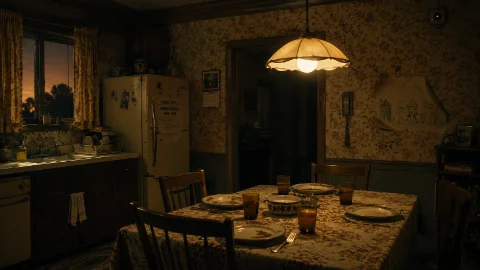
Ask any reader about a novel they loved years ago and watch what happens. They will not recite the plot. They will not summarise the themes. They will tell you about a moment. The scene where the two brothers finally say the thing they have spent the whole book not saying. The scene in the snow. The scene at the dinner table where nobody raises their voice and everything falls apart anyway.
Novels live in the memory as scenes, because scenes are the actual unit of fictional experience. Plot is an abstraction. Theme is an afterthought. Structure is invisible scaffolding. What the reader actually experiences, moment by moment, page by page, is scene after scene after scene, and the quality of those scenes is the quality of the book.
This is both liberating and demanding for a working writer. Liberating, because it means the overwhelming task of writing a novel reduces to a repeatable, learnable unit of craft. Demanding, because it means there is nowhere to hide. A novel with a brilliant premise and weak scenes is a weak novel. A novel with a modest premise and unforgettable scenes is the book readers press into their friends' hands.
Here is how scenes actually work, and how to write the kind that stay with people.
A scene is a unit of change, not a unit of time
The most common misunderstanding about scenes is that they are containers for events: a place where something happens, described from beginning to end. This definition produces the flat, dutiful scenes that fill so many unpublished manuscripts, scenes in which characters arrive, do the thing the plot requires, and leave.
A scene is better understood as a unit of change. Something must be different at the end of a scene than it was at the beginning, and the difference must matter. A character knows something they did not know. A relationship has shifted, even fractionally. A decision has been made or has become impossible. A door has opened or closed. If nothing has changed, what you have written is not a scene. It is an interlude, and interludes are what readers skim.
The practical test is brutally simple and worth applying to every scene in a draft: could this scene be deleted without anything downstream needing to be rewritten? If the answer is yes, the scene is not currently earning its place. Either it needs to be cut, or, more often, it needs to be given a job: some specific change that the rest of the story then depends on.
This is why experienced novelists often describe their revision process as an audit of scene function. Not "is this scene well written" but "what does this scene change." A beautifully written scene that changes nothing is a luxury a novel cannot afford. A plainly written scene that turns the story is load-bearing, and its plainness can be fixed in polish.
Every scene needs a character who wants something right now
The engine of a scene is desire operating at close range. Not the protagonist's grand novel-spanning goal, but what this character wants in this room in the next five minutes. To get an answer without asking the question directly. To leave without being noticed. To be forgiven without having to apologise first. To find out how much the other person knows.
Scene-level desire is what gives a scene its direction and its tension, because the moment a character wants something within a scene, everything that happens either moves them toward it or away from it, and the reader begins, often unconsciously, to track the progress. The scene acquires a current. Dialogue stops being conversation and becomes strategy. Small actions acquire meaning because they are moves in a game the reader understands.
The richest scenes give opposed desires to everyone present. Two characters who want incompatible things in the same conversation generate conflict without anyone needing to raise their voice. A dinner scene in which one character wants to make an announcement, another wants to prevent it, and a third wants to pretend everything is fine is a scene that writes itself forward, because every line of dialogue is doing double work: surface meaning and strategic purpose.
When a scene in your draft feels inert, the diagnosis is almost always here. Somebody in the scene has no active want. They are present as furniture, responding to the plot rather than pursuing anything. Give every character in the room something they are trying to get, however small, and the scene comes alive on its own.
Enter late, leave early
The most consistently useful piece of scene craft ever borrowed from screenwriting is the principle of entering a scene at the last possible moment and leaving at the first. Fiction writers, given unlimited space, tend to walk their characters to the door: the arrival, the greeting, the settling in, the small talk, and then finally, on page two, the actual substance of the scene. Then, substance delivered, they walk the characters out again: the goodbyes, the door, the drive home.
Almost all of that is disposable. Readers do not need the approach or the exit. They arrived in this scene from a previous one and they will orient themselves within a sentence or two of specific detail. A scene can begin in the middle of the conversation that matters. It can begin with the answer to a question the reader did not hear asked. It can end on the line that changes everything, leaving the aftermath to the reader's imagination or the next scene's opening, which is almost always more powerful than describing the stunned silence at length.
Entering late does more than improve pace. It creates a small, continuous pressure of curiosity, because the reader is perpetually catching up, working out what is already in motion, and that low-level cognitive engagement is a large part of what makes prose feel alive rather than administered. Leaving early does the complementary work: it hands the scene's final weight to the reader while it is still heavy, before explanation can lighten it.
Go through any draft and look at the first and last paragraph of every scene. In most early drafts, a remarkable number of scenes improve immediately if the first paragraph is deleted and the last paragraph is cut in half. The real scene was hiding inside the packaging.
Ground every scene in a specific body in a specific place
Scenes become memorable through the senses, and this is where much otherwise competent fiction quietly fails. Dialogue floats in white space. Emotions are named rather than felt. The reader is told a scene takes place in a kitchen but the kitchen has no temperature, no smell, no objects with history, no light coming from any particular direction.
The scenes readers remember for years are almost always physically anchored. Not through long description, which readers skip, but through a small number of precise sensory details that make the space real and then keep the characters' bodies present within it throughout. The way a character keeps turning a cold mug in her hands during a confrontation. The neighbour's radio bleeding faintly through the wall of an argument. The particular quality of afternoon heat in a car where two people are not saying what they mean.
Physical grounding does emotional work that direct statement cannot. A character who says she is fine while shredding a paper napkin into smaller and smaller pieces communicates more than a paragraph of narrated anxiety, and the reader receives it as their own perception rather than the author's instruction, which is precisely what makes it stick. The body is honest in fiction even when the dialogue is lying, and the gap between the two is one of the most powerful effects available at scene level.
One detail chosen well beats ten chosen adequately. The test of a good scene detail is whether it could only belong to this scene: this room, this character, this moment of this relationship. Generic details, the steaming coffee, the ticking clock, are wallpaper. Specific details are memory hooks, and they are what the reader's mind keeps when everything else fades.
Let the scene's surface and depth run on different tracks
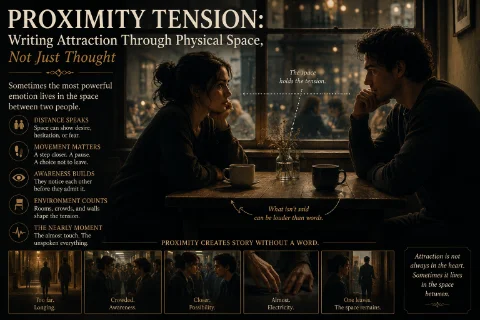
The unforgettable scenes in fiction are almost never about what they appear to be about. The surface is a conversation about whose turn it is to visit their ageing mother. The depth is thirty years of one sibling feeling like the family's unpaid caretaker. The surface is two colleagues discussing a project handover. The depth is that one of them is in love with the other and this is the last time they will ever be in a room together.
This layering is what craft discussions call subtext, but the term undersells what is actually happening. A great scene runs two complete tracks simultaneously: a surface action that is coherent and worth following on its own terms, and an underlying emotional transaction that the surface is either enabling, disguising or straining against. The reader perceives both, and the energy of the scene lives in the gap between them.
Building this deliberately is more mechanical than it sounds. Decide what the scene is really about, the depth track, and then deny the characters the ability to address it directly. Give them a reason they cannot say the true thing: pride, fear, the presence of a third person, the rules of the relationship, the simple human difficulty of saying true things. Then give them a surface activity, and let the depth pressurise it. The argument about the dishwasher becomes the argument about the marriage. The chess game becomes the power struggle. The reader feels the true subject rising through the floorboards of the scene, and feeling it, rather than being told it, is what makes it unforgettable.
The scenes to be most suspicious of in revision are the ones where characters say exactly what they mean and mean exactly what they say. Occasionally a story earns a scene of full directness, and when it has been earned by chapters of restraint, it lands with enormous force. But as a default mode, total directness flattens fiction, because it collapses the two tracks into one and leaves the reader nothing to do.
End every scene by loading the next one
Scenes in a novel are not beads on a string, self-contained and merely sequential. In well-built fiction each scene ends by creating the pressure that the next scene will have to deal with: a question raised, a decision made whose consequences are now inevitable, a piece of information that a specific character now possesses and someone else does not.
This forward loading is what produces the sensation readers describe as "I couldn't put it down," and it is engineered at scene endings. The classic tools are all versions of the same move. The revelation arrives in the scene's final lines rather than its middle. The decision is made but the outcome is deferred. A new element enters just as the scene closes. The character gets what they wanted and the reader can see, before the character can, what it is going to cost.
There is a rhythm to be managed here. A novel in which every scene ends on a cliffhanger becomes exhausting and starts to feel manipulative; readers sense the machinery. The craft is variation: some scenes end on open questions, some on quiet emotional resonance, some on a hard turn, some on a soft click of closure that lets the reader breathe before the next escalation. What no scene should end on is neutral: a tidy wrap-up that resolves everything it raised and hands the reader a natural place to put the book down. Every neutral ending is an invitation to stop reading, and some readers accept.
A useful revision pass is to read only the final paragraph of every scene in sequence, ignoring everything else. That sequence of endings is the novel's pulse. If several in a row release tension rather than transferring it forward, you have found the exact place where readers will drift.
The scene list is the novel's true outline
All of this scene-level craft has a structural implication that changes how many novelists plan and revise. Since the novel is experienced as a sequence of scenes, the most honest outline of any novel is not a chapter summary or a plot synopsis but a scene list: every scene, one line each, stating who wants what, what changes, and what pressure it sends forward.
A scene list makes problems visible that no other view of the manuscript reveals. Four consecutive scenes in which the same two characters discuss the situation without anything changing. A hundred pages in which the protagonist wants nothing at scene level and merely reacts. A major character who has no scene in the entire middle third. A crucial reversal that happens off-stage between scenes when it deserved to be dramatised. These are the structural illnesses that make novels sag, and they hide comfortably in prose while standing exposed in a list.
For planners, building the scene list before drafting turns the terrifying abstraction of "write a novel" into a sequence of concrete, achievable tasks, each one a single scene with a known job. For discovery writers, building the list after the first draft is the single most efficient revision tool available, a map of what was actually built, drawn at the level where the building actually happened.
The whole secret, stated plainly
Unforgettable fiction is not produced by unforgettable ideas. It is produced by ordinary ideas dramatised in scenes where specific people want specific things from each other in specific rooms, where something real changes before the scene releases the reader, where the true subject runs beneath a surface that never quite names it, and where every ending hands its pressure to the scene that follows.
That is the entire secret, and it is learnable. Take the scene you are working on today and ask the questions in order. What does each person in this scene want right now? What changes by the end? Where does the scene really start, and am I entering before that point? What is this scene actually about, and have I been careful not to let anyone say it? What does the final line send forward?
Answer those honestly, scene after scene, and the novel takes care of itself. Because the novel was never anything else. It was always just this scene, done properly, and then the next one.