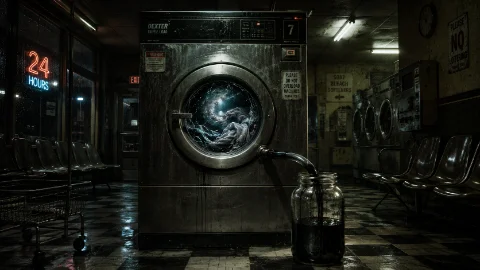
In the quiet, fog-heavy coastal town of Oakhaven, the most dangerous business is not a back-alley casino or an illicit distillery. It is a mundane, twenty-four-hour establishment sitting between a failing bakery and an empty bookstore. The sign on the glass door reads The Spin Cycle, but the locals know it by its true name: The Laundromat of Regrets. This is a sanctuary where memory behaves like a physical stain, and where the heavy iron washing machines do not clean dirt, but systematically extract the heavy, water-logged sorrows from human clothing.
The Physics of Fabric Sorcery
Within the framework of magical realism, memory is never an abstract neurological process. It is a physical weight that sheds from the human body, anchoring itself into the fibers of the things we wear every day. A wool coat worn during a tragic heartbreak becomes unnaturally heavy, retaining cold moisture even on a dry summer afternoon. A silk scarf present during a betrayal will gradually stiffen, its threads tightening around the owner's neck like a subtle, spectral noose.
The proprietors of the laundromat are practitioners of fabric sorcery, an ancient, domestic art that treats industrial laundry machines as magical cauldrons. When a customer brings in a garment burdened by trauma, the attendants do not use ordinary soap. They formulate specialized chemical solvents mixed with crushed salt, dried graveyard moss, and distilled river water collected exactly at midnight. As the heavy metal drums spin, the churning water acts as a spiritual solvent, dissolving the emotional resonance out of the fabric and separating the memories from the threads.
The Extraction and the Liquid Shadow
The process of washing away a regret is a delicate, irreversible procedure that changes both the garment and the individual who wore it. As the cycle runs, the extracted memories are drained out of the machine through clear plastic tubes, pooling into glass carboys kept in the basement below.
The Gray Water: The runoff liquid from a washed regret is thick, dark, and smells faintly of ozone and old dust. Each jar is meticulously labeled by year and emotion, creating a massive, fluid archive of the town’s collective suffering. If an individual drinks this water, they temporarily experience the raw, unfiltered grief of a complete stranger.
The Bleached Soul: When a customer puts on a freshly laundered coat, the change is instantaneous. The physical weight is gone, and the phantom coldness has vanished. However, the extraction leaves a psychological void. The individual can still recall the factual details of the event—they know who left them or what they lost—but they can no longer feel the corresponding emotion. Their heart treats the memory like a scene from a movie they watched years ago, leaving them strangely detached and emotionally bleached.
The Danger of the Stitched Shadow
The true hazard of fabric sorcery lies in the thrift stores and clothing drives of the world. Because memories can be washed out, they can also be transferred. In the dark corners of the laundromat, a dangerous black market exists for garments that have been intentionally modified through a process known as shadow stitching.
Reckless individuals who are desperate to escape their own mundane lives will buy clothes that have been infused with the high-yield passion, artistic genius, or reckless luck of someone else's discarded past. Using silver needles and thread spun from spider silk, underground tailors stitch these extracted liquid shadows directly into the linings of ordinary suits and dresses. When a new owner slips the garment on, they are instantly flooded with an intoxicating rush of borrowed identity. But a human soul cannot support two histories at once. Over time, the stitched shadow begins to bleed into the wearer's true personality, rewriting their habits, erasing their original relationships, and eventually forcing them to vanish entirely, replaced by the ghost of a stranger who simply wanted to forget.