Cyberpunk asked what happens when corporations own the machines. Biopunk asks a colder question: what happens when they own the meat.
In the living marketplace, your genome is a product line. The enzymes that digest your breakfast were licensed to your parents before you were born. The immune upgrade that got you through the last plague season came with a subscription, and the subscription came with terms, and somewhere in clause forty-seven you agreed that the cartel may audit your bloodstream at any time. Miss a payment, and the repossession is not a knock at the door. It is a fever.
This guide is for writers building biopunk worlds. We will look at how gene cartels rise and rule, why the patent is the genre's true weapon, and how the black-market splice shop became the beating heart of its underworld. Because biopunk is not really about science. It is about ownership crawling under the skin, and about the people who decide their own cells are worth going to war over.
The First Rule: The Cartel Began as a Cure
Every gene cartel in your world should trace its origin to something genuinely good.
The cartel that now owns the patents on half the human immune system began as three researchers in a rented lab, racing a pandemic and winning. The cartel that licenses agricultural bloodlines across two continents began as a foundation that ended a famine. The cartel whose enforcement arm now audits bloodstreams began as a patient-safety division, created after a rival's untested splice killed forty children in a single district.
This origin is not decoration. It is the source of the cartel's legitimacy, its self-image, and its most chilling rhetoric. When your protagonist confronts a cartel executive, the executive should not cackle. She should point to the graveyard that does not exist because her company's patent does, and ask, with complete sincerity, how many of those unbuilt graves your protagonist is volunteering to fill. The cure was real. The famine ended. The cartel's crime is not that it lied about the good it did, but that it turned the good into a toll gate and posted armed men beside it.
Write your cartels as monopolies with saints in their foundation stones, and every moral confrontation in your book becomes a genuine argument instead of a shooting gallery.
The Second Rule: The Patent Is the Weapon
Biopunk drafts often reach for the wrong arsenal. They give the cartels soldiers, drones, and kill squads, and those can exist, but they are the cartel's last resort. The first, and by far the most frightening, is the patent.
In the living marketplace, a patent on a gene sequence is a claim on every body that carries it. Consider what that makes possible. A farmer whose crop cross-pollinates with a patented strain is not a victim of the wind. He is an infringer, and the cartel's lawyers arrive before the harvest does. A woman whose parents bought her a metabolic upgrade in childhood discovers, at thirty, that the licensing model has changed from purchase to subscription, and her own liver is now billed monthly. A community of splice refugees cannot legally cross a border, because their modified genome is classified as stolen intellectual property, and they are not carrying contraband. They are contraband.
The craft power of the patent is that it makes violence bureaucratic. The cartel never has to raise its voice. It sends letters. It adjusts terms of service. It flags an account, and a pharmacy three thousand miles away quietly declines to refill the enzyme that keeps a stranger's heart in rhythm. Your reader has signed terms of service without reading them. They know, in their gut, that they have already agreed to things they would never have chosen. Biopunk simply moves that signature into the bloodstream.
When you build your world, write the licensing model before you write the army. The army will hardly ever be needed.
The Third Rule: The Splice Shop Is the Cathedral of the Underworld
Every ownership regime creates its heretics, and in biopunk, the heresy has an address. The back-alley splice shop is the genre's signature location, and it deserves the same loving construction that fantasy gives its taverns.
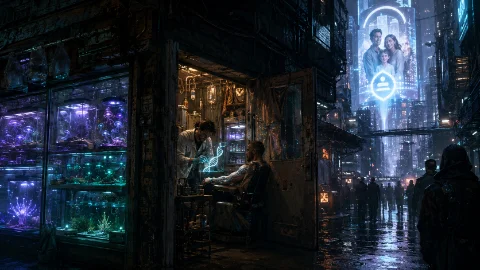
The shop hides behind a legitimate front, a tattoo parlor, a veterinary clinic, an aquarium supply store with a suspiciously advanced filtration section. The back room smells of antiseptic and warm agar. Secondhand medical equipment hums against the walls, its serial numbers filed smooth, and in the corner a modified refrigerator holds the shop's true inventory: open-source gene lines, cracked cartel sequences with the license locks broken, and custom work the gene-cutter will discuss only face to face.
The gene-cutter is the underworld's priest, and should be written with that weight. They took an oath once, in a former life, at an institution that later blacklisted them, and they will tell you the oath still holds even if the license does not. They refuse certain work on principle, and the principles are their own, argued from a personal code rather than any law. They keep a wall of photographs, patients whose subscriptions they cracked, children whose repossession fevers they broke, and they know that every photograph is a count on the indictment the cartel is patiently assembling against them.
The splice shop scene is where your book's moral argument gets made in dialogue. The cutter has heard every justification the cartels offer, and has a counter for each, and has also, if you are writing honestly, made mistakes of their own that the open-source gospel cannot quite absolve. Give the heresy its own doubts. Cathedrals earn their gravity from what is buried under the floor.
The Fourth Rule: The Body Is the Contested Territory
In dystopian fiction, the state occupies the city. In biopunk, the cartel occupies the body, and your descriptions should treat human bodies the way war fiction treats terrain.
The enhanced districts glow with cartel-standard health, uniform, calibrated, and subtly branded. Skin that clears on schedule. Children in licensed growth curves, their heights tracking the projections in their parents' subscription tier. In the unlicensed quarters, the bodies tell a different story: gray-market splices with visible seams, immune systems running cracked software two plague seasons out of date, and the particular caution of people who cannot afford to be scanned.
Between these territories move the genre's most interesting figures. The repossession agent who can read a bloodstream the way a tracker reads a trail, and who has begun, quietly, to falsify the results for families with children. The walking chimera whose body carries sequences from four different cartels, each license in a different state of default, a one-person jurisdictional nightmare no court wants to touch. The elderly woman whose original, unmodified genome has become, through sheer rarity, the most valuable property in the district, and who has stopped telling anyone her blood type.
When you write a biopunk scene, ask who owns each body in the room, in what percentages, and which of those claims is in arrears. The answers are your tension. No gun needs to be drawn.
The Fifth Rule: The Plague Is the Market Correction
Every biopunk world lives in the shadow of outbreaks, and the genre's sharpest insight is what an outbreak means in a living marketplace. A plague is not only a tragedy. It is a product launch.
The cartel that patents the cure for a new pathogen owns the next decade. This single fact should warp everything in your world. Cartels run vaccine divisions and threat-assessment divisions, and the wall between them is a matter of ongoing rumor. When an outbreak emerges in an unlicensed quarter, the response is shaped by actuarial tables: quarantine is cheaper than treatment, and treatment is priced by what the surviving market will bear. Conspiracy theories bloom in every district, some of them false, and your book should be honest about the fact that in this world, the paranoid have been right before.
The plague also creates the genre's most devastating choices. The cracked, open-source version of the cure works, mostly, and the gene-cutter distributing it knows that mostly is doing terrible work in that sentence. The cartel's version works completely and costs a family three generations of debt. A mother in your story will stand between those two options, and whichever she chooses, your reader will understand that the marketplace designed her dilemma on purpose, priced it precisely, and calls it choice.
The Sixth Rule: Liberation Has a Body Count
The temptation in biopunk's final act is the jailbreak ending. The heroes crack the master license, upload every patented sequence to the open commons, and the crowd cheers as the cartels' stock collapses. Resist writing it that cleanly, because the genre's own logic will not support it.
The sequences are in people. When the license servers die, so do the subscription safeguards, the dosage calibrations, and the update channels that patch dangerous splices. Open-sourcing the genome frees a million bodies and destabilizes them in the same instant. The famine-proof crop, unowned, is also unmaintained. The immune upgrade, liberated, stops receiving the seasonal patches that kept it ahead of the pathogens. Your revolutionaries will win, if they win, into a world that immediately needs everything the cartels actually provided, stripped of everything the cartels stole.
The strongest biopunk endings hold this tension without resolving it. The gene-cutter inherits responsibilities the size of the enemy they toppled. The liberated districts form councils, and the councils begin, with horror and dark comedy, to draft licensing rules of their own, swearing these will be different. Ownership of the body turns out to be a question the revolution can seize but not answer. Your reader closes the book still holding it, which is exactly where a genre this honest should leave them.
Building Your Own Living Marketplace
Before you draft your biopunk project, work through this quick checklist.
Give every cartel a cure in its foundation, and let its executives argue from the graves that were never dug.
Write the licensing model before the army. Decide what is purchased, what is subscribed, what happens on default, and who audits the bloodstream.
Build one splice shop with the care of a cathedral, and give its gene-cutter an oath, a wall of photographs, and at least one mistake.
Map every body in every scene as territory. Who owns it, in what percentage, and which claims are in arrears.
Treat the next plague as a product launch, and put one family in front of the two cures.
Deny yourself the clean jailbreak. Liberation inherits the maintenance schedule.
The gene cartels endure as biopunk's great antagonists because they never had to invent anything monstrous. They only had to take things we already accept, patents, subscriptions, terms of service, default and repossession, and move them under the skin. The living marketplace is our marketplace with the metaphor removed.
Write the cure first, then the toll gate built on top of it. Write the patent as the weapon and the splice shop as the cathedral. And when your revolution comes, make it inherit the ledger along with the liberty. The body was the territory all along, and in biopunk, every reader is already standing on contested ground.