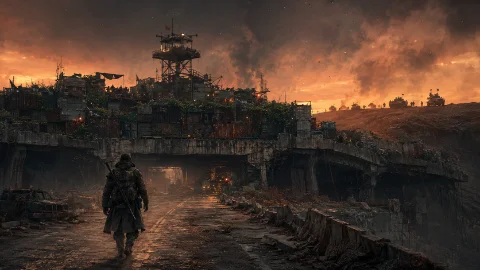
The apocalypse is the easy part. Any writer can burn down a civilization in a prologue. The hard part, the part that separates a forgettable ruin from an unforgettable one, is what grows back in the ashes.
Because something always grows back. A week after the end, someone rebuilds a hierarchy. A month after, someone starts collecting a tax. A year after, someone writes down a law and other people begin to obey it, not because they believe in it, but because obedience is quieter than the alternative. This is how the ashen kingdoms form. Not with kings and crowns, but with warlords, wanderers, and the slow calcification of survival into rule.
This guide is for writers building the world after the end. We will look at how power reorganizes itself around scarcity, why the road produces a different kind of character than the settlement does, and how to give your post-apocalyptic setting the depth that makes readers stop asking when the collapse happened and start caring about who is running things now.
The First Rule: Power Follows Whoever Solves the Problem
In the first weeks after a collapse, no one cares about ideology. They care about water, medicine, ammunition, and someone who knows how to keep a diesel engine running. Whoever solves the immediate problem becomes the first authority in that region, and every ashen kingdom in your world should trace its origin to a solved problem.
The warlord who controls the last working refinery does not need a manifesto. He needs a fence and a small number of loyal men. The council of nurses who kept a hospital running through the first winter does not need votes. They need a locked pharmacy and a rota. The old army sergeant who kept his convoy alive on the road for six months does not need a uniform. He needs the road itself to keep bending toward him.
When you design a faction in your apocalyptic setting, start with the problem it solved during the first year. That answer will shape everything else. The refinery warlord will build a culture obsessed with fuel and fire, and his laws will punish waste more harshly than murder. The nurse council will build a culture obsessed with cleanliness and quarantine, and their exiles will be people who refuse to wash. The sergeant will build a culture of the road, and his shame will fall on anyone who cannot walk twenty miles in a day.
The reader does not need the origin explained. They need to feel it in every ritual the faction still performs.
The Warlord Is Not a Villain, He Is a Function
Amateur apocalyptic fiction treats warlords as cackling raiders in leather. Strong apocalyptic fiction understands that a warlord is what fills the vacuum when the state dies, and that most warlords believe themselves to be doing something closer to public service than tyranny.
The functional warlord provides three things in exchange for obedience. He provides physical safety inside his territory, arbitration of disputes between his people, and a predictable set of rules that survivors can plan their days around. That predictability is the currency he trades in. A brutal warlord who is at least predictable will hold more territory than a kind one who changes his mind.
This does not make him good. It makes him coherent, which is the far more useful quality on the page. A warlord your reader can predict is a warlord your reader can dread, because the reader knows exactly what the character will do when your protagonist steps out of line.
Give your warlord a personal wound that shaped his rule. The lieutenant he lost in the first winter. The daughter he could not protect from a raider clan. The oath he broke to save his own men. Then let that wound show up in his laws. Warlords legislate their traumas onto everyone they rule, and readers will feel the shape of the man in the shape of the code.
The Wanderer Carries the World Between Kingdoms
Every apocalyptic story needs its wanderers, and understanding why they exist is one of the deep pleasures of the genre.
Warlords hold territory. Wanderers connect it. In a world where mass communication has collapsed, the wanderer is the internet. They carry news, letters, rumors, seeds, medicine, and, most importantly, a functioning worldview larger than any single ashen kingdom. They know that the refinery lord is not the last man on earth, because they walked out of his territory last month and reached the nurse council in a week.
This is why the wanderer archetype produces such rich protagonists. A settled character can only see what their kingdom lets them see. A wandering character has already looked over the wall, and that vision makes them dangerous to every warlord they encounter. The refinery lord does not fear the wanderer's rifle. He fears the wanderer's stories.
If you write a wanderer, decide early what they carry that no one else does. A physical object, a piece of medical knowledge, a message for a specific person three hundred miles away, or simply the memory of a place that still works. Give them a reason to keep moving that is not just restlessness. The road is a hard employer, and no one stays on it without a wage.
The Settlement Is the Ashen Kingdom's Character Sheet
If a warlord is the face of a faction, the settlement is the soul. When you describe a survivor town, the physical details should tell the reader everything about the values of the people inside.
A watchtower manned around the clock says the settlement fears the road. Gardens on every roof say they have survived a famine and never intend to survive another. A weekly market with strict rules of exchange says they have chosen commerce over raiding. A gallows in the square, still in working order, says they have chosen order over mercy. Children playing openly in the street says they have chosen hope, and it also tells the reader exactly what the antagonist will threaten in act three.
Every settlement in your world should answer three questions on the page without stating them aloud. What did they lose in the first year? What did they build to make sure they never lose it again? And what would they be willing to become to protect what they built?
The answers should be different for every kingdom. A world where every settlement responds to collapse the same way is a world with only one culture, and one culture is not enough to sustain a novel.
The Rules No One Writes Down
The most fascinating layer of any ashen kingdom is the unwritten code. These are the rules that keep survivors alive but that no one would ever put in a charter, because putting them in a charter would force everyone to admit what they have become.
You do not shoot a wanderer before hearing their news. You do not eat a horse in a town that still uses horses to plow. You do not drink the last of a shared bottle unless the person offering it has already refused. You do not ask a stranger where their family is. You do not sing after dark within a mile of the road. You do not use the word before, meaning the world before the end, in front of children who were born after.
These small taboos are the fingerprints of the culture. When you scatter three or four of them through a chapter, the reader begins to feel the weight of a society that has been living this way for years. When your protagonist violates one, even accidentally, the reaction from every other character in the scene will teach the reader the depth of the world without a single line of exposition.
Make a short list of unwritten rules for each of your major factions. Do not put the list in the manuscript. Just make sure your characters obey them without noticing, and violate them at the exact moments your plot requires.
The Ashes Themselves Are a Character
Finally, the landscape of your post-apocalyptic world is not scenery. It is a persistent antagonist and occasional benefactor, and it should be described with the same specificity you would give a person.
The ash-choked highway does not just slow travel. It coats lungs, ruins engines, and hides the bodies of everyone who has died on that stretch of road. The overgrown suburb does not just look eerie. It shelters small predators, produces edible plants no one had ever heard of before the end, and echoes strangely because half the houses have collapsed inward.
The land remembers what happened to it. When you describe a burn scar, describe what it burned. When you describe a flooded city, describe the smell of the water. When you describe a silent forest, tell the reader why the animals left and whether they have started to come back. A landscape that carries its history is a landscape the reader will trust, and trust is what buys you the willing suspension of disbelief for every dragon-scale detail you invent later.
Building Your Own Ashen Kingdom
Before you draft the first chapter of your apocalyptic project, work through this quick checklist.
Choose the problem your central faction solved in the first year, and let that answer shape their laws, rituals, and shame.
Give your warlord a wound that has become a policy, so his cruelty reads as coherent rather than cartoonish.
Send at least one wanderer through the settlement early, because the wanderer will show your reader what your protagonist has not yet let themselves see.
Write three unwritten rules for your setting and violate one of them by chapter five.
Describe the land as if it remembers, because in the world after the end, the land is often the only witness left.
The ashen kingdoms are what happens when human beings survive something they were not supposed to survive, and then keep going long enough to build a new normal on top of the old wreckage. Warlords rise because someone has to. Wanderers move because someone has to. Settlements grow because hope, even scorched hope, is a stubborn crop.
Write the rule before you write the ruler. Write the road before you write the traveler. Write the ashes as if they remember, and your readers will step into your world the way survivors step into a new territory, cautiously at first, and then with the slow, hard-earned faith that this place, too, is worth learning.