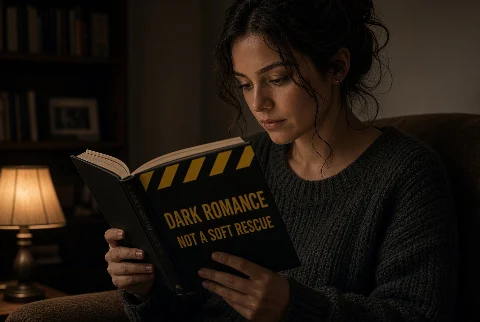
"Dark” on a cover is not a mood board, and it is not a promise that someone will be unkind for a chapter and then apologize with a cabin.
In romance it means the love story is built on harm: captivity, revenge, a power gap the book does not treat as a cute obstacle; violence in the room where the relationship happens; wanting someone you should run from.
Readers who pick up dark romance are usually agreeing to be uncomfortable on purpose. They expect the danger to be part of the attraction, not a subplot you can skip. They also expect you to say so.
A book can be dark and still have a line you don't cross, such as — consensual adults; no surprise incest; no child on the page — and the readers who live in this lane know the difference between a content note and a spoiler.
What “dark” does not mean is gray filters, a gun on the cover, or a sad backstory in chapter two. Mystery is dark when the world is rotten and the ending doesn’t wash it. Thriller is dark when the threat stays in the house after the plot is over. Women’s fiction is dark when the harm is ordinary and nobody arrives with a helicopter.
If your book is about surviving a trafficking ring, a sick woman who's after your eighteen year old - and intends to take her after thirty chapters of psychological taunting and worse, and a family that does not get a clean conscience - that is dark. It is not the same product as “morally gray billionaire, captive for 300 pages, wedding at the end,” and readers are right to be angry when the cover borrows that promise and the book is something else. Put the real thing in the first lines of the blurb. Spice level. Who gets hurt. Whether the monster is the love interest or the woman at the gate. Dark is a contract. The readers who want it will stay. The readers who wanted a soft rescue will put it down on page 40, and that is not a review problem. That is the cover doing the wrong job.