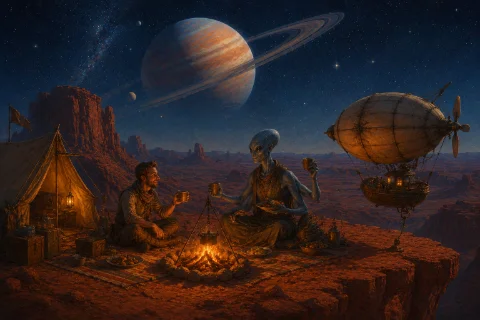
Long before space opera dominated science fiction, there was sword and planet. The genre took shape in the early 20th century with Edgar Rice Burroughs' A Princess of Mars, in which Confederate veteran John Carter is mysteriously transported to Barsoom, a dying Mars of red deserts, warring city-states and airships. That single novel and its sequels created a template that has echoed through science fiction and fantasy for over a century. An Earth hero. An alien world with its own rules of gravity, biology and politics. Swords and airships instead of laser guns and starships. Adventure, romance and rescue at planetary scale.
What Makes Sword and Planet Different
Sword and planet sits deliberately between genres. Its settings are science fictional: other planets, alien species, occasional ancient technology. But its storytelling is pure fantasy adventure, with duels, honour, empires and quests. It stands apart from space opera by focusing on a single world rather than galactic scope, and apart from planetary romance only in its greater emphasis on swordplay and heroic action.
The genre's DNA runs everywhere. Frank Herbert's Dune borrowed its desert planet romance. George Lucas openly acknowledged Burroughs' influence on Star Wars, especially the Tatooine sequences. Films like John Carter and Avatar sit squarely in the tradition. Beyond Burroughs, Leigh Brackett's Eric John Stark stories and Michael Moorcock's Michael Kane books helped keep the flame alive through the 20th century.
Three qualities tend to mark a sword and planet story. First, an exotic planetary setting rendered in vivid, sensory detail, from twin suns to strange fauna. Second, a hero, often but not always from Earth, dropped into that world and forced to master it. Third, an adventure structure that leans heroic: duels, chases, palace intrigues, uprisings, and love stories tangled with all of it.
Why Readers Love It
Sword and planet delivers something rare and unabashed: pure adventure with a science fiction paintjob. The genre never apologises for wanting to entertain, and readers who love bold heroes, alien vistas and high emotion find plenty of both.
The genre also offers world-tourism at its most vivid. A good sword and planet novel invests deeply in its planet: the climates, the cultures, the beasts, the ruins. You do not just read the story, you visit the place, and years later it is the sky and the sand you remember as clearly as the plot.
Where to Start
Edgar Rice Burroughs' A Princess of Mars remains the foundational read, short, propulsive and endlessly influential. Leigh Brackett's collected Eric John Stark stories offer moodier, more literary pulp. Michael Moorcock's Kane of Old Mars trilogy is a loving homage. Modern authors including S.M. Stirling and others have written contemporary takes on the tradition. From there, dive into indie territory, where sword and planet is quietly enjoying a revival. Independent authors are writing new adventures on new worlds, unashamed of the genre's pulp heart and often adding fresh perspectives Burroughs' era never imagined.