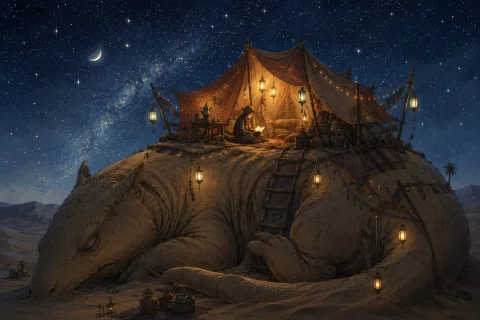
Every punk subgenre answers the same question in a different accent: what if this environment powered civilisation? Steampunk chose Victorian coal. Dieselpunk chose oil and war. Sandpunk chooses the desert. In these worlds, sand is not backdrop but resource, obstacle and mystery all at once. Whole societies are built around the movement of dunes, the recovery of buried tech, the harvesting of solar or wind power, and the constant negotiation with an environment that would rather bury you than shelter you.
What Makes Sandpunk Different
Sandpunk pulls from a wide desert imagination. Frank Herbert's Dune casts the longest shadow, with its spice, sandworms and desert politics. Films like The Mummy franchise, Mad Max: Fury Road and animated worlds like Nausicaä of the Valley of the Wind all contribute to the aesthetic vocabulary. Video games such as Sable and Journey have shaped the modern visual sense of the genre. The result is a look and mood that is unmistakable: ochre skies, veils and goggles, salvage rigs, sunken temples and machines encrusted with a century of grit.
Three qualities tend to mark a sandpunk story. First, a desert or arid setting treated as a full character, with weather, culture and danger built into every scene. Second, technology adapted to sand: wind sleds, solar sails, filtered breathing gear, ruin-diving equipment. Third, a fascination with what lies beneath. Sandpunk worlds are almost always haunted by an older, greater civilisation, half-buried and half-dangerous, whose leftovers shape the present.
Why Readers Love It
Sandpunk delivers a sensory experience unlike any other genre. The heat, the glare, the taste of dust, the eerie silence of a dune sea at night: these books make you feel the environment in your bones. For readers tired of the same rainy fantasy cities and neon cyberpunk streets, that sensory shift alone is a joy.
The genre also carries deep themes almost automatically. Deserts speak to endurance, memory and loss. Buried empires speak to hubris and time. Sandpunk stories tend to be quietly philosophical, even when they are also full of chases, heists and monstrous worms.
Where to Start
Dune is the obvious foundation, though its scale can be intimidating. For something lighter, Alwyn Hamilton's Rebel of the Sands offers a fun desert-fantasy entry point, and Kate Elliott's Crown of Stars adjacent worlds edge into similar territory. From there, look to indie territory, where sandpunk is quietly flourishing. Independent authors are writing dune-crossing caravans, ruin-diver mysteries and solar empire sagas that mainstream publishing has barely noticed yet.