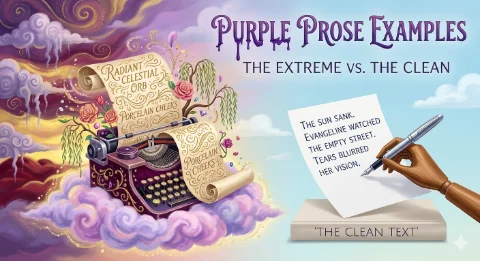
The best way to understand the impact of over-writing is to see it in action. When a writer tries too hard to sound poetic, the actual plot gets buried under a mountain of adjectives.
Below is an extreme example of a scene written in a heavy, florid style, followed by a direct, polished version of the exact same moment.
The Over-Written Version
The radiant, golden orb of the celestial sun sank beneath the jagged, obsidian horizon, bleeding its crimson agony across the velvet canopy of the twilight sky. Anguish, sharp as a diamond blade, pierced Evangeline’s fragile, trembling heart as she gazed upon the empty, cobblestone street. Her crystalline tears cascaded down her porcelain cheeks like a torrential summer rain, mourning the tragic absence of her departed lover. She let out a heavy, melancholic sigh that resonated through the quiet evening air.
The Clean Version
The sun sank behind the mountains, casting a red glow across the evening sky. Evangeline watched the empty street, her chest tightening with grief. Tears blurred her vision as she realized he was not coming back.
Why the Second Version Works Better
The first version uses too many adjectives like radiant, golden, jagged, and obsidian. These words slow down the reading speed. It also relies on clichés like crystalline tears and porcelain cheeks, which make the sadness feel artificial.
The second version focuses on the actual actions and feelings. It uses simple language to build an emotional connection. By removing the extra decoration, the reader can actually feel Evangeline's loneliness.