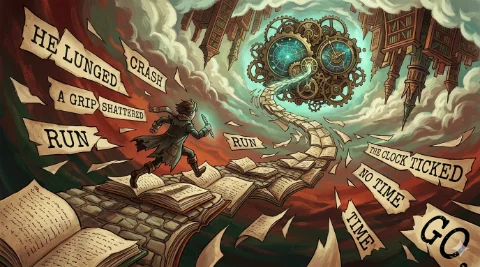
When your story hits a high-stakes moment, your writing style must shift gears. Keeping the same descriptive pace during a car chase or a sword fight that you used during a quiet dinner scene will ruin the tension.
To create a sense of urgency, you need to alter the physical structure of your sentences. This mechanical shift tricks the reader's brain into processing information faster, simulating adrenaline.
Shorten Your Sentences to Mirror Adrenaline
Long, complex sentence structures give the reader time to breathe. In a high-action scene, you want to take that breath away. Cut out compound sentences and remove coordinating conjunctions like and, but, or so.
Slow Pacing: As the door splintered under the heavy axe, Marcus scrambled backward across the dusty floorboards, desperately searching for his fallen blade while his heart hammered against his ribs.
Fast Pacing: The wood splintered. Marcus scrambled back. He lunged across the floorboards. His fingers missed the hilt.
The second version uses short, punchy fragments. This punctuation forces the eye to jump rapidly from one action to the next, creating a fast, staccato rhythm that matches a racing pulse.
Strip Away Non-Essential Descriptions
Action scenes are the ultimate enemy of purple prose. When a character is running for their life, they do not notice the golden hue of the sunset or the intricate carvings on an ancient stone wall.
If a sensory detail does not directly affect immediate survival, delete it. Limit your world-building to raw, instinctive inputs. Focus on the sharp slap of cold rain, the smell of burning rubber, or the sudden, blinding flash of a headlight.
Eliminate Passive Verbs and Thought Blocks
Thought blocks happen when you filter the action through a character's internal processing. Phrases like he felt, she saw, or he wondered create an unnecessary cushion between the reader and the threat.
Filtered: He saw the blade swinging toward his neck and felt a wave of pure panic.
Direct: The blade swung toward his neck. Panic hit him.
By removing the words he saw and felt, you place the reader directly in the path of the danger. Use active, immediate verbs to ensure the narrative never stalls.