One of the questions that starts creeping up on you as retirement gets closer is a fairly obvious one.
What am I going to do with myself?
I’d always planned to travel. There are plenty of places I still want to see and, for the first few years of retirement at least, I don’t think I’ll have much trouble filling the calendar.
But travel was never going to take me all the way through to my eventual demise. At some point, I needed something else.
Going for a walk every day and trying to stay physically fit was one part of it. But I also wanted something that would keep the little grey cells working. Something that would challenge me, make me think and give me problems to solve.
As it turns out, I found it in writing.
I’d tried writing books when I was younger. The stories were there — they’ve probably always been there — but I couldn’t seem to turn them into a novel. Work and family life didn’t leave a lot of spare time, and creatively I simply couldn’t work out how to take all those things running around inside my head and turn them into a coherent story.
Then I reached my sixties, became semi-retired and suddenly had something I hadn’t had enough of before.
Time.
And something happened. The creative juices started flowing.
Keeping the grey cells working
There was another reason finding something mentally challenging mattered to me.
My father was a journalist and later an author, and he continued writing right up until he died. Physically, sadly, he let himself go somewhat as he got older. But his mind remained remarkably sharp.
I also saw the other side of ageing.
My grandmother on my father’s side developed dementia in her sixties. I watched her gradually lose the ability to recognise her own children and grandchildren. I’ve seen similar cognitive decline affect other people I’ve known and loved.
Those experiences stayed with me.
I don’t pretend that writing a novel is some magic protection against dementia. It isn’t. But those experiences made me very conscious that, as I got older, I wanted to keep using my brain. I wanted to keep learning, questioning, remembering, researching and challenging myself.
Writing a crime novel certainly does that.
Trying to remember what one of your characters said 150 pages ago is probably a reasonable mental exercise on its own.
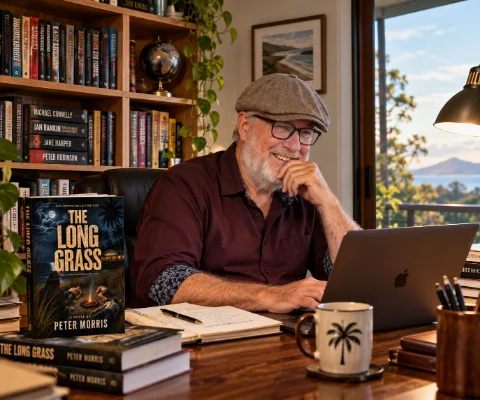
Then came The Long Grass
When I finally sat down seriously to write The Long Grass, I discovered something else.
I could actually write.
Was The Long Grass the greatest work of fiction ever produced?
Of course it wasn’t.
But it was a start. More importantly, it was my start.
Setting the story in Far North Queensland was almost inevitable. I’d spent a lot of my younger years up that way, including time in Weipa in 1985. I’d seen things, met people and experienced situations that had stayed in my memory for decades.
Some of them were funny. Some were frightening. Some were simply bizarre.
They were ripe for writing.
Part Two of The Long Grass became particularly personal. Without giving too much away for anyone who hasn’t read it, one of the central characters was inspired by someone I grew up with. In some ways, that part of the book became a little bit of an ode to him.
I don’t think I could have written that when I was thirty.
Perhaps that’s another advantage of discovering writing later in life.
You’ve accumulated a lot of material.
And then I met Annette
The other unexpected thing was Annette Mollison.
Before I started writing The Long Grass, Annette didn’t exist.
Now she feels like a good mate.
I loved discovering her while writing the first book, and I’ve loved getting involved in her life again while writing the second. This time the story is much more Annette-centric, and I’m several hundred pages into another investigation with her.
There are new characters appearing too. Some I planned. Others seem to have invited themselves in and refused to leave.
That’s becoming one of my favourite things about writing. You create somebody who didn’t exist yesterday and, before long, they’re telling you where the story needs to go.
Something I didn’t know I was looking for
So I’m very glad I discovered writing in my sixties.
Not because I expect it to make me rich or famous. And certainly not because I think I’ve suddenly mastered the art of writing novels. I’m still learning, and I hope I always will be.
I’m glad because I’ve found something I can carry with me into retirement.
Something creative. Something challenging. Something that keeps those little grey cells working.
And, most unexpectedly of all, something I genuinely love doing.
I might have come to writing relatively late.
But I’ve got a few stories left in me yet.