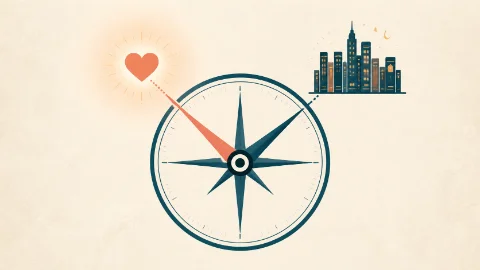
There is a version of this conversation that happens in almost every writers' room, workshop and online writing community at some point. On one side, the writer who believes that any attention paid to market trends is a corruption of the artistic process, that the only book worth writing is the one that comes from the deepest and most uncompromising part of yourself, and that commercial considerations are what produce forgettable, interchangeable fiction. On the other side, the writer who has watched too many books they loved fail to find readers because they existed in complete isolation from what anyone was actually looking for, and who now argues that understanding the market is simply professional competence rather than selling out.
Both positions are right about something. Both are also, taken to their logical extreme, a recipe for a particular kind of failure.
The writer who ignores the market entirely produces books that may be extraordinary and that may find no one, not because the books are not good enough but because no one knew how to find them and no one knew what to call them when they tried. The writer who follows market trends too closely produces books that arrive looking like the thing readers wanted two years ago, by which time the market has moved on, and which carry the faint smell of calculation that readers are surprisingly good at detecting.
The writers who thread this needle successfully, and there are many of them across every genre and form, tend to share a specific way of thinking about the relationship between personal passion and market awareness. They treat them not as opposing forces but as two different lenses on the same project, each useful at different stages of the writing process and for different purposes.
What the book of your heart actually means
The phrase gets used so often in writing communities that it has started to blur at the edges, but it points at something real and important. The book of your heart is the one that contains the specific obsession only you have, the particular combination of preoccupation, experience, imagination and perspective that no other writer would bring to a story in quite the same way. It is the book that, when you describe it to someone who gets it, produces the feeling that this story could not have been written by anyone else.
This is not the same as the book you most want to be seen writing. The book of your heart is sometimes embarrassing in its specificity. It might be about something considered too niche or too strange or too personal for a general audience. It might combine genres in ways that make it hard to categorise. It might be set in a world or a time period or a community that you care deeply about and that has not yet had its commercial moment. It might be exactly the book you would have wanted to read at a specific and formative period of your life and could not find anywhere on the shelves.
The specificity is not the problem. The specificity is usually the point. The books that find the most devoted readers tend to be the ones written with this kind of specificity, because readers who are looking for exactly that combination of obsessions find them and feel found in a way that more generically constructed books cannot replicate. The risk of the book of your heart is not that it is too specific. The risk is that without any market awareness at all, the right readers may never discover it exists.
What market awareness actually means in practice
Market awareness in fiction writing is frequently misunderstood to mean chasing whatever is currently on the bestseller lists. This is the least useful version of it, for reasons that are almost purely mechanical. A novel takes a minimum of one to three years to write, revise, pitch, sell and publish through traditional channels, and considerably less through indie publishing but still a meaningful amount of time. Whatever is at the top of the bestseller list today was commissioned and developed years ago. Writing toward it now means arriving at a destination the market has already left.
Genuine market awareness is something quieter and more structural. It means understanding which readers exist for the kind of book you are writing, where those readers currently live in terms of platforms and communities and reading habits, what they are hungry for that they are not currently finding, and how the book you are writing might be described and positioned so that the people who would love it can actually locate it.
This is more like understanding an ecosystem than following a trend. An ecosystem changes slowly and has underlying conditions that persist beneath the surface churn of what is fashionable in any given season. Readers of gothic fiction have been around for two centuries and will be around long after the current wave of gothic-adjacent releases has peaked and receded. Readers who are hungry for diverse voices in fantasy were hungry for that before the market started supplying it in larger quantities, and their hunger drove the market shift rather than the reverse.
Understanding the ecosystem means understanding the persistent underlying appetites rather than their current surface expression. The question is not "what is selling right now" but "who are the readers who have always loved this kind of story, and what are they currently not finding enough of."
The point in the process where market awareness belongs
One of the most useful structural insights about the relationship between passion and market is that they belong at different stages of the writing process rather than competing for the same moment of attention.
During the first draft, market awareness is almost always counterproductive. The first draft is where the book discovers what it actually is, where the writer follows the story's internal logic and the characters' genuine tendencies and the obsessions that drove the project in the first place. Interrupting that process with commercial considerations produces the worst of both worlds: prose that has lost the energy of genuine compulsion but has not yet gained the precision of considered positioning. The first draft should be written toward the book of your heart as completely and honestly as possible.
Market awareness enters usefully during revision and positioning. Once the first draft exists, you know what the book actually is rather than what you imagined it might be, which makes it possible to think clearly about where it sits in the landscape of published fiction, what it resembles and what it departs from, what readers it is most likely to reach and what they might need to know about it in order to find it.
This sequencing, passion first, market awareness second, is how many of the most commercially successful literary authors describe their process when they are being honest about it. The book begins as an act of personal necessity. It is shaped into a publishable object during revision. The positioning and marketing thinking happens last of all, informed by what the book turned out to be rather than constraining what it was allowed to become.
Reading the market without being consumed by it
For writers who want to maintain awareness of their genre's landscape without letting that awareness distort their creative process, the most practical approach is to develop the habit of reading widely in their genre as readers first and market analysts second.
Reading as a reader means engaging with what is being published not to identify trends to replicate but to understand what is resonating with readers and why. What emotional experience are readers of this genre currently seeking. What familiar satisfactions are being delivered in new ways by the books that are finding large audiences. What gaps exist between what readers say they want in reviews and online communities and what they are currently being given.
Reading as a market analyst means occasionally stepping back from the reading experience to ask structural questions. Which books published in the last three years would be natural shelf companions for the book you are writing. Not because you want to write those books, but because understanding the company your book is likely to keep helps you understand how to describe it and who to describe it to. Literary agents ask for comparable titles in query letters for exactly this reason: a book that can be placed in relation to existing books is a book that can be sold.
The balance is to do enough of this reading that you have a genuine, felt understanding of the landscape rather than a theoretical one, without turning every reading experience into a research exercise. Readers make the best genre writers, because they understand from the inside what the genre's pleasures and conventions are, which means they know which ones to honour and which ones they have enough authority to subvert.
When the market is ahead of where your book lives
Some books of the heart exist in territory that the market has not yet reached. The writer working in this space faces a particular challenge: the audience for their book exists and may even be large, but the infrastructure for finding that audience, the genre categories, the online communities, the retail algorithms, the critical vocabulary, may not yet be well developed.
This is uncomfortable to sit with, but it is worth sitting with rather than immediately concluding that the book needs to be changed. Some of the most important books in any genre's history were the ones that arrived slightly before the market was ready for them and helped create the market that subsequently welcomed them. The early examples of what became paranormal romance, of what became domestic noir, of what became the category now called cosy fantasy, were books written by people following an obsession into territory that did not yet have a name.
The practical question for a writer in this position is not whether to abandon the book but how to find the early readers who will recognise what it is doing before the larger market catches up. Online reading communities, particularly on platforms where genre readers are active and vocal, are often significantly ahead of mainstream publishing in their ability to identify and circulate emerging reader appetites. A book that finds a foothold in those communities can help build the category vocabulary that eventually makes it easier to find.
When your heart wants something the market has exhausted
The opposite situation is equally common and equally worth addressing directly. The writer whose book of the heart is set in a subgenre that has recently been heavily saturated, whose story is in some ways very similar to books that have just had a visible commercial moment and produced a wave of imitators, faces a different problem. The market awareness reading says the space is crowded. The personal passion says this is still the story that needs to be written.
The most useful thing to understand here is that market saturation and reader hunger are not the same thing. A subgenre that has been heavily published recently has not necessarily been well served. The wave of imitators that follows any major commercial success in fiction is largely composed of books that are replicating surface features rather than the underlying appeal, and the readers who drove the original success are usually still looking for more of what they actually wanted rather than more of what the imitators gave them.
The book of your heart in a crowded subgenre has the best chance of finding readers if it is being written toward the genuine underlying appeal of that subgenre rather than toward its current surface conventions. Understanding the difference requires the market awareness reading: asking not what these books look like but what they are actually delivering to readers, and then writing a book that delivers that thing more fully and more honestly than the crowded middle of the market is managing to do.
The commercial writers who were really writing their heart all along
It is worth spending a moment on a piece of publishing history that the passion versus market debate tends to obscure. Many of the most commercially successful novels of the past several decades were written by authors who were, by any honest description, writing exactly the book they wanted to write and simply happened to find that what they needed also happened to be what a very large number of readers needed at the same time.
Donna Tartt spent ten years writing The Secret History, an unusual, long, formally unconventional novel about a group of classics students covering up a murder. It was not calculated to a market. It was the book she needed to write and it found an audience of millions. Stieg Larsson wrote the Millennium trilogy as what amounted to an obsessive personal project. Diana Gabaldon wrote the first Outlander novel for practice, combining historical fiction with time travel romance and a Scottish setting in a combination that had no obvious commercial precedent and went on to become one of the longest-running series in popular fiction.
This does not mean that following your heart guarantees commercial success. It demonstrably does not. But it does mean that the assumption that commercial success and personal passion are in fundamental opposition is not borne out by how publishing actually works. The books that find the largest audiences are very often the ones written with the most genuine internal necessity, because that necessity produces the specificity and the conviction that readers recognise and respond to.
Holding both at once
The writers who manage this balance most sustainably tend to describe it not as a compromise between two things they value but as a deepening of both simultaneously. Market awareness makes them better at articulating what their book is doing and who it is for. Passion makes them better at doing it with the conviction that no amount of market positioning can manufacture from the outside.
Write the book only you could write. Then learn enough about the landscape it is entering to give it the best possible chance of finding the readers who have been waiting for exactly that book without knowing it yet.
Those readers exist. The book of your heart was almost certainly also the book of someone else's life. Your job is to write it so well and position it so clearly that the two of you eventually find each other.