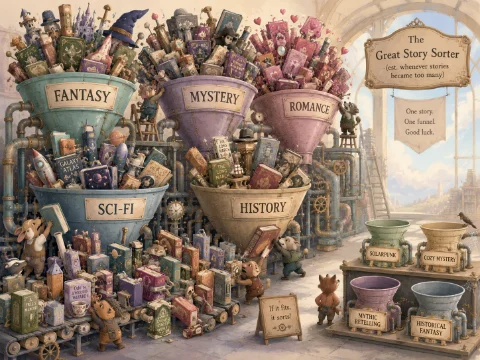
Open almost any book discovery site and the filtering system looks roughly the same: a handful of broad genre categories, fantasy, romance, mystery, literary fiction, with maybe a dropdown of subgenres underneath if you're lucky. It feels like organisation, and on the surface it is. But it's organisation built around how books get catalogued, not around how readers actually decide what to read next, and that mismatch quietly costs both readers and authors more than it seems.
The Problem With Broad Category Labels
A genre label like "fantasy" or "romance" covers an enormous range of reading experiences. Epic fantasy and cosy fantasy share almost nothing in pacing, tone or expectation beyond a loosely magical setting. Dark romance and sweet small-town romance are aimed at readers with genuinely different tolerances and appetites. Lumping them into a single broad category treats them as interchangeable, when in practice a reader who loves one might actively dislike the other.
This matters more for discovery specifically than it does for, say, a library shelving system, because the entire purpose of a discovery site is matching a reader to something they're likely to enjoy. A filter broad enough to contain wildly different reading experiences isn't really filtering anything meaningful. It's just sorting books into rooms too large to be useful.
Readers Don't Search in Genre, They Search in Mood and Trope
Most readers don't approach discovery thinking "I want fantasy." They're thinking something closer to "I want something slow-burn and atmospheric" or "I want a found-family story with low angst" or "I want something that reads fast and doesn't take itself too seriously." These are the actual decision points that determine whether someone picks up a book, and almost none of them map cleanly onto a standard genre dropdown.
Sites that filter only by genre and broad subgenre are essentially asking readers to translate their actual interest into a category system that wasn't built to express it. Some readers manage this translation without noticing. Many simply give up and default to browsing whatever's already popular, which defeats the purpose of having a discovery mechanism at all.
Where Subgenre Lists Still Fall Short
Even sites that go a layer deeper, offering subgenres rather than just top-level categories, tend to run into a related problem: subgenre labels are inconsistent and constantly evolving, and most filtering systems update far slower than the genres themselves do. A term like "romantasy" or "cosy mystery" might mean something very specific to an active reading community while barely registering in a discovery site's backend taxonomy.
This creates a strange disconnect where the readers most engaged with a genre, the ones most likely to know exactly what they want, are often the ones least well served by a filtering system still organised around older, broader categories. The more specific and engaged the reader, the worse a generic genre filter tends to serve them.
What Better Filtering Actually Looks Like
Trope and theme-based filtering, not just genre. Allowing readers to filter or search by specific tropes, enemies-to-lovers, slow burn, found family, morally grey protagonist, gives a far more accurate match than genre alone ever could. These are the details readers actually care about when choosing what to read next.
Mood-based browsing. A filter built around emotional tone, comforting, intense, atmospheric, fast-paced, captures something genre labels structurally can't. Two books in the same genre can have completely different moods, and mood is often the deciding factor for a reader choosing between them.
Community-tagged categorisation rather than fixed taxonomy. Letting readers and authors apply more specific, organic tags, rather than relying solely on a fixed dropdown built years ago, allows a discovery system to keep pace with how language around genre actually evolves. A flexible tagging system ages far better than a rigid one.
Cross-genre discovery paths. Many books genuinely blend genres, and a filtering system that forces a single primary category often misrepresents books that would appeal to readers browsing an entirely different section. Allowing multiple genre and theme tags per book, rather than one dominant label, reflects this reality more accurately.
Filtering by reading experience, not just content. Pacing, length, content warnings, and emotional intensity are often more decisive for readers than genre itself. A site that allows filtering along these lines tends to produce far better matches than genre filtering alone.
Why This Matters for Indie Authors Specifically
This isn't only a reader experience problem. It's a visibility problem for authors too. A book that doesn't fit neatly into a single broad genre category often gets miscategorised or buried, regardless of how well it might actually match a specific reader's interest, simply because the filtering system has nowhere accurate to put it.
Authors writing genre-blending or niche-within-niche work are disproportionately affected by this, since the readers most likely to love their book are also the ones least likely to find it through a generic genre filter. Better, more granular filtering systems would benefit exactly the kind of distinctive, harder-to-categorise indie work that broad genre labels tend to flatten or hide.
A Filtering System Built Around Readers, Not Catalogues
The underlying issue is that most genre filtering was designed around how books get classified rather than around how readers actually think when they're looking for something to read. Closing that gap doesn't require abandoning genre altogether, broad categories still have some use as a starting point, but it does require layering in mood, trope and theme-based filtering underneath, rather than treating genre as the only meaningful axis discovery happens along.
Until that shift becomes more common, a lot of genuinely good matches between readers and books will keep slipping through a filtering system that was never quite asking the right question in the first place.