Introduction
Of all the documents a writer must produce in the pursuit of traditional publication, the synopsis is the one that causes the most dread.
The query letter has its own intimidating reputation, but writers generally understand what it is asking for: a compelling pitch, a hook, a reason to read more. The synopsis asks for something harder. It asks you to take the novel you have spent months or years writing, the one with all its complexity and nuance and carefully built emotional architecture, and reduce it to a few pages of plain, functional prose that tells an agent exactly what happens from beginning to end.
The gap between what a synopsis must do and what a novel does is real and significant. A novel creates an experience. A synopsis reports on one. A novel earns its revelations through hundreds of pages of carefully constructed tension. A synopsis gives them all away immediately. A novel lives in its language. A synopsis, by necessity, cannot.
And yet the synopsis is one of the most important tools in the querying writer's arsenal. An agent who is intrigued by your query letter will turn to your synopsis to understand whether the story delivers on the promise of the pitch. A synopsis that is unclear, incomplete, or poorly structured can end a request for pages before those pages have been read. A synopsis that is sharp, confident, and well-organised can make an agent eager to read everything you have sent.
This guide covers exactly what a synopsis is, what it needs to accomplish, how to write it step by step, what to include and what to leave out, and how to avoid the mistakes that undermine otherwise strong submissions.
What a Synopsis Is and What It Is Not
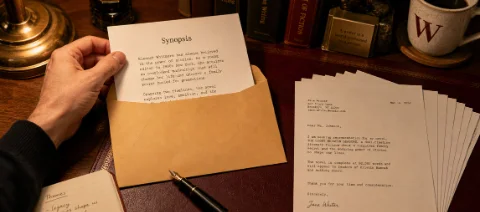
A synopsis is a complete prose summary of your novel that covers the major plot events, the central character arc, and the ending.
That last part deserves emphasis. A synopsis includes the ending. All of it. Every resolution, every revelation, every turn that the story has been building toward. The synopsis is not a back-cover blurb designed to create intrigue without giving anything away. It is a document designed to give everything away, in the most organised and compelling way possible, to a professional who needs to understand your full story before deciding whether to invest time in reading it.
This is the fundamental misunderstanding that leads most writers to write bad synopses. They approach the synopsis as a marketing document and hold back the endings and major revelations in an attempt to create suspense. Agents, reading dozens of synopses a week, recognise this immediately. A synopsis that withholds the ending is not intriguing. It is incomplete. It signals either that the writer does not understand what a synopsis is for, or that the ending is weak enough that the writer is afraid to show it.
A synopsis is also not a chapter-by-chapter breakdown. It is not a scene list or a beat sheet. It is a continuous prose narrative that covers the essential movement of your story, written in a way that is clear, engaging, and professional.
Why Agents Need the Synopsis
Understanding why agents ask for synopses helps you write one that serves its purpose.
When an agent reads a query letter, they are making a single decision: is this story interesting enough to read more? When they read sample pages, they are making a related but different decision: is this writer skilled enough to invest time in? When they read the synopsis, they are making a third and more complex decision: does this story work as a complete narrative?
The synopsis answers questions the query letter and sample pages cannot. Does the plot hold together across its full length? Does the central conflict build and resolve satisfyingly? Is the character arc complete and earned? Does the ending deliver on the promises made at the beginning? Is the story structured in a way that makes sense?
A novel can have a brilliant opening and a compelling query letter and still fall apart in its middle act or fail to land its ending. The synopsis is how an agent discovers whether that is the case without reading the entire manuscript. It is a structural X-ray of your story, and what it reveals matters as much as how it is written.
This is why the synopsis should be written after the novel is finished, not before. A synopsis written in advance of a completed manuscript is essentially an outline. A synopsis written after completion is a reflection of the actual story, with all its real turns and resolutions, and it will always be more honest and more useful than a prospective one.
Format and Length
Synopsis length requirements vary by agent, and the single most important rule is to follow the specific submission guidelines of every agent you query.
That said, most agents asking for a synopsis expect somewhere between one and three pages, single-spaced, in a standard readable font. Some agents specify a word count rather than a page count, typically between 500 and 1000 words for a short synopsis. A small number of agents ask for longer synopses of up to five pages.
If an agent does not specify a length, one to two pages is a safe default. Shorter is generally better than longer, because a tight synopsis demonstrates narrative clarity and control in a way a sprawling one does not.
Format the synopsis cleanly and professionally. Use the same font as your manuscript, typically Times New Roman or Courier in 12 point. Single space the body, with a double space between paragraphs. Put your name, title, genre, and word count in a header. Do not use section headings, chapter numbers, or bullet points. The synopsis is continuous prose, and it should look like it.
Write in third person present tense regardless of the tense and person of your novel. This is the conventional format for synopses, and departing from it without strong reason signals unfamiliarity with industry norms. First person present can work for first person novels in some cases, but third person present is the universal default.
What to Include
A synopsis needs to cover five essential elements: the protagonist, the central conflict, the major plot turns, the character arc, and the ending.
The Protagonist
The synopsis should introduce the protagonist in its first paragraph, with enough specificity that the agent immediately understands who this person is and what makes them particular. Name, situation, and a sense of their essential character. Not a physical description. Not a backstory download. The specific human being at the centre of the story, rendered in a sentence or two.
Introduce only the protagonist in the first paragraph. Secondary characters can be introduced when they become relevant to the plot, and only with enough detail to clarify their function in the story. A synopsis that introduces six characters in its first paragraph is impossible to follow.
The Central Conflict
The synopsis should establish the central conflict early, ideally in the first paragraph or the second. What does the protagonist want? What is standing in the way? What is at stake if they fail?
The central conflict is the engine of the synopsis just as it is the engine of the novel. Every plot event the synopsis covers should connect clearly to the central conflict, either as a complication that raises the stakes or a development that changes the nature of the struggle.
The Major Plot Turns
The synopsis does not cover every scene or every subplot. It covers the major structural turns of the story: the inciting incident, the first plot point that launches the protagonist into the central conflict, the midpoint shift, the escalating complications that raise the stakes, the dark moment where all seems lost, and the climax.
These beats should be covered in order and connected by clear cause and effect. Each event in the synopsis should feel like the consequence of what came before it. A synopsis that is a list of events without clear connections between them is a synopsis that makes the story feel episodic and structureless, even if the novel itself is tightly plotted.
The Character Arc
The protagonist must change in a novel. The synopsis must show that change. Not just the external events that happened to the protagonist, but the internal journey those events created.
Character arc is often the element most neglected in synopses, because it requires a different kind of writing from plot summary. Covering plot is relatively mechanical: this happened, then this happened, then this. Covering character arc requires showing how the protagonist's understanding, values, or beliefs shifted as a result of what they went through.
A synopsis that covers plot without character arc reads like a sequence of events rather than a story. It tells the agent what happened without telling them why it mattered. Including the character arc, even briefly, is what transforms a plot summary into a story synopsis.
The Ending
As established earlier, the synopsis includes the full ending. All of it. The climax, the resolution, and the emotional destination the protagonist arrives at.
The ending is arguably the most important part of the synopsis. It is the payoff of everything that came before, and it is what tells the agent whether the story delivers on its promises. A weak or rushed ending in a synopsis suggests a weak or rushed ending in the novel. A confident, clear, emotionally satisfying ending in a synopsis makes the agent want to read the manuscript to experience how the author got there.
Do not hedge or obscure the ending. Do not summarise it in vague terms to preserve mystery. Tell the agent exactly what happens and what it means for the protagonist. Be specific and be direct.
What to Leave Out
Knowing what to exclude is as important as knowing what to include.
Leave out subplots that do not directly affect the main plot. A romantic subplot that has no bearing on the central conflict does not belong in the synopsis. A secondary character's arc that runs parallel to the protagonist's but never intersects with it meaningfully should be cut. The synopsis covers the main spine of the story and only what attaches directly to it.
Leave out most secondary characters. If a character does not play a significant role in the central conflict, they do not need to appear in the synopsis. Characters who exist primarily in subplots that are excluded from the synopsis should be excluded along with those subplots.
Leave out world-building details that are not essential to plot comprehension. A fantasy novel might have an extraordinarily rich and detailed world, but the synopsis is not the place to demonstrate that richness. Include only the world-building elements the reader needs to understand why the plot events matter.
Leave out thematic statements and authorial reflection. The synopsis is not the place to explain what your novel means or what readers should take from it. Let the story speak for itself through the events and the character arc. If the theme is not visible in the plot and arc without being stated, the novel has a problem the synopsis cannot fix.
Leave out extended descriptions of scenes, locations, or characters. The synopsis works in broad strokes and essential details. Every word spent on description is a word not spent on story.
Tone and Voice in the Synopsis
The synopsis should be written in a professional, clear, confident tone that reflects the emotional register of the novel without attempting to replicate the novel's style.
This is a subtle but important point. A literary novel with a lyrical voice does not need a lyrical synopsis. A darkly comic novel does not need a comic synopsis. The synopsis is a professional document, not a demonstration of prose style. Its job is clarity and completeness, not stylistic performance.
That said, the synopsis should not be completely flat and lifeless. Vary the sentence lengths. Use active verbs. Frame events in terms of their stakes and emotional weight, not just their mechanical sequence. A synopsis that reads like a police report, all passive construction and neutral affect, undersells even a powerfully emotional story.
The tone that works best is the tone of a skilled, confident storyteller summarising a story they know and believe in. Not anxious, not overselling, not apologetic. Direct, clear, and engaged with the material.
Avoid the language of uncertainty. Do not write things like the reader follows the protagonist or we learn that something happened. Write in a direct third person present that puts the agent inside the story without meta-commentary about the reading experience.
Writing the Synopsis Step by Step
Approaching the synopsis as a structured process rather than an open-ended writing task makes it significantly less daunting.
Start by identifying the five to seven most important events in your novel. These are the structural beats: the inciting incident, the major turning points, the midpoint, the dark moment, the climax, and the resolution. Write a single sentence for each one that captures what happens and why it matters.
Then identify the protagonist's emotional starting point and ending point. What do they believe at the beginning that they do not believe at the end? What have they lost, gained, or understood? Write a sentence or two capturing that arc.
Now connect your structural beats in order, adding the minimum necessary context and causation between them. Each beat should flow from the previous one through clear cause and effect. The synopsis is a chain of events where each link leads inevitably to the next.
Read what you have and cut aggressively. Remove every detail that is not essential to following the central story. Remove every secondary character who is not critical to the main plot. Remove every descriptive detail that is not doing structural work.
Then refine the prose until it is clear, active, and professional. Read it aloud to check the rhythm and catch the moments where the language becomes flat or tangled.
Finally, check the length against the agent's requirements and adjust accordingly. If it is too long, cut secondary material before cutting primary story beats. If it is too short and the agent has requested more length, add the most important secondary material that was initially cut.
Common Synopsis Mistakes
Certain mistakes appear in synopses so consistently that they deserve direct attention.
Writing in back-cover blurb style is the most common mistake and the most damaging. Phrases like the stakes have never been higher, or in a world where nothing is as it seems, belong in marketing copy, not in a synopsis. The agent knows your book needs stakes and complexity. Show them through the story rather than announcing it.
Burying the protagonist under plot is a related problem. A synopsis that covers event after event without keeping the protagonist's emotional experience visible is a synopsis that has forgotten the point of story. Every major plot event should be connected to its effect on the protagonist.
Using too many character names creates confusion that is difficult to recover from. Every time a new name appears in a synopsis, the agent must track another person. Names that appear once and then disappear are particularly damaging. If a character is not important enough to appear more than once in the synopsis, refer to them by role rather than name.
Ending on a cliffhanger or a vague summary rather than the full resolution signals either a misunderstanding of what the synopsis is for or a weak ending in the novel. Write the ending fully and clearly.
Apologising for the synopsis in cover letters or emails is surprisingly common and reliably counterproductive. Do not tell the agent that the synopsis does not do the novel justice, or that the story is better than the synopsis makes it sound. Let the synopsis speak for itself.
The Relationship Between Synopsis and Query Letter
The synopsis and query letter are separate documents doing different jobs, and they should be written with that distinction clearly in mind.
The query letter is a pitch. It covers the hook, the premise, the central conflict, and enough of the stakes to make the agent want to read more. It does not give away the ending. It creates intrigue and makes a case for why this story deserves attention. It typically covers the first act of the novel in compressed form and stops before the story resolves.
The synopsis is a complete summary. It covers the entire story from beginning to end, including all major turns and the full resolution. It does not attempt to create suspense or withhold information. It informs rather than entices.
The two documents should be consistent with each other. The protagonist, the central conflict, and the stakes described in the query letter should match the story told in the synopsis. An agent who reads a query letter and then a synopsis that seems to be describing a different book will question whether the writer has a clear grasp of their own story.
Write the query letter and synopsis separately, for their separate purposes, and then read them together to ensure they are presenting the same story with the same emphasis.
Revising the Synopsis
A synopsis almost never works on the first attempt, and revision is where most of the real work happens.
Read the first draft of your synopsis with one question in mind: would someone who has never read my novel understand exactly what happens and why it matters, from beginning to end? If the answer is no, find the specific places where comprehension breaks down and fix them.
Then read it again asking whether the protagonist's emotional arc is visible throughout, or whether the synopsis covers plot without character. If the arc is missing, add it.
Then read it asking whether every event included is essential to following the main story, or whether some events are included out of habit because they feel significant in the novel. Cut everything that is not load-bearing.
Give it to a reader who has not read your novel and ask them to tell you what the story is about, who the protagonist is, what they want, what stands in their way, and how it ends. If they cannot answer those questions clearly from the synopsis alone, the synopsis is not yet doing its job.
Conclusion
The synopsis is not the enemy of your novel. It is a professional document that demonstrates your command of your own story, your understanding of narrative structure, and your ability to communicate clearly about your work.
Writers who dread the synopsis are usually dreading the compression, the loss of nuance, the reduction of something complex and carefully built into a few pages of functional prose. That dread is understandable. But the compression the synopsis demands is also a kind of test. A story that cannot be summarised clearly, whose essential shape cannot be articulated in a few pages without the whole thing falling apart, may have structural problems the synopsis is exposing rather than creating.
The synopsis that works is the one that makes an agent read it and immediately want to read the manuscript. Not because it has performed literary tricks or hidden crucial information to create suspense, but because it has communicated a complete, well-structured, emotionally compelling story with enough clarity and confidence that the agent trusts both the story and the writer behind it.
That trust is what the synopsis is ultimately building. Earn it, and the pages that follow will get the reading they deserve.
Indie Reading Community connects independent authors with the readers who love discovering them. Explore books across every genre, read author interviews, and browse craft articles built for indie writers at indiereadingcommunity.com