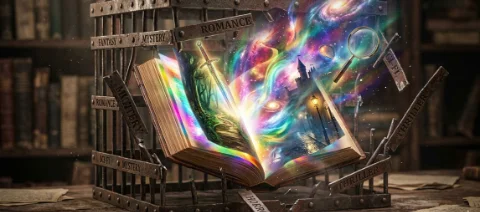
In a world that loves to label and organize everything, from our music playlists to our personalities, there is something thrilling about a piece of art that refuses to fit into a box. Nowhere is this truer than in the literary world, where the most memorable stories often belong to a fascinating and frustrating new category: the unclassifiable.
These are books that defy genre boundaries, stories that gleefully mash together elements from high fantasy, gritty crime, historical fiction, and magical realism, sometimes all within the same chapter. For some readers, this is confusing; but for many, it is a sign of true artistic freedom. Today, we’re exploring why we, as a community of discerning readers and writers, have fallen in love with these rebellious, genre-bending books.
The Architecture of Unpredictability
What makes a book uncategorizable? It’s not just about subgenres; it’s about a structural refusal to follow standard blueprints. A mystery novel, for example, typically follows a detective finding clues to solve a crime. But a genre-defying mystery might use the murder only as a lens to explore a character’s grief, an entire town’s collective trauma, or a world where reality itself is unstable.
Think of books like Cloud Atlas by David Mitchell, which is simultaneously historical fiction, a thriller, science fiction, and a post-apocalyptic saga, all bound together by nested narratives. The result is not a messy composite but a rich, cohesive, and utterly unique whole. Other famous examples of cross-genre literature include the works of Tamsyn Muir (necromancers in space), Susanna Clarke (Piranesi’s impossible world), and Carmen Maria Machado (genre-blending memoir/horror).
Why We Love the Unclassifiable Book
If these stories are so hard to pin down, why are they so dominant in the indie reading and writing world?
- They Mimic Real Life: Life rarely happens in a straight line or adheres to a single tone. We can experience grief and humor, mystery and domesticity, all in the same afternoon. Books that refuse to settle into a single genre feel more raw, real, and authentic.
- They Demand Our Attention: When you know you’re reading a standard cozy mystery, your brain can coast. When you are reading a book that could become an erotic thriller or a high-stakes fantasy adventure at any moment, you have to be fully present. The experience is active, not passive.
- They Celebrate Curation Over Algorithm: Recommendation engines struggle with these books. How can an algorithm recommend Gideon the Ninth based on a user’s love of swordfights if they don’t also love necromancy? These stories thrive on peer-to-peer curation and word-of-mouth in indie reading communities that celebrate depth and weirdness over mass marketability.
A Final Thought for Writers
For writers, the myth of the "trending trope" can be stifling. The fear that a book is too weird, too dark, or doesn't have a clear "shelf label" can make you kill your best ideas. But remember: the grey area is where great storytelling lives. While traditional publishing might demand a clear pitch, the independent reading world is actively looking for stories that dare to break the rules.
Protect your creative well, trust your voice, and write the messy, complicated, multi-passionate story that only you can tell. Your right readers are out there, waiting for exactly that kind of magic.