Every writer has a drawer, a notes app, or a battered notebook full of ideas that never went anywhere. A character voice that wouldn't leave them alone. A premise scribbled on a napkin. A "what if" that sounded brilliant for about ten minutes and then quietly fizzled.
The problem usually isn't that the idea was bad. It's that an idea on its own isn't a story. It's a single ingredient, and most writers stop there because nobody ever showed them what to do next. This is the actual process of taking a raw idea and building it into something with shape, weight and momentum.
Separate the idea from the story
The first mistake is treating the idea as the whole thing. A premise like "a woman discovers her late mother was living a secret double life" is interesting, but it's not a story yet. It's a situation. A story needs someone who wants something, something stopping them, and a reason the reader should care how it ends.
Before doing anything else, write the idea down as plainly as possible, then ask what it's actually about underneath the surface. Is the secret double life story really about trust, about grief, about the fear of never truly knowing the people closest to you? The premise gives you a setting to stand in. The underlying question gives you a story to tell.
Find the character who has the most to lose
A lot of ideas stall because the writer picks the most obvious character to follow instead of the one with the highest stakes. If the idea is about a town discovering a buried secret, the obvious choice is the person who finds it. The more interesting choice might be someone who already knew and has been hiding it for years.
A useful exercise here is to list every person the idea could possibly affect, then rank them by how much they stand to lose if the truth comes out or the situation changes. The character at the top of that list, not the one who happened to come to mind first, is usually your real protagonist.
Turn the idea into a question, not a plot
Strong stories tend to be built around a central dramatic question rather than a sequence of events. Not "what happens" but "will she choose to tell the truth even though it destroys her family" or "can he forgive the person who ruined his career." This single question becomes the spine that every scene either pushes toward or pulls against.
If you're struggling to develop an idea, try writing it as a yes-or-no question with real consequences attached to both answers. If you can't make both outcomes feel costly, the idea probably needs another layer before it's ready to carry a full story.
Stress test the idea with the opposite scenario
One of the fastest ways to find the real shape of a story is to imagine the exact opposite premise and ask which version is more interesting. If your idea is about someone seeking revenge, what does the story look like if they get it immediately in chapter two? If your idea is about a forbidden romance, what changes if the relationship was allowed from the start.
This isn't about rewriting your idea into its opposite. It's a diagnostic tool. Often the opposite scenario reveals what was actually compelling about the original idea in the first place, the tension, the restraint, the thing being withheld, and that insight tells you what to protect and amplify as you build the story out.
Give the idea a shape before you give it scenes
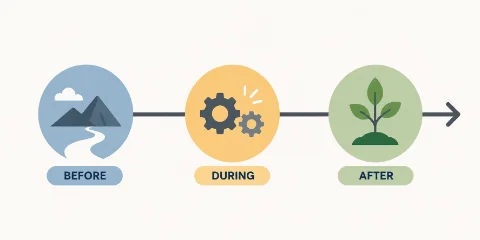
Writers often jump straight from idea to drafting, which is how stories end up meandering for fifty pages before anything happens. Before writing a single scene, sketch the shape in three points: where the character starts, the moment everything changes for them, and roughly where they end up by the final page. This isn't a rigid outline, it's scaffolding.
Even a single sentence for each of these three points gives an idea enough structure to survive the messy middle of drafting, where most abandoned stories actually die. You don't need to know every scene. You need to know the destination well enough that you can recognise when a scene is taking you closer to it or further away.
Let the idea generate its own obstacles
A common reason ideas feel thin is that the writer hasn't asked what specifically is making the character's goal hard to reach. Generic obstacles produce generic stories. The trick is to make the obstacle come directly from the same source as the idea itself, rather than bolting on an external complication that could belong to any story.
If the idea involves a long held family secret, the best obstacle to revealing it shouldn't be a random subplot, it should be something rooted in the same family, the same history, the same fear that created the secret in the first place. Obstacles that grow out of the idea's own DNA feel inevitable. Obstacles imported from outside feel like padding.
Know what the idea is willing to sacrifice
Every strong story eventually asks the protagonist to give something up to get what they want, and figuring out what that sacrifice is early on often reveals the emotional core of the whole piece. If your character wants justice, what relationship, reputation or piece of themselves might that justice cost them.
This question is worth sitting with longer than feels comfortable. Writers often want their protagonist to get everything, the happy ending and an easy path there, and that instinct is usually what flattens an otherwise promising idea into something forgettable.
Test it on someone before you commit months to it
Before investing in a full draft, describe the idea out loud to another person in two or three sentences and watch their reaction closely. Not whether they say it sounds good, people are often too polite for that, but whether they ask a follow up question. A genuine question, "wait, so does she ever find out," is a far better sign than enthusiastic but vague praise.
If nobody asks anything, the idea may still be too abstract or too safe in its current form. Go back to the dramatic question step and sharpen the stakes until the idea naturally invites curiosity rather than polite nodding.
The idea was never the hard part
Most writers already have more ideas than they'll ever use. What separates a story that gets finished from one that quietly dies in a notebook is almost never the quality of the original spark. It's whether the writer did the unglamorous work of finding the real character, the real question, and the real cost, before sitting down to write the opening line.
The next time an idea grabs you, resist the urge to start drafting immediately. Spend an hour with these questions first. The story that comes out the other side will be sturdier than anything built straight from the spark alone.