From Córdoba to Mexico: How an Architectural Language Crossed the Atlantic
An extraordinary journey through architecture, cultural transformation, and the artistic connections between medieval Spain and colonial Mexico.
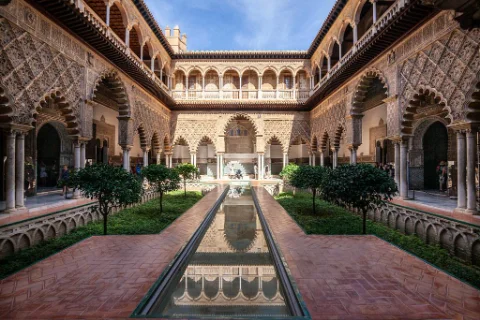
Imagine standing beneath the magnificent arches of the Mosque-Cathedral of Córdoba, surrounded by a seemingly endless succession of columns and alternating red-and-white voussoirs.
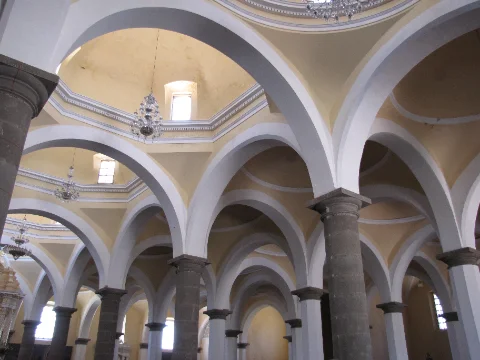
Now imagine traveling thousands of kilometers across the Atlantic Ocean to Cholula, Mexico, where another extraordinary religious building reveals a striking architectural landscape of arches, columns, and domes.
What connects these two places?
At first glance, their architectural similarities might suggest a direct relationship.
But the real story is more complex—and far more fascinating.
It involves centuries of artistic exchange, the expansion of the Spanish monarchy, the movement of craftsmen and architectural knowledge, and the transformation of European traditions within the societies of colonial America.
Córdoba: An Architectural Legacy That Transcended Its Origins
The Mosque-Cathedral of Córdoba is among the most remarkable monuments of medieval Iberia.
Its celebrated arcades, horseshoe arches, and sophisticated spatial organization reflect the architectural achievements of al-Andalus.
Over the centuries, the building underwent significant transformations, particularly following the Christian conquest of Córdoba in 1236.
Yet its architectural vocabulary continued to influence artistic production beyond its original political and religious context.
Forms associated with Islamic Iberia became part of a broader repertoire employed and transformed in buildings commissioned by Christian patrons.
This phenomenon contributed to the development of architectural traditions commonly described as Mudéjar.
When Architectural Traditions Crossed the Atlantic
The Spanish expansion into the Americas beginning in the late fifteenth century brought profound political, religious, social, and cultural transformations.
Architecture became an essential instrument in the establishment of colonial institutions.
Churches, monasteries, convents, administrative buildings, and urban spaces reflected the priorities of the new colonial order.
But architectural traditions did not travel as fixed or unchanging models.
They were adapted to different materials, climates, construction techniques, and local circumstances.
Among the traditions carried across the Atlantic were decorative and structural practices associated with medieval Iberian architecture, including geometric ornamentation, particular carpentry techniques, and forms that had developed through centuries of contact between Islamic and Christian artistic cultures.
Their presence in the Americas demonstrates how architectural knowledge could survive and evolve far beyond the societies in which it originated.
Cholula: An Unexpected Architectural Encounter
In Cholula, Puebla, the Royal Chapel—known as the Capilla Real—offers a particularly intriguing example of the architectural complexity of colonial Mexico.
Its interior features numerous columns and arches supporting an extraordinary system of domes.
The resulting spatial rhythm can evoke comparisons with the celebrated arcades of Córdoba.
However, visual resemblance alone does not establish direct architectural descent.
The Capilla Real belongs to a different historical, religious, and construction context, and its architectural development must be understood through the specific circumstances of colonial New Spain.
Its significance lies not in the assumption that it reproduces Córdoba, but in the opportunity it provides to investigate how architectural ideas, construction traditions, and local adaptations interacted across the Atlantic world.
Such comparisons invite questions rather than simplistic conclusions.
Who designed these spaces?
Which architectural models were available?
What roles did local builders and Indigenous communities play in their construction?
And how were inherited artistic traditions transformed in the Americas?
The Artisans Who Transformed an Architectural Inheritance
The history of colonial architecture cannot be explained exclusively through European patrons or imported artistic models.
Indigenous artisans and builders played fundamental roles in the construction and decoration of religious and civic buildings throughout New Spain.
Their technical knowledge, materials, craftsmanship, and local traditions shaped the architectural environment that emerged under colonial rule.
The result was not simply the transplantation of European architecture onto American soil.
It was a complex process of adaptation and transformation, taking place within the unequal political and social structures of colonial society.
Understanding these contributions is essential to appreciating the originality of Ibero-American architectural heritage.
Geometry, Carpentry, and the Persistence of Artistic Knowledge
The connections between Iberian and American architecture extend beyond monumental arches.
Wooden ceilings, geometric ornamentation, decorative carpentry, and other artistic practices reveal additional pathways through which technical knowledge circulated.
In the Iberian Peninsula, traditions such as carpintería de lo blanco developed sophisticated methods for constructing and decorating wooden architectural elements.
Related techniques and ornamental vocabularies subsequently appeared in different parts of Spanish America.
Yet these practices were never entirely uniform.
They were reinterpreted according to local craftsmanship, available resources, and the artistic preferences of different communities.
This capacity for adaptation helps explain the enduring presence of Islamic-derived artistic traditions within architectural environments far removed from medieval al-Andalus.
Beyond Imitation: Architecture as Cultural Transformation
The history of Mudéjar-related architecture in the Americas challenges the idea that artistic influence operates through simple imitation.
Architectural traditions move through people, institutions, technical manuals, workshops, patronage networks, and systems of political power.
As they circulate, they acquire new meanings.
An ornamental form associated with medieval Islamic Iberia could eventually become part of a Christian religious building in colonial Mexico.
But its appearance in a new context did not necessarily preserve its original symbolism or function.
Architecture reveals both continuity and change.
It also reminds us that cultural exchange can occur within relationships marked by conquest, domination, negotiation, and adaptation.
A Shared Architectural History Across the Atlantic
What connects Córdoba and Cholula?
Not a single architectural formula, nor necessarily a direct line of influence between two monuments.
Their comparison instead opens a broader historical investigation into the circulation of artistic knowledge between the Iberian Peninsula and the Americas.
The legacy of medieval Iberian architecture became part of the diverse artistic landscape of colonial America, where imported traditions encountered local techniques and creative practices.
The Atlantic Ocean separated continents, but it did not prevent architectural knowledge from crossing borders, changing meanings, and generating new artistic expressions.
And sometimes, the most fascinating historical connections begin with a simple question:
Why does a building thousands of kilometers away remind us of another world?
Discover More
This article is part of a series exploring the architectural connections behind Our Secret Geometry: A Fascinating Journey through Ibero-American Mudéjar Art, by Monserrat Díaz Ortega.
Explore the book and watch its trailer:
Monserrat Díaz Ortega
Independent Researcher and Author | International Relations, Art History and Cultural Heritage