The Illusion of the Grammar Rule
If you spend any time in writing workshops, you will inevitably hear a singular, commanding piece of advice. Instructors will tell you to always use the active voice. They treat the passive voice as a symptom of amateur writing. Yet, independent authors who craft stories with real depth and lasting resonance know that absolute rules are often misleading.
Language is a toolkit. Every grammatical structure exists for a reason, and both active and passive voices are essential instruments for controlling the speed and focus of your story.
The Engine of the Active Voice
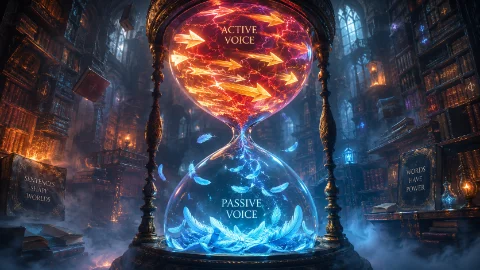
The active voice is straightforward, punchy, and relentless. In an active sentence, the subject performs the action directly.
- Structure: Subject + Verb + Object
- Example: The detective kicked the door.
When you use the active voice, you propel the reader forward. It accelerates the pacing of your scene. If you are writing a high-stakes action sequence or a tense confrontation, the active voice is your best friend. It removes all unnecessary padding and delivers the raw energy of the moment immediately to the reader.
The Strategic Power of the Passive Voice
The passive voice flips the traditional structure upside down. Instead of the subject performing the action, the subject receives the action.
- Structure: Object + Verb + (by Subject)
- Example: The door was kicked by the detective.
While it is true that overusing the passive voice can make your prose feel sluggish, using it intentionally is a mark of true craftsmanship. The passive voice forces the reader to slow down. It allows you to shift focus away from the person doing the action and place a spotlight squarely on the object receiving it.
If you want to build a creeping sense of mystery or explore complex archetypes in a quiet moment, the passive voice is highly effective. It allows you to create prose that feels passed down rather than actively written, giving your narrative an ancient, atmospheric quality.
Tip: Use the passive voice when the actor is unknown, unimportant, or intentionally hidden to build suspense. Writing "The antique mirror was shattered" is much more mysterious than writing "A brick shattered the antique mirror."
Mastering the Balance
To help you curate your sentences intentionally, use this quick guide to determine which voice serves your scene best.
| Narrative Goal | Best Voice to Use | The Effect on the Reader |
|---|---|---|
| High Action | Active | Accelerates heart rate and speeds up reading time. |
| Atmospheric Tension | Passive | Slows down time and shifts focus to the environment. |
| Character Agency | Active | Highlights a character taking charge of their destiny. |
| Mystery or Victimhood | Passive | Hides the perpetrator and highlights the aftermath. |
Do not let rigid grammar rules dictate your artistic choices. By blending active energy with passive atmosphere, you take total control over the rhythm of your narrative.