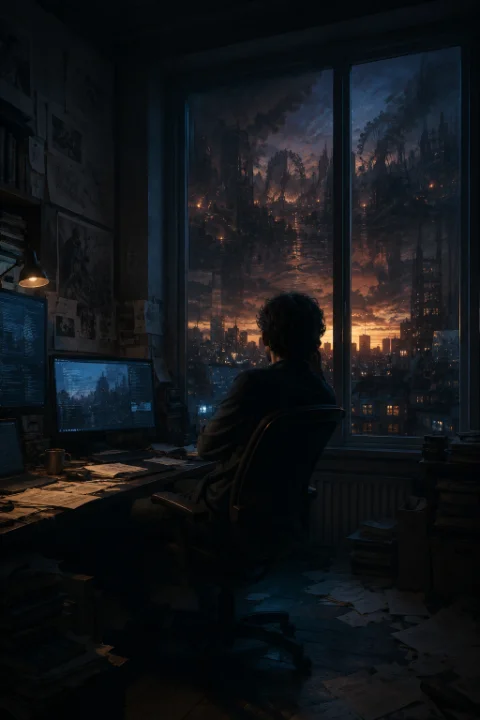
Apocalyptic fiction has traditionally looked backward or forward. Writers often set their stories in a distant future after society has already collapsed, or they look back at the moment everything changed. But a growing number of stories are choosing a different approach. They write the apocalypse as it unfolds, in something close to real time.
This style creates a particular kind of urgency. Instead of presenting a ruined world as a finished state, these stories capture the confusion, denial, fear, and strange moments of normalcy that occur while the world is still ending. The reader experiences the collapse alongside the characters rather than looking at its aftermath from a safe distance.
Why Real-Time Apocalyptic Fiction Resonates Now
Many readers today live with a constant background awareness of large-scale threats. Climate change, pandemics, political instability, and technological disruption can make the idea of sudden or gradual collapse feel less like speculation and more like something that could already be underway.
Writing the apocalypse in real time allows fiction to engage directly with that feeling. It can explore how ordinary people process overwhelming news, how societies respond (or fail to respond) to crisis, and how daily life continues even as everything changes. These stories often feel more immediate and emotionally raw than traditional post-apocalyptic narratives.
They also reflect how many people actually experience major events now, through fragmented information, social media, news cycles, and personal uncertainty rather than through clean historical distance.
Techniques for Writing Apocalyptic Fiction in Real Time
Use present tense and compressed time frames.
Present tense can create a stronger sense of immediacy. Some stories limit the timeline to days or weeks rather than years, forcing both characters and readers to stay inside the unfolding crisis.
Incorporate fragmented information sources.
Characters in these stories rarely have complete knowledge. They piece together what is happening through news reports, social media, rumors, and direct experience. This fragmentation mirrors how real crises often feel and can heighten tension and confusion.
Focus on ordinary people and small decisions.
Instead of centering world leaders or dramatic action sequences, many effective real-time apocalyptic stories follow regular individuals trying to make sense of events while managing daily responsibilities. The tension often comes from small, personal choices made under increasing pressure.
Balance dread with moments of normalcy.
Even during major crises, people still eat, work, argue, and try to maintain routines. Including these moments of ordinary life makes the larger collapse feel more believable and emotionally complex.
Show the slow erosion of certainty.
Rather than a single dramatic event, real-time apocalyptic stories often depict a gradual loss of normal functioning. Power becomes unreliable. Information becomes contradictory. Social trust begins to fray. Tracking these small breakdowns can be more unsettling than one big catastrophe.
Use multiple perspectives or voices.
Switching between different characters or formats (texts, news snippets, journal entries) can effectively convey the chaotic, multi-threaded nature of a crisis as it happens.
Examples of This Approach
Some of the most discussed apocalyptic and near-future stories in recent years have adopted elements of real-time storytelling. They often feel urgent and unsettling because they refuse to give readers the comfort of hindsight. Instead, they place both characters and readers inside the uncertainty of the moment.
These stories succeed when they capture not just the external events but the psychological and social experience of living through something that might be ending the world as we know it.
Common Pitfalls
One risk is making the story feel too much like current events without enough imaginative distance. When fiction too closely mirrors real headlines without offering new insight or emotional depth, it can feel like commentary rather than storytelling.
Another challenge is reader fatigue. Constant dread without moments of relief, connection, or meaning can become exhausting. Even in real-time crisis stories, characters need reasons to keep going.
Be careful not to rush the pacing so much that important emotional beats get lost. Real-time storytelling works best when it still allows space for characters to react and change.
Practical Exercises
Choose a current global or local issue and write a short scene in which an ordinary character is trying to understand what is happening through fragmented information sources.
Take an apocalyptic idea you have and compress the timeline so that the major events unfold over a few days or weeks instead of months or years. Notice how this changes the tension.
Write a scene from the perspective of someone who does not yet fully believe that something catastrophic is occurring. Focus on their attempts to maintain normal routines.
Experiment with including short fragments of news, social media posts, or text messages within a scene to show how information reaches your character during a crisis.
The Power of Writing the End as It Unfolds
Writing apocalyptic fiction in real time asks both writer and reader to sit with uncertainty. These stories do not offer the safety of looking back at what went wrong. Instead, they place us inside the confusion, fear, and strange persistence of hope that can exist even when everything seems to be falling apart.
This approach can feel risky because it refuses easy answers or clean resolutions. But it also creates fiction that feels alive to the present moment. It acknowledges that many people are already living through slow or sudden versions of the end, and it gives them stories that reflect that experience.
When done well, apocalyptic fiction written in real time does not just depict the end of the world. It captures what it feels like to be alive while the world is changing in ways we may not fully understand.
What apocalyptic or crisis stories have felt most immediate or urgent to you? Have you experimented with writing fiction that unfolds in something close to real time? Share your thoughts in the comments. The Indie Reading Community is always interested in how stories engage with the present moment.