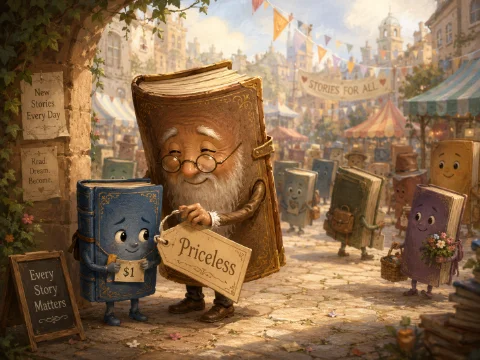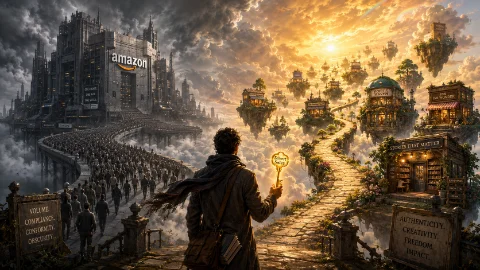
The Shift Away from Dependency
For more than a decade, the standard indie author playbook was simple. Publish on Amazon. Enroll in Kindle Unlimited. Run Amazon ads. Repeat. Amazon was the engine that powered independent publishing, and for good reason. Its discovery algorithms, massive audience, and Kindle Unlimited page-read royalties created opportunities that did not exist before.
But something is changing. A growing number of indie authors are rethinking their reliance on the retail giant. They are building their own storefronts, selling directly to readers, and reclaiming control over their businesses. This is not an anti-Amazon movement so much as a pro-independence one.
Why Authors Are Looking Elsewhere
The reasons authors are exploring direct sales are as varied as the authors themselves.
For some, it is about the math. Amazon's 70 percent royalty tier only applies to ebooks priced between $2.99 and $9.99. Price your book outside that window—a $1.99 short story, a $14.99 box set, a nonfiction technical manual—and your royalty drops to 35 percent. A $14.99 box set on Amazon nets $5.25; on a direct sales platform it can net $11.74. More than double.
For others, it is about values. Author Alicia McCalla unpublishing her books from Amazon citing the company's rollback of Diversity, Equity, and Inclusion policies and a royalty reduction on print books below $9.99. "I'd much rather readers purchase directly from me, knowing that our values align and that their money is supporting an independent, Black woman veteran-owned creative business," she wrote.
For Jess Mahler, who unpublishing all her fiction ebooks from Kindle Direct Publishing on January 1, 2026, the decision was about reader freedom. "With Amazon all you are buying is a license to read the book. A license that can be revoked at any time, with no warning," she wrote.
For Beth Martin, it was about building her own bookshelf. "Conscientious readers have asked me, 'How can I buy your book so you make the highest royalty?'" she wrote. She now sells ebooks directly through Payhip and has seen steady sales from organic social media reach, newsletter announcements, and word of mouth.
The Math of Direct Sales
The revenue math is compelling. For a $4.99 ebook—the most common indie price band in 2026—Amazon's 70 percent tier nets the author $3.34 per sale after delivery fees. Apple Books, Kobo, and Google Play net $3.49. A direct sales platform like Publica.la nets $3.74.
The gap widens dramatically outside the $2.99 to $9.99 sweet spot. A $14.99 box set on Amazon nets $5.25; on a direct sales platform it nets $11.74. A $1.99 short story collection nets $0.70 on Amazon's 35 percent tier versus $1.34 through direct sales.
But per-sale math only tells half the story. The harder question is volume. Can you sell as many copies on your own storefront as Amazon sells for you? The honest answer is no, at least not in year one. Amazon's discovery engine, ranking system, and Kindle Unlimited subscriber base are powerful machines that no direct store can match.
When Going Wide Goes Wrong
The romance author who pulled her books from Kindle Unlimited to go wide learned this lesson the hard way. On Amazon with KU, her three-book series was earning between $800 and $1,200 monthly. After going wide across Apple Books, Barnes & Noble, Kobo, and Google Play, her first month generated just $340 total. By month six, her best month across all five platforms was $580. Going wide cost her roughly $1,000 over six months compared to what she would have earned staying in KU.
The lesson? For established authors with large catalogs and existing audiences, going wide can make complete sense. For newer authors with limited platforms, exclusivity can be a better bet while building momentum.
The Hybrid Model
The authors who are succeeding with direct sales are not abandoning Amazon entirely. They are adopting hybrid models.
One of the strongest models in 2026 is combining direct-to-reader sales with traditional retailer listings. You get the best of both worlds: the reach of platforms and the margins of direct.
Amazon for discovery. Direct sales for the audience you already own. It is not about choosing one or the other. It is about diversification.
The Tools Making Direct Sales Possible
A growing ecosystem of platforms is making direct sales easier than ever.
Payhip allows authors to sell ebooks directly from their own storefront with a low 5 percent fee. Readers download an EPUB file that can be read on phones, ereaders, and computers.
Gumroad has handled all sales tax worldwide as a Merchant of Record since 2025. Authors create, Gumroad deals with the tax paperwork.
Shopify and WooCommerce offer full ecommerce capabilities for authors who want complete control.
Publica.la offers an authors early-access program that retains 80 percent of each sale, minus a small transaction fee.
Bookshop.org launched an ebook platform in January 2025, allowing independent bookstores to sell ebooks while keeping 100 percent of the profits from each sale. A deal with Draft2Digital has made it increasingly accessible for indie authors.
Ream has become a true multi-format publishing platform, building an end-to-end ecosystem for modern creators.
What the Data Shows
According to a survey cited by PublishDrive, more than 80 percent of indie authors now run their own websites with direct sales in mind. However, fewer than 30 percent are actually selling ebooks or print directly from that site. The intention is there. The execution is still catching up.
Print revenue across PublishDrive's network grew 75 percent year-over-year in 2025, the strongest expansion of any single publishing format. Much of that growth came from direct-to-reader storefronts.
Is Direct Sales Right for You?
The answer depends on where you are in your career.
If you are a new author with a small catalog and limited audience, Kindle Unlimited can still make sense. It offers Amazon-driven discovery and the opportunity to build momentum.
If you are an established author with a growing audience, direct sales offer higher margins, deeper reader relationships, and greater control. You can offer exclusive content, signed copies, and special editions that build loyalty and increase revenue.
If you are a genre author with a large catalog, going wide can unlock multiple revenue streams and reduce reliance on a single platform.
The key is diversification. Authors who successfully monetize fiction without Amazon are not rejecting retail entirely. They are diversifying.
The Future Is Hybrid
The rise of direct sales does not mean the end of Amazon. It means the end of Amazon as the only option. Authors are building their own storefronts, cultivating direct reader relationships, and creating sustainable businesses that are not dependent on a single platform's algorithm or policy changes.
The hybrid model, combining Amazon's reach with direct sales margins, is emerging as the smartest path forward. It is not about leaving Amazon behind. It is about building something of your own alongside it.