You've prepared for weeks. You've rehearsed the opening line, printed a few notes, maybe even arranged the chairs yourself the night before because you wanted the room to feel right. Then the time comes, and three people are sitting there, scattered across rows meant for thirty. The temptation in that moment is to feel like the evening has already failed before it's even begun.
It hasn't. A small turnout changes the shape of the evening, but it doesn't have to ruin it, and in some ways it opens up things a full room never could. What matters most is recognising quickly that the talk you prepared for a crowd isn't the talk this room actually needs, and adjusting rather than pushing through as if nothing has changed.
Why the Instinct to Push Through Is the Wrong One
The most common mistake is delivering the exact same talk you'd planned for a packed room, simply performed at a smaller scale. Standing at a podium, working through prepared slides or notes meant to hold a crowd's attention from a distance, in front of three people sitting a few feet away, creates an odd mismatch. The formality that works for a large group can feel stiff and slightly absurd in a small one, and everyone in the room, including you, ends up aware of how strange the gap between the format and the audience really is.
A small room calls for a different register entirely, closer to a conversation than a presentation, and recognising that early saves the evening from feeling like a diminished version of something bigger rather than its own, genuinely worthwhile thing.
Shifting From Talk to Conversation
With only a handful of people, you have an opportunity a large talk never offers, real back and forth. Rather than working through a full prepared structure, consider opening with a shorter version of your usual hook, then inviting questions much earlier than you normally would. A small audience often has more specific, more personal questions than a large one, since there's less social pressure stopping someone from asking something they're genuinely curious about.
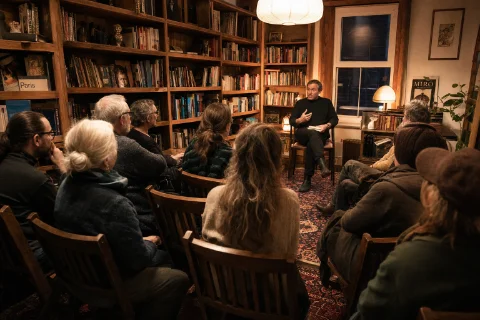
Move from behind a podium, if there is one, and sit closer to the group instead. Physical distance matters more than people realise. Three people scattered across a formal stage setup feels distant and a little sad. Three people gathered in a closer, more relaxed configuration feels intimate, almost like a planned small gathering rather than a failed big one.
Making the Small Group Feel Like the Point, Not a Letdown
How you frame the evening out loud matters considerably. Apologising for the turnout, even lightly, sets a tone of disappointment that the room will absorb, even if those three people were genuinely glad to be there. Instead, treat the smaller group as its own kind of event, mentioning, if it feels natural, that smaller talks like this often end up being the most interesting ones, since there's room for proper conversation rather than a one-way lecture.
This isn't about pretending the turnout doesn't matter. It's about not making the people who did show up feel like they're witnessing a disappointment, when in fact they're often getting a far richer, more personal version of the evening than a packed room would have received.
Using the Extra Time Well
A talk built for thirty people often runs shorter when delivered to three, since some of the original structure, designed partly to hold a larger room's attention, becomes unnecessary. Rather than padding the talk out to fill the planned time, let the extra time go toward deeper questions, follow-up conversation, or even just getting to know the people in the room a little, what brought them there, what they're hoping to get out of the evening. Small groups often appreciate this kind of genuine exchange more than a strictly timed structure pushing through regardless of how the room actually feels.
What to Do for the Venue and Organiser Afterwards
A quiet turnout is worth a brief, honest conversation with whoever organised the event, not to dwell on disappointment, but to understand what might help next time, whether that's earlier promotion, a different time slot, or simply a quieter season for events generally. Thank them sincerely regardless of numbers, since organisers remember authors who handle a small turnout graciously, and that goodwill often matters more for future invitations than the size of any single evening's crowd.
Turning Three People Into More Than Three People
A small, attentive audience that leaves genuinely engaged, having had a real conversation rather than sat through a stiff, underpopulated lecture, often becomes some of your strongest word of mouth. Three people who felt like they had a memorable, personal evening will talk about it more enthusiastically than thirty who sat through a competent but impersonal talk in a half-empty room. The smaller number doesn't necessarily mean a smaller impact, if the evening itself was handled well.
The Part Worth Remembering
An audience of three isn't a failed version of an audience of thirty. It's a different kind of evening entirely, one with more room for real conversation and genuine connection than a larger crowd usually allows. The talks that go badly with a small turnout are rarely undone by the size of the room. They're undone by treating a small, intimate gathering as though it were simply a big talk that didn't work out.