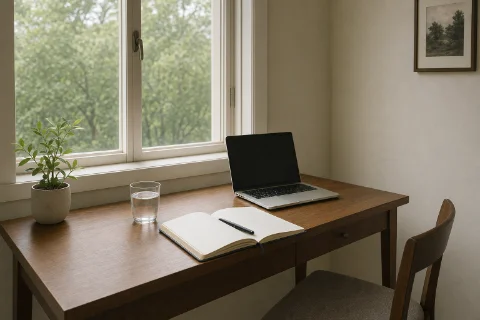
The photos always look the same. A laptop on a wooden desk by a window. A cup of something warm steaming gently beside it. Maybe a view of hills or sea in the background. The caption usually mentions peace, focus, or finally finding the headspace to write.
It looks lovely, and it isn't entirely a lie. But it leaves out almost everything that actually happens during the hours between those photos, which is where the real work, and the real value, of a writing retreat tends to live.
The Part That Doesn't Get Photographed
Most of a writing retreat looks nothing like the curated shot. It looks like sitting at that same desk an hour later, having written four sentences and deleted three of them. It looks like staring out the window not because the view is inspiring, but because you've hit a scene you don't know how to write yet. It looks like checking your phone far more than you planned to, then feeling vaguely guilty about it in a way that has nothing to do with the retreat itself and everything to do with habit.
None of this means the retreat isn't working. It means writing, even away from your usual distractions, is still writing, with all the friction that comes with it. The photo captures the one good hour out of eight. The other seven are where most of the actual progress quietly happens.
The First Day Is Rarely Productive
Almost everyone arrives expecting to start strong, and almost nobody does. The first day is usually spent settling in, figuring out the rhythm of the space, and shaking off whatever you were doing before you arrived. Your brain doesn't switch into deep focus the moment you sit down at a new desk, no matter how nice the desk is.
This catches a lot of first-time retreaters off guard. They arrive with a word count target in mind, get a fraction of it done on day one, and spend that evening convinced the whole trip is going to be a failure. In practice, the first day is almost always the slowest, and the work tends to pick up properly from the second day onward, once the initial unfamiliarity wears off.
The Quiet Isn't Always Comfortable
Retreats are sold on the promise of quiet, and the quiet does exist, but it isn't always the peaceful, productive silence the photos suggest. For a lot of writers, removing every usual distraction also removes every usual excuse, which means whatever you've been avoiding in your draft is suddenly the only thing left to deal with.
This can be uncomfortable in a way nobody warns you about. Without a commute, a inbox to check, or a household task pulling your attention, there's nowhere left to hide from the chapter you've been putting off for months. Some of the most useful writing that happens on a retreat comes directly out of this discomfort, not despite it.
Group Retreats Involve More Talking Than Writing
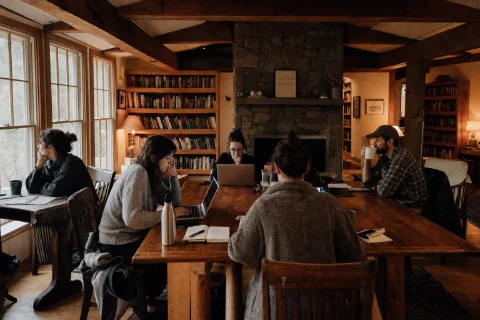
If you've joined a retreat with other writers, a significant part of the experience happens away from the desk entirely. Meals, walks, and evening conversations often end up being as valuable as the writing hours themselves, sometimes more so. Talking through a plot problem with someone over dinner, or simply hearing that another writer is also stuck on their second act, does something for motivation that an empty room never will.
This surprises people who sign up expecting total focus and instead find themselves spending two hours one evening just talking about craft with people who happen to understand the particular kind of stuck they're in. That's not a distraction from the retreat. For most people, it ends up being one of the main reasons the trip was worth it.
Solo Retreats Involve More Boredom Than Expected
The flip side applies to retreats taken alone. Without anyone else around, the quiet stretches can feel long, and boredom shows up far sooner than most people expect. This isn't necessarily a problem. Boredom often pushes writers back to the page simply because there's nothing else left to do, which is part of why solitary retreats work for some people even when they sound, on paper, like they'd be lonely.
The key difference from a normal day at home is that there's no easy substitute for the boredom. No errands to run, no friends nearby to call. Just the work, and eventually, often reluctantly, you go back to it.
The Real Output Isn't Always Word Count
Plenty of writers leave a retreat having written fewer new words than they hoped, and still come away calling it one of the most useful trips they've taken. Sometimes the real output is a plot problem finally untangled after months of circling it. Sometimes it's simply remembering what it feels like to want to write, after a long stretch of treating it like a chore.
Measuring a retreat purely by word count misses most of what actually happens during one. The quiet thinking, the conversations, the slow return of motivation, none of that shows up in a daily total, but all of it tends to matter more in the long run.
What to Actually Expect
A realistic version of a writing retreat looks something like this. A slow first day. A few genuinely productive stretches mixed in with plenty of staring at the wall. Some boredom or discomfort that turns out to be useful rather than wasted. And, if you're with others, more conversation than you expected, most of it more valuable than you'd have guessed.
None of this makes for as tidy a photo as the laptop by the window. But it's a far more honest picture of what a retreat actually gives a writer, and it tends to set expectations that make the experience easier to enjoy, rather than one that quietly disappoints because it didn't look like the version online.