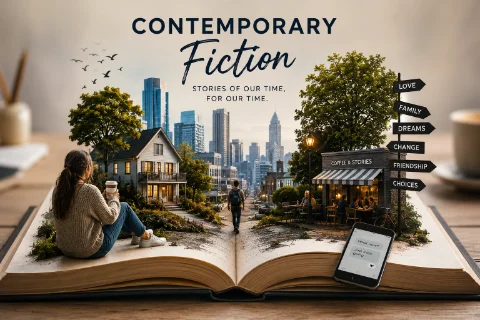
Contemporary fiction is one of the most familiar types of fiction because it often feels close to real life. These stories are usually set in the modern world, with characters facing problems, relationships, choices, and emotions that readers can recognize.
Unlike fantasy, science fiction, or historical fiction, contemporary fiction usually does not depend on imaginary worlds, future technology, or distant historical periods. It focuses on life as it is lived now, or as it has been lived in the recent past.
A contemporary novel may follow a family in crisis, a young person discovering who they are, a marriage under pressure, a friendship changing over time, a city full of secrets, or an ordinary person facing a major decision.
At its heart, contemporary fiction asks: What does it mean to live in the world we know today?
What Is Contemporary Fiction?
Contemporary fiction is fiction set in the present day or in a time period close to the present.
In simple words, contemporary fiction tells stories about modern life.
The characters usually live in a recognizable world. They may use phones, social media, modern transportation, current workplaces, schools, cities, towns, or family structures. The story often reflects the culture, values, struggles, and questions of its time.
Contemporary fiction can be serious, emotional, funny, romantic, dramatic, quiet, or fast-moving. What connects these books is their modern setting and realistic connection to everyday life.
Main Features of Contemporary Fiction
Contemporary fiction can take many forms, but it often has several common qualities.
Modern Setting
The most important feature of contemporary fiction is its modern setting.
The story usually happens in the present day or recent past. It may be set in a city, small town, school, office, home, neighborhood, college, hospital, restaurant, apartment building, or any place that feels part of the real modern world.
The setting does not need to be dramatic. In contemporary fiction, ordinary places can become meaningful because of what happens inside them.
A kitchen table, a classroom, a train station, a family home, or a quiet street can carry deep emotional weight.
Realistic Characters
Contemporary fiction often focuses on realistic characters. These characters may be students, parents, workers, artists, friends, lovers, neighbors, immigrants, professionals, caregivers, or people trying to rebuild their lives.
They may not be heroes in the traditional sense. Instead, they are people facing choices, mistakes, dreams, disappointments, and changes.
Readers often enjoy contemporary fiction because the characters feel familiar. They may remind us of ourselves, our families, our friends, or people we have met.
Everyday Problems with Emotional Depth
Contemporary fiction often explores problems that feel close to real life.
These may include:
Family conflict
Love and heartbreak
Marriage and divorce
Friendship and betrayal
Career pressure
Grief and healing
Identity and belonging
Money struggles
Parenthood
Mental and emotional growth
Social pressure
Cultural change
The problems may seem ordinary at first, but good contemporary fiction reveals the deeper emotions beneath them.
Focus on Relationships
Relationships are often central to contemporary fiction.
The story may explore relationships between lovers, parents and children, siblings, friends, neighbors, classmates, coworkers, or communities.
These relationships may be loving, complicated, broken, healing, painful, or changing. A contemporary novel often shows how people affect one another, how they misunderstand one another, and how they try to reconnect.
Contemporary Fiction vs Historical Fiction
Contemporary fiction is set in the present day or recent past. Historical fiction is set in a clearly earlier time period.
For example, a novel set during World War II is historical fiction. A novel set in today’s world, with modern jobs, phones, cities, and social issues, is contemporary fiction.
Historical fiction often requires the writer to recreate the customs, politics, language, clothing, conflicts, and daily life of an earlier time. Contemporary fiction usually works with a world the reader already recognizes.
However, both can explore universal themes like love, loss, ambition, fear, courage, family, and survival.
Contemporary Fiction vs Literary Fiction
Contemporary fiction and literary fiction can overlap, but they are not exactly the same.
Contemporary fiction describes the time setting of the story. It tells us that the story happens in the modern world.
Literary fiction describes the style and focus of the story. It usually places strong attention on character, language, theme, and deeper meaning.
A book can be both contemporary fiction and literary fiction if it is set in modern times and focuses deeply on character, language, and theme.
A book can also be contemporary commercial fiction if it is set in modern times and focuses more on plot, readability, emotion, and broad reader appeal.
Contemporary Fiction vs Commercial Fiction
Commercial fiction is often written for broad reader appeal and usually has strong plot momentum. Contemporary fiction simply means the story is set in the present or recent past.
A contemporary novel can be commercial if it has a strong hook, clear pacing, and wide audience appeal.
For example, a modern family drama with secrets and emotional twists may be contemporary commercial fiction. A quiet modern novel about loneliness and memory may be contemporary literary fiction.
The word “contemporary” tells us when the story happens. The words “commercial” or “literary” tell us more about how the story is written and what kind of reading experience it offers.
Can Contemporary Fiction Include Romance, Mystery, or Drama?
Yes. Contemporary fiction can include many story elements.
A contemporary novel may include romance, mystery, family drama, coming-of-age themes, humor, workplace conflict, social issues, or emotional suspense.
For example:
A love story set in a modern city can be contemporary romance.
A story about a young adult facing school, identity, and friendship can be contemporary young adult fiction.
A family secret revealed in the present day can be contemporary drama.
A realistic story about a crime in a modern neighborhood can be contemporary mystery.
Contemporary fiction is flexible because modern life contains many kinds of stories.
Common Themes in Contemporary Fiction
Contemporary fiction often explores themes that matter to modern readers.
Some common themes include:
Identity and self-discovery
Family and generational conflict
Love and emotional connection
Loneliness in modern life
Technology and communication
Career pressure and ambition
Migration and belonging
Friendship and community
Grief and recovery
Marriage and relationships
Social class and inequality
Personal reinvention
These themes help contemporary fiction feel relevant and emotionally close to the reader.
Why Do Readers Enjoy Contemporary Fiction?
Readers enjoy contemporary fiction because it reflects the world around them.
A contemporary novel can make readers feel seen. It can show familiar struggles in a new way. It can turn everyday life into a story with meaning, beauty, tension, and emotional truth.
Many readers like contemporary fiction because they do not have to learn a new world or historical setting before entering the story. The world already feels familiar, so they can focus quickly on the characters and their problems.
Contemporary fiction can be comforting, challenging, emotional, funny, painful, hopeful, or eye-opening.
Is Contemporary Fiction Always Realistic?
Most contemporary fiction is realistic, but it can still use creative storytelling.
Some contemporary novels include unusual structures, multiple timelines, letters, emails, social media messages, memories, or alternating points of view. Some may include a small touch of mystery, humor, or emotional suspense.
However, if the story includes major magic, supernatural forces, futuristic science, or invented worlds, it may belong more clearly to fantasy, science fiction, or speculative fiction.
The central world of contemporary fiction is usually grounded in reality.
How to Identify Contemporary Fiction
You can often identify contemporary fiction by asking a few simple questions:
Is the story set in the present day or recent past?
Do the characters live in a recognizable modern world?
Are the problems connected to real modern life?
Does the book focus on relationships, identity, family, society, or personal change?
Could the story happen in today’s world?
Does the setting feel current rather than historical or futuristic?
If the answer is yes to most of these questions, the book is likely contemporary fiction.
Contemporary Fiction for Writers
For writers, contemporary fiction offers a powerful way to explore the world as it is now.
You do not need dragons, spaceships, ancient kingdoms, or historical wars to create a meaningful story. A modern apartment, a family dinner, a school hallway, a workplace meeting, or a phone call can become the center of a powerful novel if the emotional stakes are strong.
Writers of contemporary fiction should pay attention to:
Realistic dialogue
Modern habits and culture
Emotional conflict
Character motivation
Social details
Relationships
Setting and atmosphere
Inner change
The challenge is to make ordinary life feel urgent, honest, and worth reading.
Does Contemporary Fiction Become Historical Fiction Over Time?
Yes, sometimes.
A novel that was contemporary when it was first published may feel historical many decades later. For example, a story written in the 1950s about life in the 1950s was contemporary at the time, but readers today may experience it as a picture of the past.
This is why contemporary fiction is connected to time. What feels modern today may become historical later.
However, the emotional truth of the story can still remain powerful.
Contemporary fiction is fiction set in the modern world or recent past. It focuses on realistic characters, present-day settings, relationships, personal struggles, and the emotional questions of everyday life.
It can be literary, commercial, romantic, dramatic, humorous, or deeply serious. What matters most is that the story feels connected to the world readers recognize.
For beginners, the easiest way to understand contemporary fiction is this: it is fiction about life as people live it now. It turns modern experience into story, giving readers a chance to see their own world with fresh eyes.